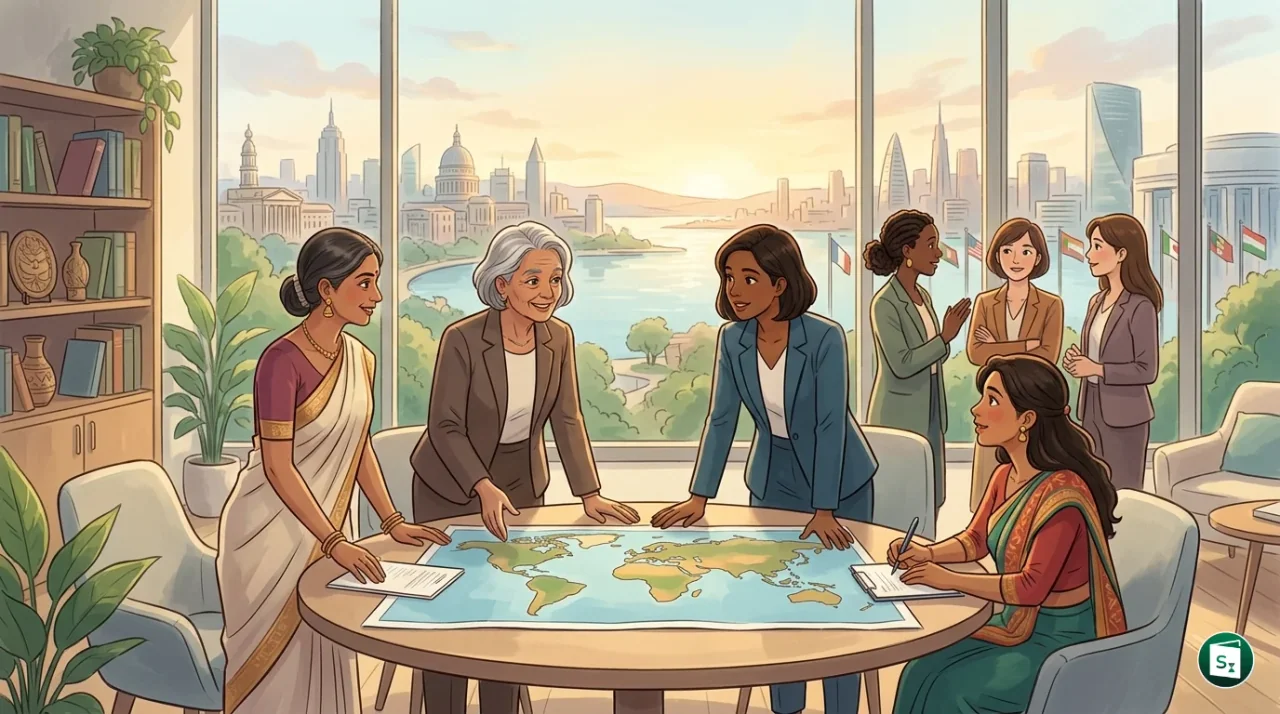
The United Nations observes the International Day of Women in Diplomacy every year on June 24 to recognize the critical role women play in shaping international relations, peacebuilding, and global cooperation. The 2026 edition, marked under the theme “Diplomacy for All”, calls for inclusive diplomatic systems that reflect the diversity of the societies they serve. Established by the UN General Assembly in 2022 through resolution A/RES/76/269, the day also serves as a reminder of the structural barriers that continue to limit women’s participation at the highest levels of diplomacy.
What Is the International Day of Women in Diplomacy?
The International Day of Women in Diplomacy is a United Nations observance that celebrates the contributions of women in the field of diplomacy and encourages greater participation of women in international affairs. The UN General Assembly proclaimed the day on June 20, 2022, during its 76th session, adopting the resolution by consensus with an unprecedented 191 co-sponsors out of 193 member states.
The resolution was spearheaded by the Maldives and introduced by Thilmeeza Hussain, the Permanent Representative of Maldives to the UN. Abdulla Shahid, then President of the UN General Assembly and also from Maldives, championed the initiative. The first official observance took place on June 24, 2023.
The resolution invites all member states, UN organizations, civil society groups, academic institutions, and associations of women diplomats to observe the day through awareness campaigns and educational activities. Its core message is that the participation of women on equal terms with men at all levels of decision-making is essential for achieving sustainable development, peace, and democracy.
The 2026 Theme: “Diplomacy for All”
The theme for the 2026 International Day of Women in Diplomacy is “Diplomacy for All”. It calls for diplomatic systems that are inclusive, representative, and equitable, reflecting the full diversity of the populations they represent. The theme emphasizes that diplomacy should not be the preserve of a select few but must draw from the widest possible range of voices and experiences.
Key pillars of the 2026 theme include ensuring equal participation of women in international decision-making, strengthening peace and cooperation through diverse perspectives, and promoting gender equality across diplomatic institutions worldwide. The theme aligns with Sustainable Development Goal 5, which calls for gender equality and the empowerment of all women and girls. It also connects to the broader objectives of the Beijing Platform for Action, which remains a foundational framework for advancing women’s rights globally.
Previous themes have progressed from building awareness to demanding structural change. The 2024 theme “Women’s Leadership in Multilateral Diplomacy” focused on increasing women’s participation in international decision-making, while the 2025 theme “Equal Voices at Every Table” emphasized women’s voices in shaping foreign policy.
Why This Day Matters
Despite decades of progress, women remain significantly underrepresented in diplomacy worldwide. Data presented at the time of the resolution’s adoption revealed stark gaps. Between 1992 and 2019, women represented only 13 percent of negotiators, 6 percent of mediators, and 6 percent of signatories in peace processes globally. In 2020, women made up just 23 percent of conflict-party delegations in UN-supported peace processes. At UN Headquarters, only 21.7 percent of permanent representatives were women.
These numbers have improved marginally since then. As of 2025, women held approximately 22 percent of ambassador positions globally, with wide regional variations. The Nordic countries lead with nearly 42 percent, while regions such as Central Asia and parts of Asia trail behind at around 11 to 13 percent. Only about 25 countries had a woman serving as head of state or government as of early 2025, and 113 countries had never had a woman in that position.
Studies have consistently shown that the inclusion of women in peace negotiations leads to more durable outcomes. Peace agreements that include women as negotiators, mediators, or signatories are more likely to last. Women’s participation broadens the scope of negotiations beyond security questions to include community-level concerns, social justice, and human rights, making peace more sustainable.
Women in Indian Diplomacy
India has a long and complex relationship with women in diplomacy, marked by early pioneering achievements followed by persistent structural challenges.
The Pioneers
India’s engagement with women in international diplomacy began even before independence. Vijaya Lakshmi Pandit became India’s first woman ambassador when she was appointed to the Soviet Union in 1947. She went on to serve as ambassador to the United States and the United Kingdom, and in 1953 became the first woman to serve as President of the UN General Assembly. Other early women diplomats included Hansa Mehta, who played a key role in drafting the Universal Declaration of Human Rights, and Begum Shareefah Hamid Ali, a founding member of the UN Commission on the Status of Women in 1947.
C.B. Muthamma became the first woman to join the Indian Foreign Service (IFS) through the civil services examination in 1949. Her career was marked by discrimination. The service rules at the time required women to seek government permission before marrying, a restriction that did not apply to men. In 1979, Muthamma approached the Supreme Court challenging these discriminatory rules. The court dismissed her petition after the government promoted her, but Justice V.R. Krishna Iyer famously called the rules a “hangover of the masculine culture.” Muthamma served as India’s ambassador to the Netherlands before retiring in 1982.
Only three women have risen to the post of Foreign Secretary in India’s history: Chokila Iyer (2001-2002), Nirupama Menon Rao (2009-2011), and Sujatha Singh (2013-2015). In 2022, Ruchira Kamboj became India’s first woman Permanent Representative to the United Nations, and in December that year, she became the first Indian woman to preside over the UN Security Council.
Current Landscape
The representation of women in the IFS has improved significantly in recent years. According to data from the Ministry of External Affairs placed before Parliament in December 2025, 263 women serve among 954 total IFS officers, accounting for approximately 27.6 percent of the cadre.
The share of women in annual IFS recruitment has grown steadily from 31.2 percent in 2014 to 37.8 percent in 2022. Between 2018 and 2020, the intake crossed the 40 percent mark. However, the pipeline narrows at senior levels. While 19 women headed Indian missions abroad in 2020, that number had dropped to just 11 by December 2025, even as the overall share of women in the cadre rose. Women currently lead missions in countries including Armenia, Cambodia, Cyprus, Italy, Mauritius, the Netherlands, New Zealand, Poland, and Serbia, but are absent from major capitals and high-profile postings.
The Way Forward
The International Day of Women in Diplomacy provides an annual platform to assess progress and renew commitments. At the global level, the UN continues to push for gender parity in its own ranks. The UN Gender Parity Strategy, launched by the Secretary-General, has resulted in the highest number of women serving as heads of UN entities in the organization’s history. The UN Office at Geneva has achieved overall gender parity across all professional categories.
For India, the challenge lies in converting higher recruitment numbers into leadership positions. The share of women entering the IFS has risen steadily, but the drop-off between entry-level and ambassadorial appointments remains stark. A larger IFS cadre, more transparent promotion pathways, and institutional mentorship programmes could help bridge this gap. India’s G20 Presidency in 2023 championed “women-led development” as a core theme, and extending that approach to the foreign service could serve as a model for inclusive diplomacy.
The global movement toward Feminist Foreign Policy (FFP) is gaining traction, with countries such as Sweden, Canada, France, and Mexico adopting explicit FFP frameworks. Liberia became the first African country to commit to a Feminist Foreign Policy approach in 2025. While India has not adopted an official FFP, its emphasis on women-led development internationally signals alignment with the broader goals of inclusive diplomacy.
Key Takeaways
- The International Day of Women in Diplomacy is observed annually on June 24, established by UN General Assembly resolution A/RES/76/269 on June 20, 2022.
- The 2026 theme is “Diplomacy for All”, calling for inclusive and representative diplomatic systems.
- The resolution was spearheaded by the Maldives and co-sponsored by 191 of 193 UN member states, a record for the 76th session.
- Globally, women represented only 13 percent of negotiators and 6 percent of mediators in peace processes between 1992 and 2019; as of 2025, women held about 22 percent of ambassador positions worldwide.
- In India, C.B. Muthamma was the first woman IFS officer (1949), and Vijaya Lakshmi Pandit was the first woman ambassador (1947) and first woman UN General Assembly President (1953).
- As of December 2025, 263 women serve in the 954-strong IFS cadre (27.6 percent), but only 11 women head Indian missions abroad, down from 19 in 2020.