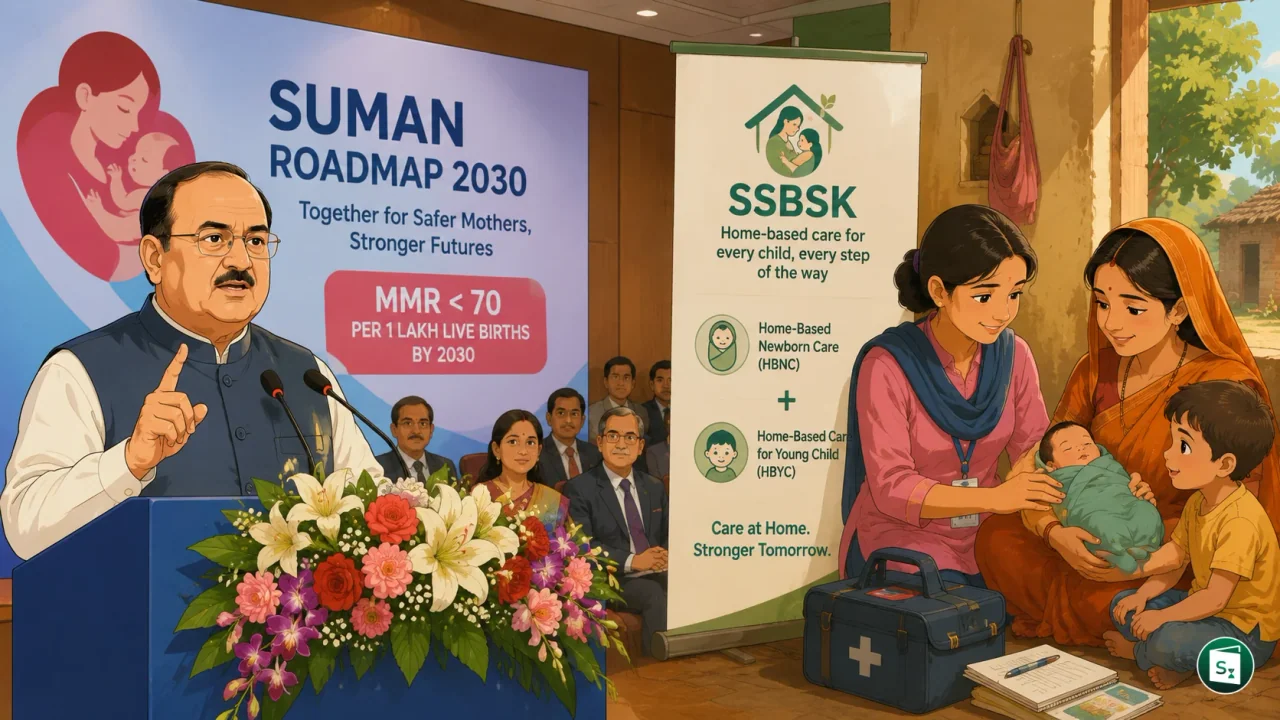
Union Minister of Health and Family Welfare JP Nadda chaired the 16th Conference of the Central Council of Health and Family Welfare (CCHFW) at Vigyan Bhawan in New Delhi, where he launched two major health initiatives. The SUMAN Roadmap 2030 sets a target to bring the Maternal Mortality Ratio (MMR) below 70 per 100,000 live births by 2030, while the Samagra Shishu Bal Swasthya Karyakram (SSBSK) integrates home-based care for children from birth to five years. These frameworks represent a coordinated push to accelerate India’s progress in maternal and child health ahead of the 2030 Sustainable Development Goal deadline.
What Is the Central Council of Health and Family Welfare?
The Central Council of Health and Family Welfare (CCHFW) is the apex advisory body to the Ministry of Health and Family Welfare (MoHFW) . It was constituted under Article 263 of the Constitution of India, which empowers the President to establish a council for coordinating between the Centre and states on matters of common interest. The Council reviews the implementation of health policies and programmes and recommends measures for their effective rollout in partnership with states and union territories.
The Union Minister of Health and Family Welfare serves as the Chairman of the Council, while the Minister of State for Health and Family Welfare is the Vice Chairman. Its members include health ministers from all states and union territories, members of Parliament, the full-time member of NITI Aayog, and representatives from professional bodies such as the Indian Medical Association. The conference serves as an institutional mechanism for cooperative federalism in the health sector, enabling the Centre and states to deliberate on national health priorities.
SUMAN Roadmap 2030: Towards Zero Preventable Maternal Deaths
The SUMAN Roadmap 2030 builds on the existing Surakshit Matritva Aashwasan (SUMAN) initiative, which was launched in October 2019 to provide assured, dignified, and zero-cost maternal and newborn healthcare at public facilities. The new roadmap is a comprehensive strategic framework designed to accelerate India’s progress toward the Sustainable Development Goal (SDG) 3.1, which calls for reducing the global MMR to below 70 per 100,000 live births by 2030.
The roadmap is anchored in the RMNCHA+N framework (Reproductive, Maternal, Newborn, Child, Adolescent Health plus Nutrition), which adopts a life-cycle approach to healthcare delivery. It is spearheaded by the Maternal Health Division of the MoHFW and aims to achieve zero preventable maternal and newborn deaths, universal access to quality maternal health services, and a reduction in the Neonatal Mortality Rate (NMR) and Infant Mortality Rate (IMR).
A Life-Cycle Approach to Maternal Care
The SUMAN Roadmap 2030 moves beyond a one-size-fits-all strategy by introducing state-specific and district-specific interventions. It adopts a life-cycle approach that integrates care across four critical stages: pre-pregnancy care, antenatal care, intrapartum care (during labour and childbirth), and postnatal care.
A key feature is a structured four-stage framework for identifying, tracking, and managing high-risk pregnancies. This covers antenatal high-risk pregnancy detection, third-trimester monitoring, intrapartum care, and postnatal follow-up for high-risk mothers. The framework includes bi-weekly home visits by Accredited Social Health Activists (ASHAs) during the eighth and ninth months of pregnancy for danger sign screening, nutrition counselling, and birth preparedness counselling.
The roadmap also introduces several infrastructure and technology interventions. These include establishment of Birth Waiting Homes (BWHs) in remote areas, Maternal and Child Health (MCH) Wings, Obstetric High Dependency Units (HDUs) , and Intensive Care Units (ICUs) in underserved locations. Clinical innovations such as Non-Pneumatic Anti-Shock Garments (NASG) for managing obstetric haemorrhage and AI-enabled digital labour rooms are part of the strategy. The JANANI Portal will serve as the central digital platform for monitoring pregnancies, tracking clinical interventions, and measuring health outcomes. A centralised SUMAN Call Centre has also been proposed for grievance redressal.
Targeting 130 High-Burden Districts
The roadmap concentrates resources on 130 high-priority districts across 13 high-focus states where maternal and newborn mortality remains stubbornly high. These states are Assam, Bihar, Chhattisgarh, Haryana, Jharkhand, Karnataka, Madhya Pradesh, Odisha, Punjab, Rajasthan, Uttar Pradesh, Uttarakhand, and West Bengal.
Community participation is built into the framework through SUMAN Panchayats and initiatives such as Mothers’ Picnic, aimed at improving awareness, antenatal care uptake, institutional deliveries, and immunisation coverage. The roadmap also addresses emerging challenges such as climate change and its impact on maternal and newborn health, alongside long-standing issues like transportation barriers in tribal and hard-to-reach areas.
Samagra Shishu Bal Swasthya Karyakram: Unifying Child Healthcare
The Samagra Shishu Bal Swasthya Karyakram (SSBSK) is a unified national programme that integrates two existing flagship initiatives into a single comprehensive framework: Home-Based Newborn Care (HBNC) , launched in 2011, and Home-Based Care for Young Child (HBYC) , launched in 2018. The programme embodies the vision of comprehensive care during the first five years of life, recognising that the first 28 days are critical for newborn survival and the early years are central to optimal brain development, growth, and nutrition.
Under HBNC, ASHA workers conducted scheduled home visits for newborns up to 42 days after birth, with additional visits for preterm or low-birth-weight babies. Under HBYC, these visits were extended through five additional home visits at the 3rd, 6th, 9th, 12th, and 15th months. SSBSK now brings these two programmes under one roof, creating a seamless continuum of home and community-based care.
Risk-Stratified Care for Vulnerable Children
For the first time, SSBSK introduces a risk-stratified approach for newborns and children identified as at-risk. Risk factors include low birth weight, premature birth, delayed breastfeeding, discharge from neonatal care units, malnutrition, repeated illness, or developmental delays. Children identified as at-risk will receive intensified follow-up through additional home visits.
Under the programme, at-risk newborns will receive up to nine home visits during the first 42 days of life, while at-risk children will receive up to eight home visits up to the age of five years. The programme also strengthens continuity of care through joint home visits by ASHAs, Auxiliary Nurse Midwives (ANMs), Community Health Officers (CHOs), and Anganwadi Workers (AWWs).
SSBSK incorporates community platforms such as Well-Baby Sessions at every village and monthly Shishu Shivirs at Ayushman Arogya Mandirs for regular screening, developmental assessment, and comprehensive management of newborns and young children. The programme also mainstreams Nurturing Care for Early Childhood Development (ECD) , promoting responsive caregiving, early learning opportunities, and active family engagement. For the first time, postpartum maternal mental health screening has been integrated as an essential component of community-based care, to be undertaken by ASHAs with timely referral for further assessment.
Digital monitoring will be enabled through integrated health platforms such as the JANANI Portal, U-WIN, and the POSHAN Tracker, ensuring seamless tracking of beneficiaries and continuity of care. The programme also includes tailored strategies for urban slum, migrant, and underserved populations.
India’s Progress on Maternal and Child Health
India has recorded significant improvements in maternal and child health over the past two decades. According to the Sample Registration System (SRS) data released by the Registrar General of India, the Maternal Mortality Ratio declined from 130 per 100,000 live births in 2014-16 to 88 per 100,000 live births in 2020-22. This means India has already achieved the National Health Policy (NHP) 2017 target of bringing MMR below 100. Eight states, including Kerala, Maharashtra, Tamil Nadu, and Telangana, have already met the SDG target of MMR below 70.
The Neonatal Mortality Rate has fallen from 26 per 1,000 live births in 2014 to 19 per 1,000 live births in 2021, while the Infant Mortality Rate declined from 39 to 27 per 1,000 live births over the same period. Institutional deliveries have risen from 79% in 2015-16 to 89% in 2019-21, driven by schemes such as the Janani Suraksha Yojana (JSY) , launched in 2005, and the Janani Shishu Suraksha Karyakram (JSSK) , launched in 2011.
However, disparities persist across states. High-focus states such as Uttar Pradesh, Bihar, Assam, Madhya Pradesh, and Odisha continue to record MMR levels well above the national average, while the southern states have reached levels comparable to developed countries. The SUMAN Roadmap 2030 and SSBSK are designed specifically to bridge these gaps through targeted, evidence-based interventions in the most vulnerable districts.
| Indicator | India 2014-16 | India 2018-20 | India 2020-22 | SDG Target (2030) |
|---|---|---|---|---|
| MMR (per 100,000 live births) | 130 | 97 | 88 | Below 70 |
| Institutional Births | 79% (2015-16) | 89% (2019-21) | - | Universal |
Other Key Initiatives at the 16th CCHFW Conference
The 16th CCHFW Conference also saw the launch of several other significant health initiatives. The Operational Guidelines on National Ambulance Services (NAS) 2026 establish uniform national standards for emergency medical transport across all states and union territories. These guidelines cover ambulance infrastructure, staffing, equipment, response protocols, digital integration, and quality assurance, and recommend Integrated Command and Dispatch Centres with GPS-enabled tracking.
The revamped Anaemia Mukt Bharat Abhiyaan was also launched, expanding the programme through saturation-based screening, digital beneficiary tracking, improved case management, and stronger nutrition interventions. Additionally, several digital health initiatives were unveiled under the National Health Authority (NHA) , including Aarogya Setu 2.0, a revamped Personal Health Record application; the Unified Health Interface (UHI) for cross-platform healthcare service bookings; eSushrut@Clinic, a cloud-based Hospital Management Information System for small clinics; and a National Drug Registry listing over 1.23 lakh branded medicines.
Key Takeaways
- The 16th Conference of the Central Council of Health and Family Welfare (CCHFW) was chaired by Union Health Minister JP Nadda at Vigyan Bhawan in New Delhi.
- The SUMAN Roadmap 2030 aims to reduce India’s Maternal Mortality Ratio (MMR) to below 70 per 100,000 live births by 2030, aligning with SDG 3.1.
- The roadmap targets 130 high-priority districts across 13 high-focus states with tailored interventions.
- The Samagra Shishu Bal Swasthya Karyakram (SSBSK) integrates Home-Based Newborn Care (HBNC) , launched in 2011, and Home-Based Care for Young Child (HBYC) , launched in 2018, into a single framework.
- SSBSK introduces a risk-stratified approach where at-risk newborns receive up to nine home visits in the first 42 days and at-risk children receive up to eight home visits up to age five.
- The CCHFW is a constitutional body set up under Article 263 of the Constitution, serving as the apex advisory body to the Ministry of Health and Family Welfare.