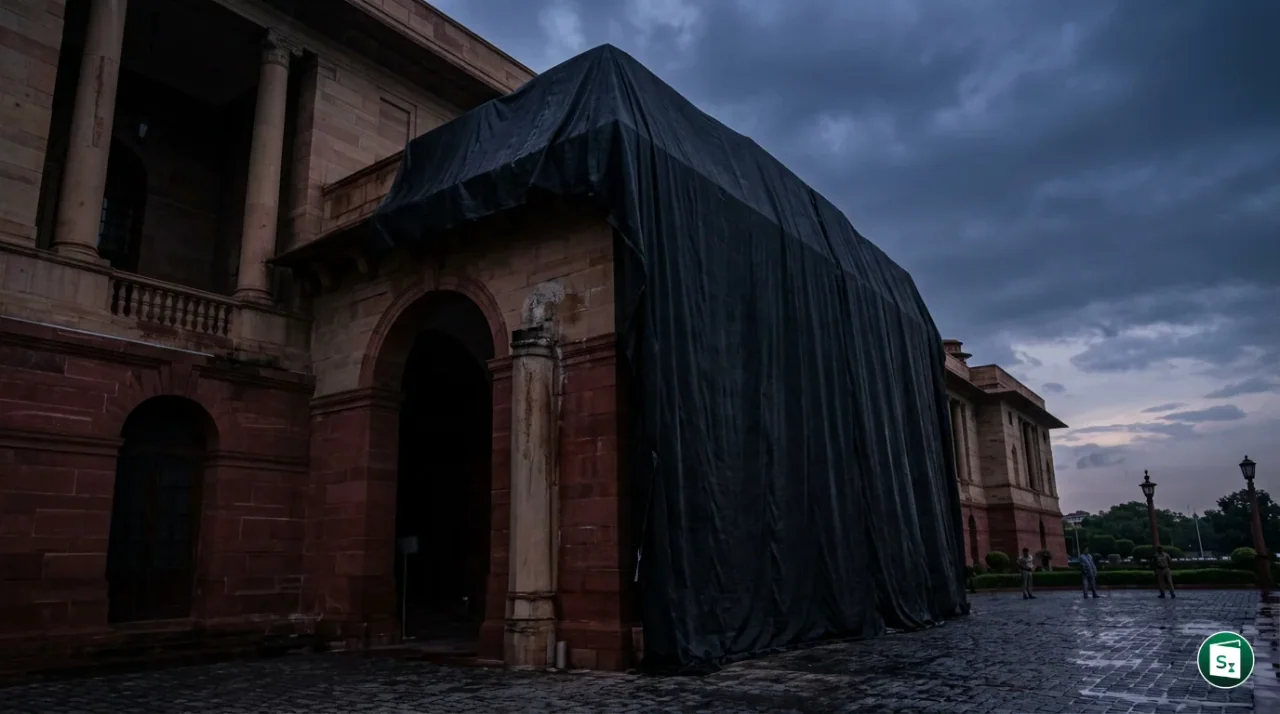
June 25 is observed every year as Samvidhaan Hatya Diwas (Constitution Murder Day) , a day designated by the Government of India in 2024 to commemorate the imposition of the Emergency in 1975. This 21-month period remains the most serious challenge Indian democracy has faced, when fundamental rights were suspended, political opponents were jailed, and the press was muzzled. The observance serves as a reminder to every citizen of the consequences of disregarding constitutional norms.
What Is Samvidhaan Hatya Diwas?
Samvidhaan Hatya Diwas translates literally to Constitution Murder Day. The Government of India, through a gazette notification issued by the Ministry of Home Affairs on July 11, 2024, officially declared June 25 as the day to be observed annually. The notification states that the proclamation of Emergency on June 25, 1975, led to gross abuse of power by the government of the day, subjecting the people of India to excesses and atrocities.
The day aims to pay tribute to all those who suffered and fought against the abuse of power during the Emergency period. It also seeks to recommit citizens to never support such abuse of power in the future. The government observed a year-long commemoration from June 25, 2025, to June 25, 2026 , marking the 50th anniversary of the Emergency with programmes in educational institutions, seminars, and public awareness campaigns.
The Emergency of 1975: How It Unfolded
The road to the Emergency began with mounting political and economic troubles in the early 1970s. India faced high inflation, unemployment, and food shortages following the 1973 oil crisis. Political unrest was widespread. The Bihar Movement led by Jayaprakash Narayan demanded a Total Revolution against corruption, while the Navnirman Andolan in Gujarat saw student-led protests. A massive railway strike in 1974 , led by George Fernandes , added to the pressure on the government.
The Immediate Trigger
The spark came on June 12, 1975 , when the Allahabad High Court delivered a historic judgment in the case of Indira Nehru Gandhi v. Raj Narain. Justice Jagmohan Lal Sinha found Prime Minister Indira Gandhi guilty of corrupt electoral practices in her 1971 Rae Bareli election. The court declared her election void and disqualified her from holding elected office for six years.
Indira Gandhi appealed to the Supreme Court. On June 24, 1975 , a vacation bench led by Justice V.R. Krishna Iyer granted a conditional stay. She could continue as Prime Minister but could not vote in Parliament. This partial relief was not enough to end the political crisis.
The Midnight Declaration
On the night of June 25, 1975 , opposition leaders held a massive rally at Ramlila Maidan in Delhi. Jayaprakash Narayan called on the police and military to disobey illegal orders. Around 11:45 pm, Indira Gandhi met President Fakhruddin Ali Ahmed and advised him to proclaim a state of national emergency under Article 352 of the Constitution, citing internal disturbance. The President signed the proclamation just before midnight.
The declaration was made without consulting the Cabinet, though it was ratified the next day. The Emergency was imposed on the ground of internal disturbance, a vague term that the 44th Amendment later replaced with armed rebellion.
Life Under the Emergency
The Emergency lasted 21 months , from June 25, 1975, to March 21, 1977 , and it transformed Indian democracy in ways that left deep scars.
Suspension of Fundamental Rights
The most immediate effect was the suspension of fundamental rights, including the right to freedom of speech and expression, the right to assemble peacefully, and the right to move the court for enforcement of fundamental rights. A presidential order under Article 359(1) barred citizens from approaching any court to enforce their rights.
Mass Arrests Under MISA
The government used the Maintenance of Internal Security Act (MISA) , enacted in 1971 , to detain political opponents without trial. More than 110,000 people were arrested during the Emergency, including opposition leaders like Atal Bihari Vajpayee , L.K. Advani , Morarji Desai , Chandra Shekhar , and Jayaprakash Narayan . Journalists, activists, and student leaders were also jailed. MISA allowed preventive detention for up to 12 months without any judicial review.
Press Censorship
A strict censorship regime was imposed on the media. Newspapers were required to submit content for pre-publication approval. The Indian Express and The Statesman were among the publications that resisted, but most media outlets complied under pressure. Foreign journalists were asked to leave the country.
The Habeas Corpus Case
The darkest moment for the judiciary came on April 28, 1976 , when the Supreme Court delivered its judgment in ADM Jabalpur v. Shivkant Shukla , also known as the Habeas Corpus case. By a majority of 4:1, the Court held that during the Emergency, no person could approach any court for enforcement of fundamental rights, including the right to life and personal liberty under Article 21. Justice H.R. Khanna delivered the sole dissenting opinion, arguing that the right to life could not be suspended even during an Emergency. His dissent cost him the position of Chief Justice of India, but it remains a landmark defence of civil liberties.
The 42nd Amendment
In 1976 , the government passed the 42nd Constitutional Amendment Act , often called the Mini Constitution due to the scale of changes it brought. It added the words Socialist, Secular, and Integrity to the Preamble. It introduced Fundamental Duties under Article 51A . It gave primacy to Directive Principles over Fundamental Rights and sought to limit the power of judicial review. The term of the Lok Sabha and state assemblies was extended from five to six years.
Constitutional Changes During and After the Emergency
The Emergency brought about profound constitutional changes, first through the 42nd Amendment that consolidated executive power, and then through the 43rd and 44th Amendments that sought to restore democratic balance.
The 42nd Amendment (1976)
The 42nd Amendment was enacted in November 1976 and came into force on January 3, 1977. It amended 59 articles , added 14 new articles , and inserted two new Schedules . Besides the changes to the Preamble and the addition of Fundamental Duties, it transferred five subjects from the State List to the Concurrent List, strengthening the Centre at the expense of states. It also inserted Articles 323A and 323B , providing for administrative tribunals.
The amendment attempted to place constitutional amendments beyond judicial scrutiny by adding clauses to Article 368 . These clauses were later struck down by the Supreme Court in the Minerva Mills v. Union of India (1980) case, which reaffirmed the Basic Structure Doctrine established in the Kesavananda Bharati (1973) judgment.
The 44th Amendment (1978)
When the Janata Party came to power after the 1977 general election , it enacted the 44th Constitutional Amendment Act in 1978 to undo the distortions of the Emergency era. The amendment was a comprehensive reform that introduced several crucial safeguards.
The most important change was the replacement of the term internal disturbance with armed rebellion in Article 352, making it harder to declare a National Emergency. The amendment also required the President to act only on the written advice of the Cabinet , preventing a repeat of the 1975 declaration made without cabinet consultation.
The 44th Amendment provided that Article 20 (protection against conviction for offences) and Article 21 (protection of life and personal liberty) could never be suspended, even during a National Emergency. This directly overruled the majority decision in the ADM Jabalpur case. It also restored the term of the Lok Sabha and state assemblies to five years, removed the right to property from the list of fundamental rights, and restored the power of judicial review to the Supreme Court and High Courts.
Safeguards Against Future Misuse
The constitutional safeguards introduced by the 44th Amendment can be summarized in the following comparison:
| Aspect | Before the 44th Amendment | After the 44th Amendment |
|---|---|---|
| Ground for Emergency | Internal disturbance (vague) | Armed rebellion (specific) |
| Cabinet approval | Not required for proclamation | Written recommendation of Cabinet mandatory |
| Parliamentary approval | Within 2 months | Within 1 month |
| Duration of Emergency | Indefinite with six monthly approvals | Maximum 6 months, requires fresh approval for extension |
| Suspension of Articles 20 and 21 | Could be suspended | Cannot be suspended under any circumstances |
| Lok Sabha revocation | No special provision for revocation | Lok Sabha can revoke by simple majority; special sitting to be held within 14 days if 1/10 members give notice |
| Term of Lok Sabha | Extended to 6 years (by 42nd Amendment) | Restored to 5 years |
Additionally, the 43rd Amendment (1977) had already restored the jurisdiction of the Supreme Court and High Courts that had been curtailed by the 42nd Amendment. Together, these amendments ensured that the constitutional excesses of the Emergency could not be repeated easily.
The End of Emergency and Its Aftermath
In January 1977 , Indira Gandhi called for fresh elections, releasing some political prisoners. The opposition parties united to form the Janata Party and fought the March 1977 general election on the single issue of restoring democracy. The result was a landslide victory for the Janata Party, which won 295 of 542 seats , while the Congress was reduced to 154 seats. Indira Gandhi herself lost her Rae Bareli seat to Raj Narain.
Morarji Desai became the first non-Congress Prime Minister of India on March 24, 1977 . The new government immediately repealed MISA, restored press freedom, and appointed the Shah Commission to investigate the excesses of the Emergency. The 44th Amendment was the Janata government’s most lasting contribution to Indian constitutionalism, ensuring that the lessons of the Emergency were written into the fundamental law of the land.
Significance for Indian Democracy
The Emergency of 1975 remains a defining moment in India’s democratic journey. It demonstrated how fragile constitutional guarantees can be when executive power is unchecked. The Samvidhaan Hatya Diwas observance serves not merely as a memorial but as an institutional safeguard, reminding every generation of the dangers of authoritarianism.
Several lasting changes emerged from this period. The Basic Structure Doctrine , which limits Parliament’s power to amend the Constitution, was strengthened by the Supreme Court’s resistance to the 42nd Amendment. The media became more vigilant about protecting its independence. The judiciary became more assertive in protecting fundamental rights, culminating in the overruling of the ADM Jabalpur judgment in the K.S. Puttaswamy (2017) case, which declared the right to privacy a fundamental right.
The Emergency also reshaped India’s political landscape. It broke the Congress party’s dominance at the national level and ushered in an era of coalition politics. It created a lasting public consciousness about the importance of democratic institutions, civil liberties, and constitutional morality.
Key Takeaways
- Samvidhaan Hatya Diwas (Constitution Murder Day) is observed on June 25 every year since 2024 , commemorating the imposition of the Emergency in 1975 .
- The Emergency was declared on the night of June 25, 1975 , by President Fakhruddin Ali Ahmed on the advice of Prime Minister Indira Gandhi , under Article 352 on grounds of internal disturbance.
- The Emergency lasted 21 months (June 25, 1975, to March 21, 1977 ), during which over 110,000 people were arrested under the Maintenance of Internal Security Act (MISA) .
- The 44th Constitutional Amendment Act (1978) replaced internal disturbance with armed rebellion in Article 352, required written Cabinet advice for Emergency declaration, and made Articles 20 and 21 non-suspendable.
- In the ADM Jabalpur v. Shivkant Shukla (1976) case, the Supreme Court by a 4:1 majority upheld the suspension of habeas corpus during Emergency; Justice H.R. Khanna gave the dissenting opinion.
- The 1977 general election ended the Emergency with the Janata Party winning 295 seats , and Morarji Desai becoming the first non-Congress Prime Minister.