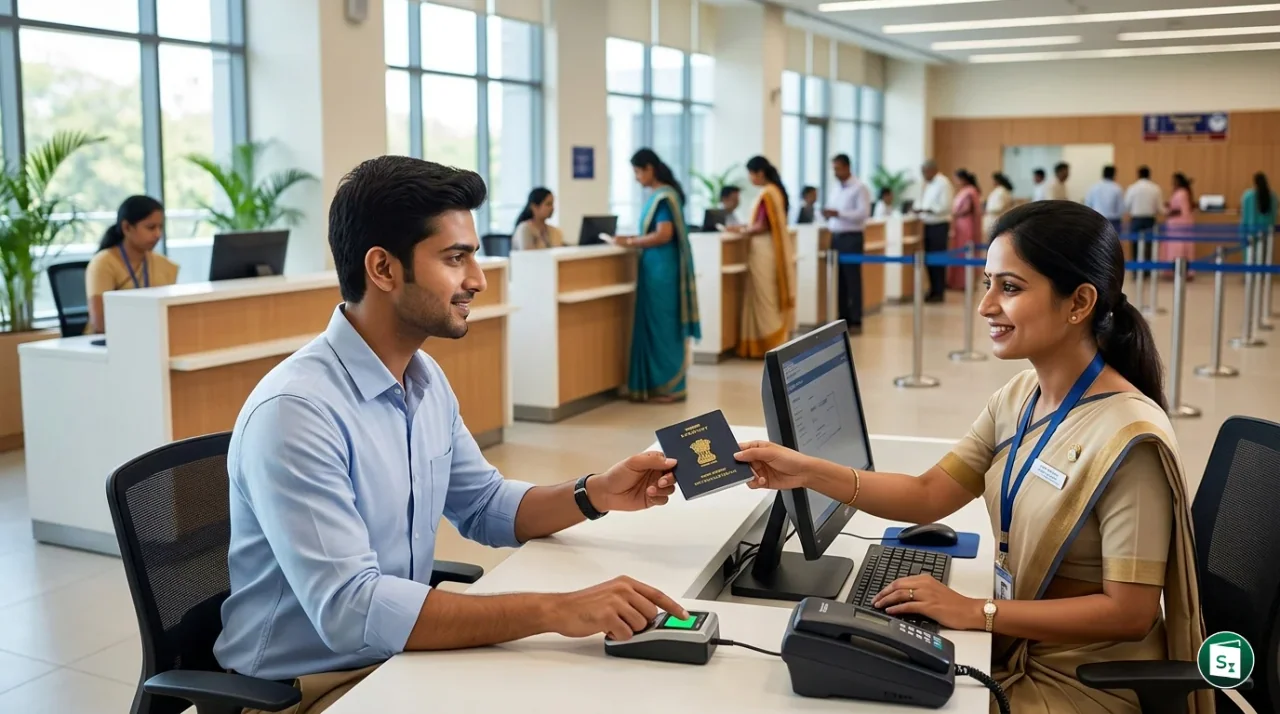
The Ministry of External Affairs (MEA) observed the 14th Passport Seva Divas on June 24, 2026, commemorating the enactment of the Passports Act, 1967. On this occasion, External Affairs Minister S. Jaishankar highlighted the ministry’s major digital milestones, including the nationwide rollout of the upgraded Passport Seva Programme (PSP V2.0) and the introduction of chip-enabled e-Passports. The event also served as an opportunity to review the remarkable expansion of India’s passport infrastructure, which has grown from 77 centres a decade ago to over 545 today.
What Is Passport Seva Divas?
Passport Seva Divas is observed every year on June 24 by the Ministry of External Affairs (MEA). The day commemorates the enactment of the Passports Act, 1967, which provides the legal framework for the issuance of passports and travel documents in India. First observed in 2013, the occasion is used to review the performance of passport services, recognise outstanding work by passport officials, and announce new initiatives aimed at improving citizen services.
The day also serves as a platform for the MEA to reaffirm its commitment to making passport services more efficient, transparent, and accessible. The guiding principle of the Passport Seva Programme is “Surakshit Passport, Sugam Seva, Sashakt Nagrik” (Secure Passport, Easy Service, Empowered Citizen).
The Passports Act, 1967: The Legal Foundation
The Passports Act, 1967 (Act No. 15 of 1967) was enacted by Parliament on June 24, 1967, in the Eighteenth Year of the Republic of India. It replaced the Passports Ordinance, 1967, which had been promulgated earlier that year. The Act extends to the whole of India and applies also to citizens of India who are outside India.
Before the enactment of this law, passport issuance in India was governed by administrative instructions and the colonial-era Passport (Entry into India) Act, 1920, which was originally called the Indian Passport Act, 1920. The 1920 Act, administered by the Ministry of Home Affairs, dealt primarily with regulating the entry of persons into India and remains in force for that purpose.
The need for a dedicated law for issuing Indian passports arose after the Supreme Court in the landmark case of Satwant Singh Sawhney vs. Government of India (1966) held that the right to travel abroad was a fundamental right under Article 21 of the Constitution and that a statutory framework was necessary to regulate passport issuance, removing arbitrariness. This led to the enactment of the Passports Act, 1967, which is administered by the Ministry of External Affairs.
The Act covers key areas including classes of passports and travel documents, application procedures, grounds for refusal, duration of passports, conditions, variation and revocation of passports, appeals, and offences and penalties. It empowers the Central Government to make rules for carrying out the purposes of the Act.
Evolution of India’s Passport Services
India’s passport service delivery has undergone a radical transformation over the past decade. The Passport Seva Programme (PSP) was launched to modernise the passport application process, replacing the earlier system that was marked by long queues, opaque processes, and delays. The programme introduced online appointments, biometric data collection, and streamlined processing at dedicated Passport Seva Kendras (PSKs).
A major milestone was the establishment of Post Office Passport Seva Kendras (POPSKs) in 2017 through a partnership between the MEA and the Department of Posts. This initiative leveraged India’s vast postal network to take passport services to smaller towns and rural areas. Since their launch, POPSKs have served over 1.52 crore citizens.
In 2025, the MEA rolled out the upgraded PSP V2.0 across all 37 Passport Offices, 93 PSKs, and 450 POPSKs on May 26, 2025. This was followed by the Global Passport Seva Programme (GPSP V2.0), deployed at Indian embassies and consulates worldwide on October 28, 2025. The upgraded platform uses AI-powered chat and voice bots, auto-filled forms, simplified document uploads, and online payments through UPI and QR codes, creating a fully integrated digital ecosystem.
The introduction of chip-enabled e-Passports marks another significant leap. These hybrid passports combine paper and electronic elements, featuring an embedded Radio Frequency Identification (RFID) chip and antenna that store the holder’s data in line with International Civil Aviation Organisation (ICAO) standards. As of 2026, about 10% of Indian passport holders possess an e-Passport, and all newly issued passports are now e-Passports.
14th Passport Seva Divas: Key Achievements in 2026
The 14th Passport Seva Divas in 2026 provided an opportunity for the MEA to showcase significant achievements in passport service delivery. External Affairs Minister S. Jaishankar, in his message, credited Prime Minister Narendra Modi’s vision of “Minimum Government, Maximum Governance” as the driving force behind the programme’s success. The ministry reported that India delivered 1.5 crore passport and related services in 2025, including 1.39 crore passports.
Digital Transformation and e-Passports
Jaishankar highlighted that the MEA has successfully operationalised the upgraded PSP V2.0 across India and deployed GPSP V2.0 at diplomatic missions worldwide, ensuring a unified digital infrastructure for both domestic applicants and the Indian diaspora. The annual passport issuance surged to more than 138 lakh in FY 2025-26, compared to 83 lakh in FY 2013-14, reflecting the growing demand and improved service capacity.
The mPassport Police App has been another transformative tool, reducing police verification time to 5 to 7 days in 25 states and Union Territories. Police officers receive electronic notifications and can upload verification reports in real time, eliminating paperwork and delays.
Expanding Reach Through PSKs and POPSKs
The passport service network has expanded dramatically over the past decade. The number of passport centres has risen from 77 ten years ago to 545 today, a six-fold increase. This network now covers almost every Lok Sabha constituency. The government opened 10 new POPSKs in the past year and plans to add another 10 in the current year. Under an MoU renewed in 2024 between the MEA and the Department of Posts, the number of POPSKs is planned to reach 600 by 2028-29, with an annual customer base target of 1 crore.
Passport Mobile Vans have been deployed to bridge last-mile connectivity gaps in rural areas, bringing passport services to the farthest corners of the country.
Enhanced Global Mobility for Indians
The MEA official also noted significant improvements in global mobility for Indian passport holders. The number of countries offering visa-free entry to Indians has increased to 27 from 16 in 2019. Additionally, 47 countries provide visa-on-arrival facilities, while 66 countries offer e-visas to Indian passport holders.
India has also signed mobility agreements, largely with European countries, to facilitate easier movement of students, academics, apprentices, tourists, and business travellers. These agreements also create mechanisms for the return of illegal migrants.
The Road Ahead
The MEA has outlined a clear roadmap for further improving passport services. The expansion of POPSKs to 600 centres by 2028-29 will significantly enhance accessibility, especially in underserved regions. The continued rollout of e-Passports with enhanced security features is expected to facilitate smoother immigration experiences for Indian citizens through contactless reading at automated border control gates.
The integration of AI and cloud-native technologies under PSP V2.0 will further streamline the application process, reduce processing times, and improve grievance redressal. The ministry’s focus on “Seva, Sushasan, and Garib Kalyan” (Service, Good Governance, and Welfare of the Poor) as guiding principles aligns the passport programme with the broader vision of Viksit Bharat (Developed India).
Before the Passport Seva Divas, the MEA organised a three-day Annual Regional Passport Officers’ (RPO) Conference at the Sushma Swaraj Bhawan in New Delhi from June 17-19, 2026. Discussions covered the Passport Seva Programme, human resource development, capacity building, grievance handling, and security issues, all aimed at delivering faster, secure, and hassle-free passport services.
Key Takeaways
- Passport Seva Divas is observed annually on June 24 by the Ministry of External Affairs to commemorate the enactment of the Passports Act, 1967.
- The 14th Passport Seva Divas was celebrated in 2026, with EAM S. Jaishankar highlighting the rollout of PSP V2.0 domestically and GPSP V2.0 at Indian missions abroad.
- India delivered 1.5 crore passport and related services in 2025, including 1.39 crore passports, with an average processing time of six working days.
- The passport network expanded from 77 centres a decade ago to 545 centres today, a six-fold increase, covering nearly every Lok Sabha constituency.
- The number of countries offering visa-free entry to Indian passport holders increased to 27 from 16 in 2019.
- Chip-enabled e-Passports with RFID technology meeting ICAO standards have been introduced, and all new passports issued are now e-Passports.