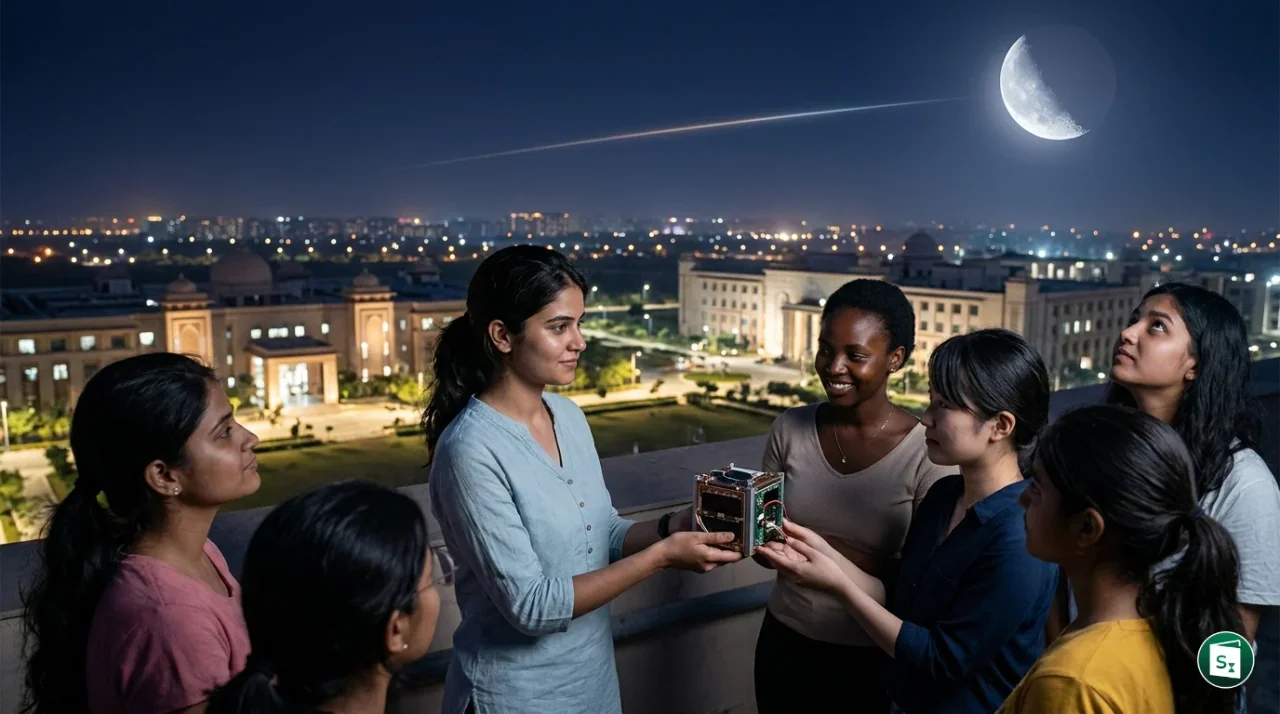
Gautam Buddha University has partnered with Space Kidz India and IN-SPACe to support Mission ShakthiSAT, the world’s first all-girls international satellite mission to the Moon. The initiative will train 12,000 young women from 108 countries in satellite design, space technology, and STEM skills, with a student-built satellite planned for lunar orbit. Mahima Rajput, a student from Raipur, Chhattisgarh, is among the selected participants in this global mission.
What Is Mission ShakthiSAT?
Mission ShakthiSAT is a global STEM and space exploration initiative conceptualised by Space Kidz India, a Chennai-based aerospace startup founded by Dr. Srimathy Kesan. The mission aims to train 12,000 girls aged 14 to 18 from 108 countries through a structured 120-hour curriculum covering physics, mathematics, coding, satellite systems, ham radio operation, and space technology. After the online training phase, 108 students, one from each participating country, will be selected for hands-on satellite fabrication in India.
The mission involves building both a Low Earth Orbit (LEO) satellite and a lunar satellite designed for a hard landing on the Moon. The satellite will be designed, fabricated, and operated by an all-women team. ShakthiSAT is envisioned as a follow-up to the scale and ambition of AzaadiSAT, a previous Space Kidz India mission that involved 750 rural Indian girls in building a CubeSat launched by ISRO in 2023. The number 108 carries deep cultural and scientific significance across civilisations, representing completeness and cosmic harmony, and symbolises the unity of 108 nations in this shared space endeavour.
The New Partnership: GBU and IN-SPACe Come On Board
Gautam Buddha University has joined the mission as a key academic and institutional partner. The university, established in 2008 under the Uttar Pradesh Gautam Buddha University Act (2002) and located in Greater Noida, will support mission activities through research, innovation, interdisciplinary learning, and scientific engagement. GBU’s Vice Chancellor, Prof. Rana Pratap Singh, has been instrumental in bringing the university into this partnership, along with Prof. Rajeev Varshney, Dean of Planning and Research.
IN-SPACe, the Indian National Space Promotion and Authorisation Centre, has also extended its continued support to the mission. Dr. Pawan Goenka, Chairman of IN-SPACe, has been a key figure in strengthening India’s space ecosystem and enabling transformative educational initiatives. This collaboration brings together an academic institution, a private aerospace startup, and the government’s space regulatory agency, creating a model for how India’s space sector can integrate education, innovation, and policy under one umbrella.
Why 108 Countries and 12,000 Girls?
Women currently hold only about 20% of jobs in the global space industry. ShakthiSAT was designed specifically to address this gap by creating a pathway for young girls to enter space sciences at an early age. The programme targets girls aged 14 to 18 because this is the stage when career interests are formed and when many girls, especially in developing countries, lose access to STEM education due to social and economic barriers.
The choice of 108 countries is deliberate. The number 108 holds deep spiritual and scientific significance in Indian and other civilisations. In Hinduism and Buddhism, it is considered a number of completeness. In astronomy, the Sun’s diameter is roughly 108 times the Earth’s diameter, and the distance from the Earth to the Sun is about 108 times the Sun’s diameter. By uniting 108 nations, the mission sends a message that space exploration belongs to all of humanity, not just a few technologically advanced countries.
The mission is rooted in the Indian philosophy of Vasudhaiva Kutumbakam, which means the world is one family. It prioritises participation from smaller and less developed nations that rarely have access to space programmes. Countries such as Palau, Samoa, Eswatini, Haiti, and Lesotho are among those participating, giving their young women a rare opportunity to engage in cutting-edge space science.
Space Kidz India: A Legacy of Student-Led Space Missions
Space Kidz India was founded in 2011 by Dr. Srimathy Kesan, who is also the world’s first woman to build and launch 27 space missions and the first Indian woman to experience a zero-gravity flight. The organisation is headquartered in Chennai and focuses on making space science accessible to school and college students through hands-on satellite building projects.
The organisation has an impressive track record of student-led space missions:
| Mission | Year | Key Achievement |
|---|---|---|
| KalamSAT | 2017 | World’s lightest satellite (64 grams), launched on PSLV-C38 |
| AzaadiSAT | 2022 | 8U CubeSat with 75 payloads built by 750 rural Indian girls |
| AzaadiSAT-2 | 2023 | Successfully orbited on SSLV-D2 after initial failure, carrying 750 girl students’ experiments |
| SD SAT | 2021 | 3U CubeSat with indigenous nanosatellite components |
AzaadiSAT, the organisation’s most celebrated mission before ShakthiSAT, was launched as part of India’s Azadi Ka Amrit Mahotsav celebrations. The first attempt on SSLV-D1 in August 2022 failed to reach orbit, but the team rebuilt and successfully launched AzaadiSAT-2 on ISRO’s SSLV-D2 in February 2023. This resilience showed the power of student-led innovation and the value of perseverance. ShakthiSAT builds directly on this experience, scaling the model from one nation to 108 countries.
What Is IN-SPACe and Why It Matters
IN-SPACe, the Indian National Space Promotion and Authorisation Centre, was established on 24 June 2020 as an autonomous single-window nodal agency under the Department of Space. Its creation was part of the historic space sector reforms announced by the Union Cabinet in June 2020, which opened up India’s space programme to private participation for the first time. IN-SPACe is headquartered in Ahmedabad, Gujarat, and is chaired by Dr. Pawan Goenka.
The agency is responsible for promoting, enabling, authorising, and supervising space activities of non-governmental entities in India. This includes approving the building of launch vehicles and satellites, sharing ISRO’s infrastructure and facilities with private players, and establishing new space infrastructure. Before IN-SPACe was created, ISRO itself acted as both the operator and regulator of space activities. The separation of these roles was a critical reform to allow private innovation to flourish.
IN-SPACe’s support for Mission ShakthiSAT is significant because it demonstrates the agency’s commitment to educational and non-commercial space initiatives. By facilitating partnerships between startups like Space Kidz India and academic institutions like Gautam Buddha University, IN-SPACe is fulfilling its mandate to expand India’s space ecosystem beyond government agencies and into the broader society.
The Way Forward
Mission ShakthiSAT is targeting a launch by the end of 2026, with the satellite planned to fly as a companion payload on an ISRO mission. The UK-based Meridian Space Command, part of the University of Leicester’s Space Park, has also partnered on the mission, providing mission management support and an in-space transportation vehicle to move payloads between low Earth orbit and low lunar orbit.
For the participants, the journey is already underway. Mahima Rajput, a student from Raipur, Chhattisgarh, represents India’s participation in this global programme. Her selection reflects the mission’s core belief that talent exists everywhere and that girls from smaller cities and towns can lead in space sciences when given the right opportunity.
Beyond ShakthiSAT, Dr. Srimathy Kesan has articulated a larger long-term vision: establishing a world-class Space University and a Space Research Park in India, modelled as a miniature version of NASA. Such a facility would provide Indian and international students with hands-on access to space simulation, zero-gravity experiments, and cutting-edge aerospace technology without having to travel abroad.
Mission ShakthiSAT positions India as a unifying force in the global space landscape. By combining scientific ambition with social inclusion and international cooperation, the initiative signals a shift from competition to collaboration. It demonstrates that space does not have to be the privilege of a few nations but can be a shared frontier that belongs to all of humanity.
Key Takeaways
- Mission ShakthiSAT is the world’s first all-girls international lunar mission, training 12,000 young women from 108 countries in space technology.
- Gautam Buddha University (GBU), established in 2008 under the Uttar Pradesh Gautam Buddha University Act (2002), has joined as an academic partner alongside Space Kidz India and IN-SPACe.
- IN-SPACe was established on 24 June 2020 as a single-window autonomous nodal agency under the Department of Space and is chaired by Dr. Pawan Goenka.
- Space Kidz India, founded by Dr. Srimathy Kesan in 2011, previously launched AzaadiSAT involving 750 rural Indian girls and KalamSAT, the world’s lightest satellite at 64 grams.
- The mission includes a 120-hour STEM curriculum and aims to place a student-built satellite in lunar orbit with support from ISRO and Meridian Space Command of the UK.