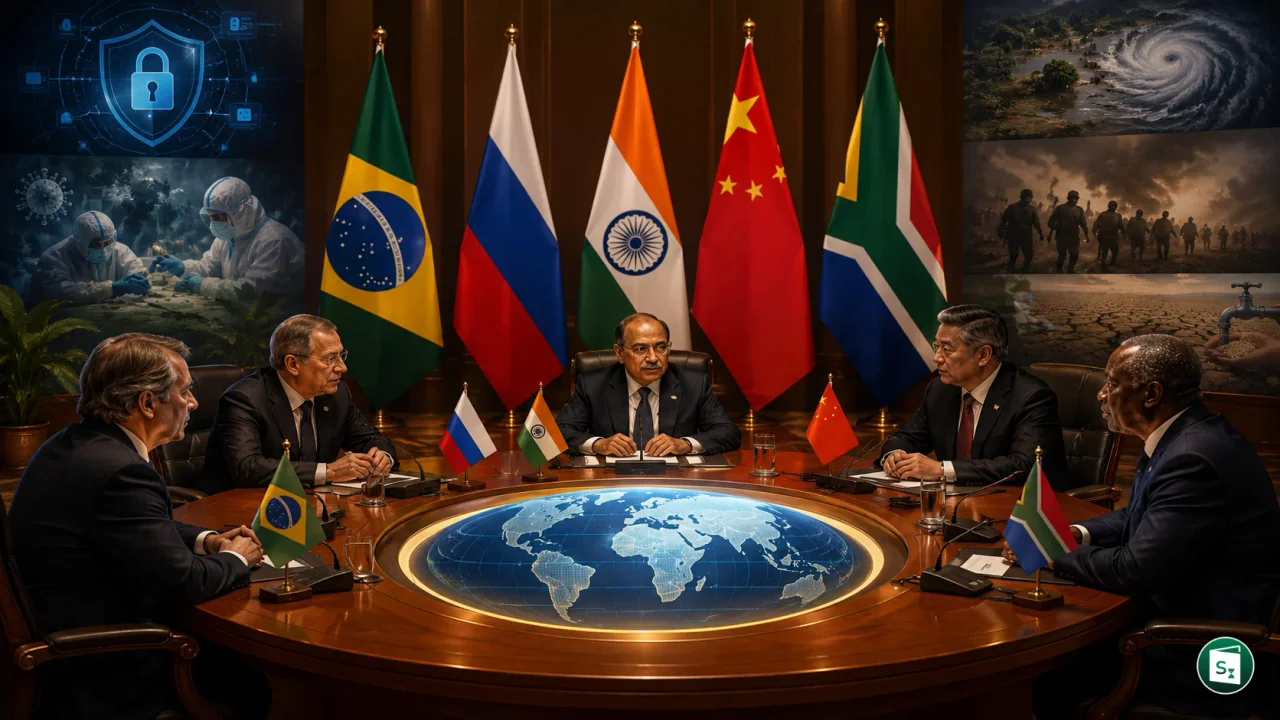
India hosted the 16th BRICS National Security Advisers’ (NSA) Meeting in New Delhi on June 22-23, 2026, with National Security Adviser Ajit Doval chairing the high-level conclave. The meeting brought together security chiefs from all 11 BRICS member states to deliberate on the theme “Non-Traditional Security Challenges Confronting the World Today.” The gathering assumed particular significance amid ongoing geopolitical turmoil, military conflicts in West Asia and Europe, and the growing inadequacy of existing multilateral mechanisms to address these crises.
What Is BRICS? Origins and Evolution
BRICS is an intergovernmental grouping of major emerging economies that began as BRIC in 2006 when the foreign ministers of Brazil, Russia, India, and China held their first meeting on the sidelines of the United Nations General Assembly in New York. The term BRIC was originally coined in 2001 by economist Jim O’Neill of Goldman Sachs to describe four rapidly growing economies that were expected to dominate the global economy by 2050. The inaugural BRIC summit took place in Yekaterinburg, Russia, in 2009, formalising the group as a diplomatic platform.
South Africa joined the bloc in 2010, changing the acronym to BRICS. The group expanded significantly in 2024 when Egypt, Ethiopia, Iran, Saudi Arabia, and the United Arab Emirates became full members. Indonesia joined in January 2025, becoming the first Southeast Asian member. The current 11 member states represent nearly 50 percent of the world’s population and about 40 percent of global GDP.
The grouping operates without a formal founding treaty, permanent secretariat, or headquarters. The chairmanship rotates annually among members in the order of the acronym. India is chairing BRICS for the fourth time in 2026, having previously held the chair in 2012, 2016, and 2021. India’s chairship is guided by the theme “Building for Resilience, Innovation, Cooperation and Sustainability,” which reflects a people-centric and humanity-first approach.
One of BRICS’s most significant institutional achievements is the New Development Bank (NDB), established in 2014 with its headquarters in Shanghai, China. The NDB provides funding for infrastructure and sustainable development projects in emerging economies. The Contingent Reserve Arrangement (CRA), another key institutional mechanism, offers liquidity support to member states during balance of payments crises.
The 16th NSA Meeting: Key Details
The two-day meeting was attended by senior security officials from all 11 BRICS member states. Notable participants included Chinese Foreign Minister Wang Yi, Russian Security Council Secretary Sergey Shoigu, Iran’s Deputy Secretary of the Supreme National Security Council Ghadir Nezamipour, Secretary-General of the UAE Supreme Council for National Security Ali Mohammed Hammad Al Shamsi, and South African Minister in the Presidency Khumbudzo Ntshavheni. Brazil was represented by Secretary of Multilateral and Political Affairs Carlos Cozendey.
The meeting was organised as part of the Heads of Agencies Meetings track within BRICS, which operates alongside ministerial tracks covering foreign affairs, finance, trade, health, and other domains. The NSA meeting serves as a key preparatory forum ahead of the BRICS leaders’ summit, scheduled to be held in India later in September 2026.
The agenda covered a review of the outcomes of two recently held BRICS joint working groups: the Joint Working Group on Counter-Terrorism, which met in May 2026, and the Joint Working Group on Security in the Use of Information and Communication Technologies (ICTs), which met earlier in June 2026. These working groups form the operational backbone of BRICS security cooperation, developing practical measures and sharing best practices among member states.
Understanding Non-Traditional Security Challenges
Non-traditional security (NTS) challenges are threats to the survival and well-being of states and people that arise primarily from non-military sources. Unlike traditional security threats involving military aggression between states, NTS challenges are often transnational in scope, meaning they cross national borders and cannot be solved by any single country acting alone. They require coordinated multilateral responses.
Key NTS Challenges Discussed at the Meeting
Terrorism and extremism were central to the deliberations. The participants reaffirmed their commitment to combating terrorism in all its forms and manifestations, with specific focus on the use of new and emerging technologies by terrorist networks. The discussions recognised that terrorist groups are increasingly using encrypted communication tools, drones, and artificial intelligence to plan and execute attacks.
Cyber security emerged as another pressing concern. As governments and critical infrastructure become more digitised, the vulnerability to cyber attacks grows exponentially. The meeting examined threats to critical information infrastructure, data security, and the weaponisation of digital platforms for hostile purposes.
Energy security was discussed in the context of global supply chain disruptions and regional conflicts affecting energy markets. NSA Doval specifically welcomed the recent MoU between the United States and Iran, expressing cautious optimism that the reopening of the Strait of Hormuz would improve energy security and remove supply chain bottlenecks in fertilisers and chemicals.
Food security and supply chain resilience were also flagged as major vulnerabilities. The meeting noted how geopolitical conflicts, climate shocks, and trade disruptions have exposed the fragility of global supply chains, particularly for food, fertilisers, and essential commodities.
Climate-induced instability was recognised as a long-term multiplier of existing security risks. Extreme weather events, resource scarcity, and climate-driven migration patterns were identified as factors that could exacerbate social tensions and create new security challenges.
| NTS Challenge | Key Concern | Impact |
|---|---|---|
| Terrorism | Use of emerging technologies by terror groups | Cross-border threat requiring joint action |
| Cyber Security | Attacks on critical information infrastructure | Disruption of government and economic systems |
| Energy Security | Supply chain disruptions, Strait of Hormuz | Price volatility, economic slowdown |
| Food Security | Fragile global supply chains | Hunger, social unrest |
| Climate Instability | Extreme weather, resource scarcity | Migration, conflict over resources |
Key Outcomes of the Meeting
The meeting produced several important outcomes despite the absence of a formal joint statement, which analysts noted reflected the divergent strategic interests among member states on certain macro-security issues.
Strengthened counter-terrorism cooperation: The NSAs agreed to expand cooperation through capacity building, enhanced information sharing, and greater coordination among law enforcement agencies. They committed to countering the use of new technologies by terrorist groups and reaffirmed their commitment to combating terrorism in all its forms.
Review of joint working group outcomes: The meeting assessed the work of the Joint Working Group on Counter-Terrorism and the Joint Working Group on Security in the Use of ICTs. These reviews help translate broad political commitments into actionable measures at the operational level.
Collective call on Prime Minister Modi: The meeting concluded with the NSAs and heads of delegation calling on Prime Minister Narendra Modi, expressing full support for India’s BRICS Chairship in 2026 and its vision for the grouping.
Recognition of the decline of multilateralism: NSA Doval, in his opening remarks, noted that the world is facing geopolitical uncertainties, economic strains, and disruptive technologies. He observed that existing institutional mechanisms are increasingly inadequate to resolve or mitigate conflicts, and that multilateralism is on the decline. This framing set the tone for the discussions on the need for reformed global governance.
India’s Role and Bilateral Engagements
On the sidelines of the main meeting, NSA Ajit Doval held a series of bilateral meetings with counterparts from fellow BRICS member states, reflecting India’s active diplomatic outreach within the grouping.
The most notable bilateral engagement was with Chinese Foreign Minister Wang Yi. According to the Ministry of External Affairs, both sides reviewed recent developments in bilateral relations and noted progress towards the gradual normalisation of ties. Doval emphasised that stable, predictable, and constructive bilateral relations contribute to building trust and better understanding between the two sides. The discussions were described as constructive and forward-looking, marking a continued effort by both countries to manage their differences through dialogue.
Doval met Iran’s Deputy Secretary for Defence Affairs Ghadir Nezamipour, with both sides reviewing the ongoing situation in West Asia and discussing cooperation under the BRICS platform as well as India-Iran bilateral ties. The meeting came at a critical time following the US-Iran MoU and the prospect of reopening the Strait of Hormuz.
With Brazil, represented by Secretary of Multilateral and Political Affairs Carlos Cozendey, Doval welcomed the growing cooperation under the BRICS framework and reviewed the overall state of India-Brazil relations. Bilateral meetings were also held with counterparts from Ethiopia and South Africa.
Doval’s remarks on the US-Iran MoU were another highlight of India’s proactive diplomacy. He stated that India welcomed the understanding with cautious optimism, noting that the reopening of the Strait of Hormuz would improve energy security and remove supply chain bottlenecks. This position reflected India’s broader interest in maintaining stable energy markets and secure maritime trade routes.
Significance for India and the Global South
The 16th BRICS NSA meeting carried particular significance for India’s role as the 2026 chair of the grouping. By hosting this security dialogue, India demonstrated its ability to convene major powers and regional rivals on a common platform despite divergent strategic interests. The meeting proved that BRICS can function as a meaningful forum even when core rivalries exist among its members.
For the Global South, the meeting sent an important signal that emerging economies are capable of developing their own frameworks to address security challenges without relying solely on Western-led institutions. Doval, in his address, described BRICS as a coalition of countries that believe in peace, progress, development, and cooperation, and noted that the group has a special role to play in a world in turmoil.
The meeting also shifted the focus from traditional military-centric security to a broader, more contemporary understanding of threats. Issues such as cyber security, supply chain resilience, food and energy security, and climate-induced instability are increasingly central to the security discourse of developing nations. By placing these at the heart of the agenda, India ensured that BRICS security cooperation reflects the priorities of the Global South.
The New Delhi meeting served as a preparatory track for the BRICS leaders’ summit scheduled for September 2026 in India. The outcomes and discussions from the NSA meeting will help shape the agenda and declarations for the summit, where Prime Minister Modi will host leaders from all 11 member states.
Key Takeaways
- The 16th BRICS National Security Advisers’ Meeting was held in New Delhi on June 22-23, 2026, chaired by India’s NSA Ajit Doval.
- The meeting was conducted under the theme “Non-Traditional Security Challenges Confronting the World Today”, covering terrorism, cyber security, energy security, food security, and climate-induced instability.
- All 11 BRICS member states participated, including the five new members who joined in 2024-2025: Egypt, Ethiopia, Iran, Saudi Arabia, UAE, and Indonesia.
- Notable participants included Chinese Foreign Minister Wang Yi, Russian Security Council Secretary Sergey Shoigu, and Iran’s Deputy SNSC Secretary Ghadir Nezamipour.
- The meeting reviewed outcomes of the BRICS Joint Working Groups on Counter-Terrorism and Security in the Use of ICTs.
- NSA Doval held bilateral meetings with counterparts from China, Iran, Brazil, Ethiopia, and South Africa on the sidelines of the main gathering.
- India holds the BRICS Chairship for the fourth time in 2026, with the leaders’ summit scheduled for September 2026.
- The New Development Bank (NDB), headquartered in Shanghai, was established in 2014 as BRICS’s flagship financial institution.