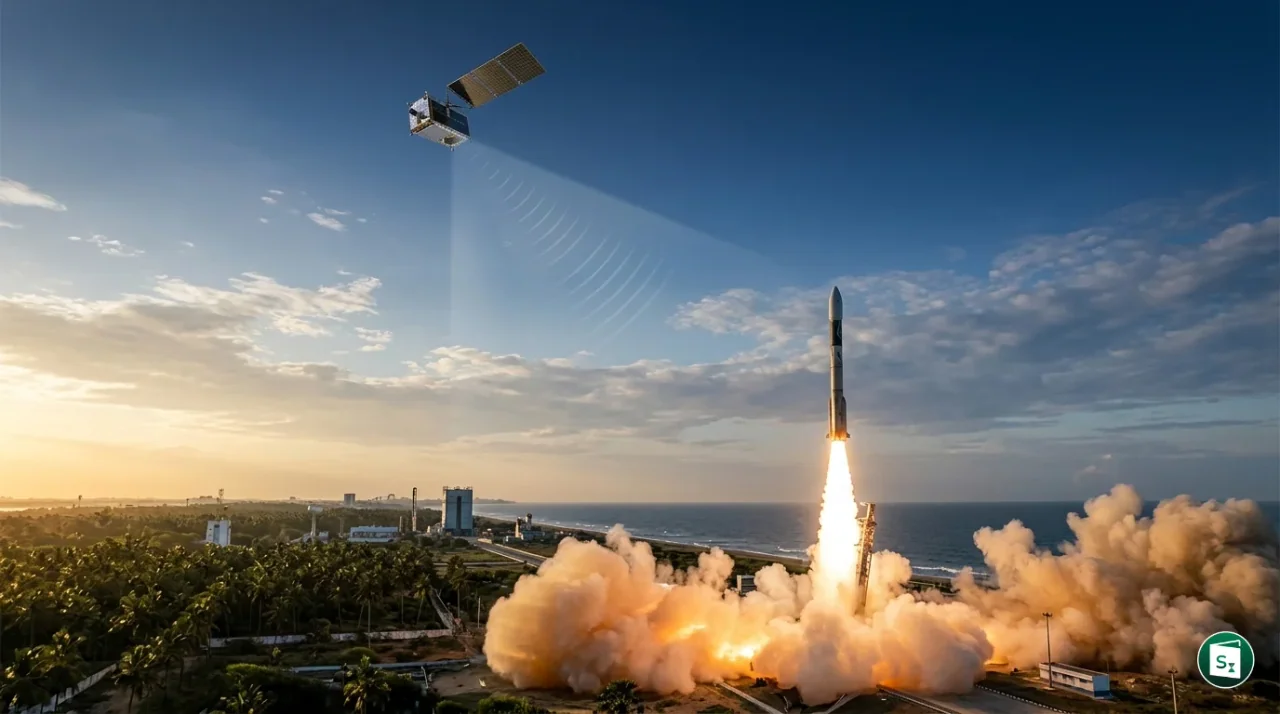
Finland-based ICEYE, the world’s largest operator of Synthetic Aperture Radar (SAR) satellites, has signed a partnership agreement with Chennai-based space startup Agnikul Cosmos to build, launch, and operate SAR Earth observation systems from India. The MoU was signed at the Bharat Innovates 2026 summit in Nice, France, an event jointly inaugurated by Prime Minister Narendra Modi and French President Emmanuel Macron. The collaboration aims to create a fully sovereign, end-to-end SAR capability where satellites are manufactured in India and launched aboard Agnikul’s indigenous rockets, eliminating dependence on foreign launch providers.
What Is Synthetic Aperture Radar (SAR)?
Synthetic Aperture Radar is an advanced remote sensing technology that uses microwave signals instead of visible light to create high-resolution images of the Earth’s surface. Unlike optical satellites that rely on sunlight and are blocked by clouds, SAR satellites generate their own radar pulses and can capture images in any weather condition, day or night. This makes SAR an invaluable tool for persistent monitoring of disaster zones, border areas, and strategic locations where cloud cover or darkness would otherwise obstruct view.
The technology works by transmitting radar pulses from a moving satellite towards the ground and recording the signals that bounce back. As the satellite travels along its orbit, it collects thousands of radar returns from the same point on the ground and combines them coherently to synthesize a much larger virtual antenna. This process, called aperture synthesis, enables resolutions as fine as 25 centimetres from satellites weighing less than 100 kilograms. ICEYE’s SAR satellites operate in the X-band (9.65 GHz) portion of the electromagnetic spectrum and are equipped with electronically steered phased array antennas that can be software-controlled to point the beam in different directions without moving the satellite itself.
ICEYE: The World’s Largest SAR Constellation
ICEYE is a Finnish microsatellite manufacturer and operator founded in 2014 as a spin-off from Aalto University’s Radio Technology Department by Rafal Modrzewski and Pekka Laurila. Headquartered in Espoo, Finland, the company has grown to employ over 1,000 people across offices in Poland, Spain, Germany, the UK, Australia, Japan, the UAE, Greece, and the United States. Its first major breakthrough was miniaturising SAR technology to fit on satellites weighing under 100 kg, a feat that was considered impossible before ICEYE demonstrated it with the launch of its first satellite, ICEYE-X1, aboard an ISRO PSLV-C40 rocket in January 2018.
Today, ICEYE operates the world’s largest SAR satellite constellation with more than 70 satellites launched since 2018. The company has delivered sovereign satellite constellations to seven European governments, including Poland, Sweden, and Germany, with some deliveries completed in less than 12 months from contract signing. In June 2026, the company raised €450 million in Series F funding at a valuation exceeding €10 billion and plans to double its annual satellite production to 100 satellites by the end of 2027, responding to surging demand from European militaries and governments.
| Milestone | Details |
|---|---|
| Founded | 2014, Espoo, Finland |
| Founders | Rafal Modrzewski (CEO), Pekka Laurila |
| Constellation | Over 70 SAR satellites (world’s largest) |
| First launch | ICEYE-X1 on ISRO’s PSLV-C40 (Jan 2018) |
| Key innovation | Miniaturised SAR below 100 kg |
| Sovereign clients | 7 European governments (Poland, Sweden, Germany, Greece, Netherlands, Portugal) |
| Manufacturing rate | 50 satellites/year, scaling to 100/year by 2027 |
Agnikul Cosmos: India’s 3D-Printed Rocket Pioneer
Agnikul Cosmos is a Chennai-based private space transportation company founded in December 2017 and incubated at the National Centre for Combustion Research and Development (NCCRD) of IIT Madras. The company was founded by Srinath Ravichandran (CEO), Moin SPM (COO), along with professors Satyanarayanan Chakravarthy and Janardhana Raju. Agnikul has raised approximately $85 million in funding and was valued at $500 million in its most recent funding round.
Agnikul’s flagship launch vehicle is the Agnibaan, a fully indigenous, customisable small satellite launch vehicle capable of placing payloads ranging from 30 kg to 300 kg into low Earth orbit. The rocket is powered by Agnilet, the world’s first single-piece 3D-printed semi-cryogenic engine, which runs on liquid oxygen and kerosene. The use of 3D printing compresses engine manufacturing from months to just seven days, representing a reduction of up to 97% in turnaround time compared to traditional manufacturing.
On 30 May 2024, Agnikul successfully launched Agnibaan SOrTeD (Sub-Orbital Technology Demonstrator) from India’s first private launchpad, Dhanush, at the Satish Dhawan Space Centre in Sriharikota. The mission was the world’s first rocket launch powered entirely by a single-piece 3D-printed engine and India’s first semi-cryogenic engine-powered rocket launch. In March 2026, the company test-fired Agnite, the world’s largest single-piece 3D-printed booster engine, measuring one metre in length and constructed from Inconel, a high-performance nickel superalloy. Agnikul plans to launch 50 rockets per year by 2028 from its upcoming integrated space campus near the Kulasekarapattinam spaceport in Tamil Nadu.
What the Partnership Entails
The MoU signed between ICEYE and Agnikul Cosmos goes beyond a traditional launch service agreement. It is structured as a comprehensive collaboration to build an end-to-end sovereign SAR capability within India, covering satellite manufacturing, launch services, and mission operations under a single domestic ecosystem.
Under the agreement, ICEYE will explore establishing satellite manufacturing capabilities in India, making the country an Asia-Pacific manufacturing hub for its global constellation. This would complement ICEYE’s existing manufacturing operations in Europe and the United States. The satellites built in India would use ICEYE’s proven SAR technology and be launched aboard Agnikul’s Agnibaan rockets, which are designed for responsive, on-demand launches. Agnikul’s mobile launchpad, Dhanush, allows launch from any geographic location, offering flexibility that is particularly valuable for time-sensitive sovereign missions.
The companies also plan to develop a repeatable satellite-to-launch model that can support long-term deployment programmes for both Indian and international customers. Each successful deployment would make the next one faster to plan and execute. Agnikul’s CEO, Srinath Ravichandran, noted that applications such as disaster response, sensitive area monitoring, and security are national priorities for which India needs sovereign capabilities. ICEYE’s CEO, Rafal Modrzewski, said India is an important market as global demand for sovereign intelligence capabilities continues to grow, and partnerships built around speed, reliability, and long-term execution are becoming increasingly important.
Work on the collaboration has already begun, with software systems and interfaces being developed ahead of deployment, though no specific launch date has been announced.
Why This Partnership Matters for India
This partnership represents a significant step in India’s journey towards self-reliance in space-based strategic intelligence. India has historically depended on foreign launch providers and overseas manufacturing for privately developed satellite missions, often facing long waiting periods and schedule uncertainties. By combining ICEYE’s proven SAR technology with Agnikul’s responsive launch infrastructure, the collaboration creates a fully domestic value chain from satellite production to orbit.
Strategic autonomy is the biggest gain. SAR satellites are critical for disaster management (flood mapping, cyclone damage assessment), border surveillance, infrastructure monitoring, and defence intelligence. Cloud-penetrating radar imagery is especially vital for India, given the heavy monsoon cloud cover over the subcontinent for nearly half the year. A sovereign SAR capability means Indian agencies can task satellites on demand without waiting for foreign approval or scheduling conflicts.
The partnership also strengthens India’s position in the global space economy, which is projected to grow from its current valuation of roughly $8-9 billion to $40-45 billion within the next decade. For ICEYE, India offers a strategic Asia-Pacific manufacturing base to serve both domestic and export markets. For Agnikul, the deal adds to its growing portfolio of international commercial partnerships spanning India, the Middle East, and Australia.
The timing is notable. The MoU was signed at Bharat Innovates 2026 in Nice, France, the largest Indian deep-tech showcase held outside India. The event, which featured over 120 Indian startups and 500 global investors, underscores the broader shift in India’s space sector since the 2020 space reforms and the Indian Space Policy 2023. The establishment of IN-SPACe as a single-window regulator has enabled private players like Agnikul to forge international partnerships that would have been difficult just a few years ago.
Key Takeaways
- ICEYE, founded in 2014 in Espoo, Finland, operates the world’s largest SAR satellite constellation with more than 70 satellites launched.
- Agnikul Cosmos, founded in 2017 and incubated at IIT Madras, developed the world’s first single-piece 3D-printed semi-cryogenic rocket engine and launched India’s first private rocket in May 2024.
- The partnership aims to establish a fully sovereign, end-to-end SAR capability in India covering satellite manufacturing, launch, and operations, reducing dependence on foreign providers.
- Synthetic Aperture Radar (SAR) uses microwave signals to capture high-resolution images through clouds, smoke, and darkness, making it critical for disaster management and defence applications.
- ICEYE has delivered sovereign satellite constellations to seven European governments, including Poland, Sweden, and Germany, often within 12 months of contract signing.
- The MoU was signed at Bharat Innovates 2026 in Nice, France, jointly inaugurated by PM Narendra Modi and French President Emmanuel Macron, as part of the India-France Year of Innovation.