The Ministry of Tourism and NITI Aayog have jointly released a report titled “Unlocking Growth in Tourism and Hospitality Sector” with 49 recommendations across 14 reform areas to simplify regulations and boost investments. The report identifies regulatory complexity and visa accessibility as the two biggest constraints holding back India’s tourism sector despite its world-class natural and cultural assets. It lays out a strategic roadmap to expand India’s tourism economy to $3 trillion and attract 100 million international visitors by 2047, in line with the Viksit Bharat vision.
The Report: Scope and Purpose
The report was launched at a National Workshop in New Delhi on 30 June 2026 by Union Minister for Tourism and Culture Gajendra Singh Shekhawat, NITI Aayog Member Rajiv Gauba, Tourism Secretary Bhuvnesh Kumar, and Additional Secretary Suman Billa. It is based on a detailed assessment of regulations governing accommodation providers, hospitality establishments, homestays, food and beverage services, tour operators, and tourism infrastructure projects.
The report’s central finding is that India’s tourism challenge lies not in demand or resource availability but in what it calls “enabling conditions.” Regulatory fragmentation, duplicative approvals, and high compliance burdens slow investment, delay project execution, and limit the scale and quality of tourism infrastructure. On the demand side, despite progress through mechanisms such as the e-Visa, India’s visa regime has not evolved to match the accessibility offered by leading tourism economies. The 49 non-financial regulatory recommendations are spread across 14 reform areas covering licensing, building regulations, visas, transport permits, environmental clearances, and institutional coordination.
Why India Lags in Global Tourism
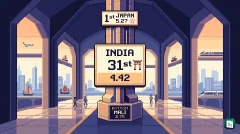
India possesses exceptional tourism assets but struggles to convert them into arrivals and revenue. The Travel and Tourism Development Index (TTDI) published by the World Economic Forum ranks India 6th globally in Natural Resources and 9th in Cultural Resources, placing it among the top three countries worldwide that rank in the top 10 across all resource pillars. Yet India’s overall TTDI rank is only 39th out of 119 countries, and the country accounts for less than 1.5% of global international tourist arrivals.
In FY 2023-24, the tourism sector contributed Rs 15.73 lakh crore to India’s GDP, accounting for 5.22% of the economy, well below the global average of about 10%. The sector supported an estimated 84.6 million jobs directly and indirectly. Domestic tourism has been the primary growth driver, with 2.9 billion domestic tourist visits recorded in 2024, surpassing the pre-pandemic peak of 2.3 billion in 2019. However, international tourist arrivals remain modest at around 10 million annually, far below countries like Thailand (35-40 million) or France (over 100 million).
The report identifies several structural reasons for this gap. Hotels require nearly 60 approvals during their lifecycle, and hospitality projects take 36 to 48 months from approval to commissioning, compared to 12 to 18 months in competing ASEAN countries. Restrictive building norms, fragmented licensing across multiple departments, and recurring compliance renewals create uncertainty that discourages investment. On the demand side, the visa regime, while improved through the e-Visa system, has not kept pace with global best practices in facilitating repeat and high-value travel.
Two-Pronged Reform Strategy
The reforms outlined in the report focus on two complementary and mutually reinforcing levers: regulatory simplification and visa facilitation. Together, the report argues, these represent a transition from a system characterised by procedural complexity and fragmented governance to one that is predictable, transparent, and visitor-centric.
Regulatory Simplification
On the regulatory front, the report recommends rationalising requirements, eliminating redundancies, and streamlining approval processes across the lifecycle of tourism enterprises. Shekhawat stressed at the launch that the goal is not to do away with compliance requirements but to make them transparent, time-bound, and streamlined so that permissions can be obtained in advance. He called for replacing fragmented systems with simpler, enterprise-level approvals and moving towards trust-based regulation rather than a regime of excessive verification.
Visa Facilitation
On the demand side, the report calls for a more facilitative visa framework. India’s e-Visa system, launched in 2014, has expanded to cover over 160 countries and simplified the application process considerably. However, the report notes that the visa regime has not yet evolved to match the scale and user experience offered by leading tourism economies. Scaling visa facilitation in line with global benchmarks is critical to enhancing India’s international accessibility and competitiveness, especially for repeat and high-value travellers.
Major Recommendations
The report’s 49 recommendations span areas including building regulations, licensing, visa policy, tourist transport, homestays, environmental clearances, and institutional coordination. The key proposals are outlined below.
Building and Licensing Reforms for Hotels
A central set of recommendations targets the high cost and long timelines of hotel development. The report proposes liberalising building regulations by increasing permissible Floor Area Ratio (FAR), removing restrictive ground coverage norms, easing minimum plot-size and road-width requirements, rationalising parking norms, and raising high-rise thresholds for hotels. These changes would reduce construction costs and enable developers to build more rooms on available land.
On licensing, the report recommends replacing the current regime of multiple approvals with a single Health Trade Licence for hotels, introducing a single liquor licence for hotels operating multiple restaurants and bars within the same premises, and removing the requirement for an Eating House Licence for food and beverage establishments. It also proposes delinking hotel star classification from statutory approvals and licensing, arguing that classification should remain a market-driven quality benchmark rather than a regulatory gate. The report recommends scrapping project-stage approvals by the Ministry of Tourism for hotels and integrating departmental clearances through digital single-window systems with Auto-DCR scrutiny.
Boosting the Homestay Sector
Recognising the growing role of alternative accommodation in India’s tourism landscape, the report recommends raising the permissible room limit for registered homestays from six rooms to nine rooms and removing unnecessary No Objection Certificate (NOC) requirements from local authorities. These changes are intended to encourage rural entrepreneurship, expand accommodation capacity in emerging destinations, and promote community-based tourism that directly benefits local households.
Tourist Transport Reforms
For interstate tourist mobility, the report recommends extending the minimum validity of the All India Tourist Permit (AITP) from 90 days to one year and removing state-level entry taxes and fees on motor vehicles that already hold AITP. These measures aim to reduce operating costs for tourist transport operators and enable seamless interstate travel, which is currently hampered by differing state-level taxes and permit rules.
Visa Facilitation for International Visitors
One of the most significant proposals is the introduction of a 90-day, multiple-entry Tourist Visa-on-Arrival (VoA) for travellers from selected countries. Eligible visitors would obtain visas at designated airports and seaports without applying in advance. The report also recommends simplifying the e-Visa architecture by reducing multiple sub-categories into a smaller set of broad-purpose visas covering tourism, business, short-term medical treatment, student travel, and attendant visits. It further suggests introducing priority processing for frequent visitors and examining a Tourist Refund Scheme (TRS) that would allow foreign tourists to claim GST refunds on purchases made in India.
Achieving the $3 Trillion Tourism Economy by 2047
The report is aligned with the broader Viksit Bharat 2047 vision, under which tourism has been identified as a strategic economic driver. The target of a $3 trillion tourism economy by 2047 would require raising the sector’s contribution to GDP from the current 5.22% to the global benchmark of 10%. The government has set an interim target of crossing 7% GDP contribution by 2030.
To put these targets in perspective, the Federation of Associations in Indian Tourism and Hospitality (FAITH) estimates that achieving a $3 trillion tourism economy would generate 200 million tourism-related jobs, up from around 84 million currently, and increase foreign exchange earnings from approximately $35 billion to $400 billion. Domestic tourist visits would need to rise from 2.9 billion to 20 billion annually.
The report’s central message is that regulatory certainty can become a competitive advantage for India’s tourism sector. Rather than proposing financial incentives or subsidies, it focuses on removing procedural barriers that increase costs and delay projects. Rajiv Gauba of NITI Aayog noted that India’s tourism challenge lies not in demand or resource availability but in enabling conditions. The reforms, if implemented collaboratively by the Centre and states through clearly defined institutional responsibilities and phased pathways, could unlock faster investment, improve visitor experiences, and strengthen India’s position as a globally competitive tourism destination.
Key Takeaways
- The Ministry of Tourism and NITI Aayog released the report “Unlocking Growth in Tourism and Hospitality Sector” on 30 June 2026 at a National Workshop in New Delhi.
- The report makes 49 recommendations across 14 reform areas focusing on non-financial regulatory reforms, not subsidies or financial incentives.
- According to the Travel and Tourism Development Index (TTDI) 2024 by the World Economic Forum, India ranks 6th in Natural Resources and 9th in Cultural Resources but only 39th overall among 119 countries.
- India accounts for less than 1.5% of global international tourist arrivals despite possessing world-class tourism assets, and its tourism GDP contribution of 5.22% is roughly half the global average of 10%.
- Key proposals include a 90-day multiple-entry Visa-on-Arrival for select countries, a single Health Trade Licence for hotels, removal of the Eating House Licence, and extending All India Tourist Permit validity from 90 days to one year.
- The strategic plan targets a $3 trillion tourism economy and 100 million international visitors annually by 2047, aligned with the Viksit Bharat vision.