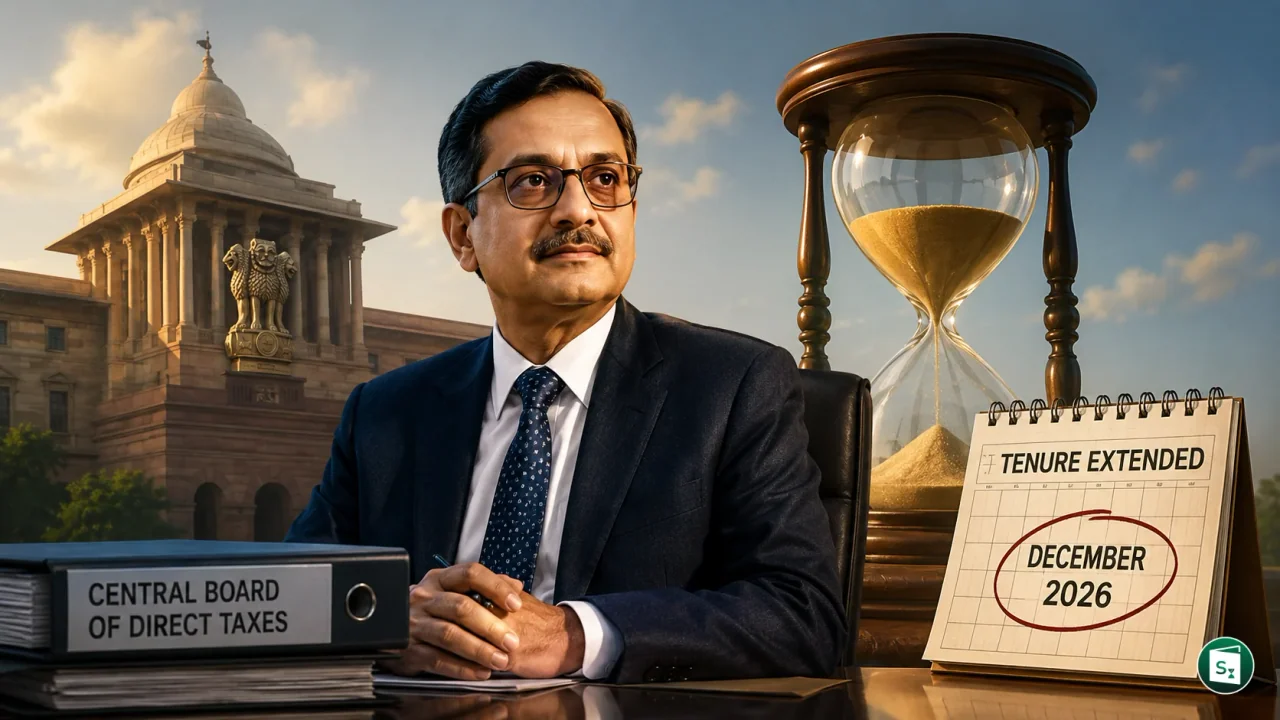
The Union government has extended the tenure of Ravi Agrawal, Chairman of the Central Board of Direct Taxes (CBDT), by six months until December 2026. The Appointments Committee of the Cabinet (ACC) approved his reappointment on a contract basis from July 1, 2026, to December 31, 2026, or until further orders. This is the second extension for Agrawal, a 1988-batch Indian Revenue Service (IRS) officer, who was initially appointed to the post in June 2024 for a one-year term.
Who Is Ravi Agrawal?
Ravi Agrawal is a 1988-batch officer of the Indian Revenue Service (IRS) from the income tax cadre. He took charge as CBDT Chairman on July 1, 2024, succeeding Nitin Gupta, a 1986-batch IRS officer whose extended tenure ended on June 30, 2024.
Before his elevation to the top post, Agrawal served as Member (Administration) in the CBDT since July 2023. His career with the Income Tax Department spans more than three decades, during which he held several key positions across the organisation. Agrawal superannuated from service on September 30, 2024, but the government retained him as CBDT chief on a contract basis, citing the need for continuity in tax administration and policy formulation.
At 62, Agrawal brings extensive experience in direct tax governance, senior personnel management, and international tax cooperation, having represented India at forums such as the OECD and the United Nations.
What Is the Central Board of Direct Taxes?
The Central Board of Direct Taxes (CBDT) is a statutory body under the Department of Revenue, Ministry of Finance, Government of India. It serves as the apex policymaking body for direct taxes in the country, administering laws related to income tax, corporate tax, and other direct levies through the Income Tax Department.
History and Establishment
The origins of the CBDT trace back to the Central Board of Revenue Act, 1924, under which the Central Board of Revenue was established as the apex tax administration body handling both direct and indirect taxes. As the scale of taxation grew more complex, the Board was split into two separate entities on January 1, 1964: the Central Board of Direct Taxes (CBDT) for direct taxes and the Central Board of Excise and Customs (CBEC, now CBIC) for indirect taxes. This division was formalised under Section 3 of the Central Board of Revenue Act, 1963. The CBDT is headquartered in New Delhi.
Structure
The CBDT is headed by a Chairman and includes up to six Members, all of whom hold the rank of Special Secretary to the Government of India. The members oversee specific functional areas:
| Member Portfolio | Key Responsibility |
|---|---|
| Income Tax and Revenue | Tax policy implementation and revenue collection |
| Legislation and Computerisation | Tax law drafting and IT modernisation |
| Administration | Personnel management and departmental operations |
| Investigation | Anti-evasion measures and search operations |
| Audit and Judicial | Tax audit oversight and litigation |
| Personnel and Vigilance | Staff matters and disciplinary proceedings |
All members of the CBDT are drawn from the Indian Revenue Service (IRS), which constitutes the top management of the Income Tax Department.
Key Functions
The CBDT formulates policies for the assessment and collection of direct taxes, supervises the functioning of the entire Income Tax Department, and advises the government on legislative changes in direct tax enactments. It also represents India at international tax forums, negotiates tax treaties with other countries, and oversees matters related to transfer pricing, black money, and foreign tax compliance.
How Was the Extension Approved?
The extension was cleared by the Appointments Committee of the Cabinet (ACC), the highest body for senior-level government appointments in India. The ACC is chaired by the Prime Minister and includes the Home Minister and other senior ministers. An order issued by the Department of Personnel and Training (DoPT) on June 30, 2026, confirmed the reappointment.
The approval was granted on a contract basis for six months, effective July 1, 2026, to December 31, 2026, or until further orders, whichever is earlier. The reappointment follows the usual terms and conditions applicable to re-employed central government officers, with a relaxation of the Recruitment Rules.
Timeline of Appointments
Agrawal’s tenure as CBDT Chairman has followed a pattern of short-term contract-based extensions rather than a standard fixed term:
| Period | Duration | Basis |
|---|---|---|
| July 1, 2024 to September 30, 2024 | 3 months | Regular tenure (pre-superannuation) |
| October 1, 2024 to June 30, 2025 | 9 months | Post-retirement contract |
| July 1, 2025 to June 30, 2026 | 1 year | Contract extension |
| July 1, 2026 to December 31, 2026 | 6 months | Contract extension |
This pattern reflects the government’s practice of retaining experienced IRS officers beyond their superannuation to maintain leadership stability in key tax administration roles.
Why Does the Extension Matter?
The extension of Agrawal’s tenure comes at a significant time for India’s direct tax landscape. According to government sources, the decision aims to ensure continuity in direct tax policy formulation and to support certain special initiatives being undertaken by the CBDT.
Ongoing Tax Reforms
The CBDT has been at the centre of several major reforms in recent years, including the rollout of the faceless assessment and appeal system, the introduction of the new income tax regime, and the ongoing work on the New Income Tax Act, 2025 which aims to replace the decades-old Income Tax Act, 1961. Continuity in leadership during this phase of legislative overhaul is seen as critical for maintaining momentum.
International Tax Forums
The CBDT Chairman represents India at key international tax platforms, including the OECD’s Base Erosion and Profit Shifting (BEPS) framework and the United Nations Tax Committee. With global tax cooperation becoming increasingly important in the fight against tax evasion and profit shifting by multinational corporations, experienced leadership at these forums is valuable for safeguarding India’s tax interests.
Administrative Stability
The CBDT Chairman oversees senior-level appointments, transfers, and postings within the Income Tax Department, besides handling public grievance redressal and administrative reforms. The extension ensures that ongoing personnel decisions and departmental restructuring efforts are not disrupted by a leadership change midway.
Key Takeaways
- The Appointments Committee of the Cabinet (ACC) extended Ravi Agrawal’s tenure as CBDT Chairman by six months until December 2026.
- Agrawal is a 1988-batch Indian Revenue Service (IRS) officer who initially took charge as CBDT chief on July 1, 2024.
- The Central Board of Direct Taxes (CBDT) is a statutory body established on January 1, 1964, under the Central Board of Revenue Act, 1963.
- The CBDT functions under the Department of Revenue, Ministry of Finance, and is headquartered in New Delhi.
- The CBDT is headed by a Chairman and includes up to six Members, all holding the rank of Special Secretary.
- The CBDT is the counterpart of the Central Board of Indirect Taxes and Customs (CBIC), which handles indirect taxes.