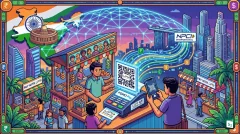
Eroute Technologies Pvt Ltd, through its OmniCard platform, launched India’s first Flexi Benefits Basket on UPI in July 2026. The product is an employee-controlled digital wallet that allows workers to allocate their salary-linked benefits across meal, fuel, telecom, books and other categories, and spend them at any of the 60 million UPI-enabled merchant outlets in the country. Built on a Reserve Bank of India (RBI) licensed Prepaid Payment Instrument (PPI) infrastructure, the launch marks a structural shift from the traditional single-purpose meal card to a flexible, tax-efficient benefits wallet.
What Is the Flexi Benefits Basket on UPI?
The Flexi Benefits Basket is a single digital wallet inside which an employee can create several sub-wallets, one for each eligible benefit category. Instead of receiving a fixed meal card issued by the human resources (HR) department, the employee decides how the total benefit allowance is split across meal, fuel, telecom, books and periodicals, gadgets and other eligible heads.
Each sub-wallet holds money meant only for that category. When the employee pays, the correct wallet is debited automatically based on the type of merchant. Spending is enforced through Merchant Category Code (MCC) based controls, which means a rupee loaded for meals cannot be used at a fuel pump, and vice versa. This category-level locking keeps the entire arrangement compliant with tax rules and audit-ready for employers.
Why Now: The 2026 Income-Tax Rules
The launch has been timed to follow a major change in tax law. Under the Income-Tax Rules, 2026, notified by the Central Board of Direct Taxes (CBDT) and effective from April 1, 2026, the tax-free limit on meals provided by employers has been raised from ₹50 to ₹200 per meal.
Unlike the earlier framework, this exemption is now available under both the old and the new tax regimes, subject to the meal being provided during working hours at the office or business premises, or through restricted-use vouchers usable only at eating joints. On a standard month of 22 working days, an employee can receive up to ₹1,05,600 annually as a tax-free meal benefit when two meals a day are provided.
OmniCard extends this logic beyond food. Telecom benefits of up to ₹36,000 and books and periodicals benefits of up to ₹50,000, as typically structured, can be added to the basket. Together, these can push total annual tax-free benefits beyond ₹2,00,000 per employee, structured within the cost-to-company (CTC) at zero additional cost to the employer.
The PPI Infrastructure Behind the Product
A Prepaid Payment Instrument (PPI) is a payment tool that stores monetary value in advance, which can then be used to buy goods and services. It covers prepaid wallets, prepaid cards and similar instruments. The RBI regulates PPIs under the Master Directions on Prepaid Payment Instruments of August 27, 2021, issued under the Payment and Settlement Systems Act, 2007.
PPIs that need RBI approval fall into two broad categories: Small PPIs (issued with minimum customer details and capped at ₹10,000 outstanding) and Full-KYC PPIs (issued after complete Know Your Customer verification, with an outstanding limit of ₹2,00,000). Full-KYC PPIs can be used for purchases, cash withdrawals and fund transfers, and must be made interoperable through authorised card networks and UPI.
Eroute Technologies received its PPI authorisation from the RBI in May 2021, which allows it to issue and operate semi-closed prepaid instruments. The Noida-based fintech, founded in 2018 by Sanjeev Pandey, a former group president of Yes Bank, and Abhishek Saxena, an alumnus of IIT-BHU, later went live with UPI as a prepaid issuer in association with the National Payments Corporation of India (NPCI). Issuing the Flexi Benefits Basket directly under its own RBI licence, rather than as a reseller of a bank’s product, is what lets the company design category-level controls and load money across multiple wallets on a single UPI-linked instrument.
How the Basket Works in Practice
The engineering core of the product is that several benefit wallets sit behind one UPI payment. An employee scans any UPI QR code, chooses the wallet to pay from, and the transaction is completed in seconds. Behind that single scan, the RBI-licensed PPI stack routes the payment to the correct sub-wallet while applying category controls in real time. There are no separate cards, separate apps or separate QR codes.
Employees receive both physical and virtual cards issued instantly after full digital KYC. On the employer side, a centralised dashboard gives HR and finance teams a single view of card issuance, benefit loading, allocation rules, real-time transaction visibility and reporting across the entire workforce. The basket is available to OmniCard’s enterprise, mid-corporate and SME clients, with same-day rollout to full workforces through digital onboarding. OmniCard, which counts more than 1,000 businesses including McDonald’s and Patanjali among its clients, also plans to open the product to partner platforms such as HRMS and payroll software, benefits consultants, staffing companies and banks through API-based integration.
What It Means for Employees and Employers
For employees, the basket converts benefits from a fixed, take-it-or-leave-it handout into a choice. Workers decide how their allowance is split across categories based on their own spending patterns, and can use the money wherever UPI is accepted, from office canteens and food delivery apps to fuel stations and bookstores. This removes the biggest complaint against older meal cards: a closed network where many merchants do not accept the card.
For employers, the product is largely a retention and compensation tool. Because the entire benefit is structured within CTC, the take-home value for the employee rises without adding to payroll cost. The merchant-category controls also mean the employer can document that each rupee was spent only on an eligible head, protecting the tax exemption during scrutiny.
| Feature | Traditional Meal Card | Flexi Benefits Basket |
|---|---|---|
| Coverage | Food only | Food, fuel, telecom, books, gadgets and more |
| Spending network | Closed merchant network | All 60 million UPI merchants |
| Choice of allocation | Fixed by employer | Controlled by employee |
| Payment method | Swipe or app payment | One UPI QR scan |
| Tax-free annual value | Up to ₹1,05,600 on meals | Beyond ₹2,00,000 across categories |
The Broader Context: UPI as a Business Payments Rail
The launch sits on top of a decade-long UPI expansion. UPI, launched on April 11, 2016 by the NPCI under the regulatory oversight of the RBI, processed over 24,162 crore transactions worth about ₹314 lakh crore in FY 2025-26. It now accounts for nearly 49 percent of global real-time payment volume, with more than 700 banks live on the network and about 85 percent of India’s digital payments moving through it.
The Flexi Benefits Basket extends UPI from person-to-merchant retail payments into the corporate benefits space. OmniCard had already pioneered UPI payments on business wallets for expense management, fleet and fuel management, and petty cash. Employee benefits are the newest use case on this business-payment stack, applying the same rails, spend controls and real-time visibility that enterprises already use for corporate payments.
The Way Forward
The move points to two parallel trends. On the tax side, the raised ₹200-per-meal exemption and its extension to the new tax regime have made salary restructuring through meal and other benefit vouchers attractive again, which had faded when the exemption was limited to the old regime. On the payments side, PPI issuers are shifting from closed-loop cards to interoperable, UPI-first instruments, exactly the direction the RBI pushed for when it made interoperability mandatory for full-KYC PPIs.
If the basket model is adopted widely, it could press the traditional meal card providers to open their networks and add categories. For employees, the practical effect is a simpler, tax-smart way to use workplace benefits; for the payments ecosystem, it widens UPI’s share of high-frequency, low-value corporate spending. The product’s real test will be adoption at scale and how strictly the merchant-category controls survive real-world usage and tax scrutiny.
Key Takeaways
- Eroute Technologies Pvt Ltd, through its OmniCard platform, launched India’s first Flexi Benefits Basket on UPI in July 2026.
- The basket is an employee-controlled digital wallet that splits benefits across meal, fuel, telecom, books and periodicals, and gadgets, spendable at 60 million UPI merchants.
- It is built on an RBI-licensed Prepaid Payment Instrument (PPI) infrastructure, and Eroute received its PPI authorisation in May 2021.
- Under the Income-Tax Rules, 2026, effective April 1, 2026, the tax-free meal exemption was raised from ₹50 to ₹200 per meal, available under both tax regimes.
- The meal exemption alone can yield up to ₹1,05,600 per year tax-free per employee, and across categories, total tax-free benefits can exceed ₹2,00,000 annually.
- UPI, launched on April 11, 2016 by the NPCI, processed over 24,162 crore transactions worth about ₹314 lakh crore in FY 2025-26.