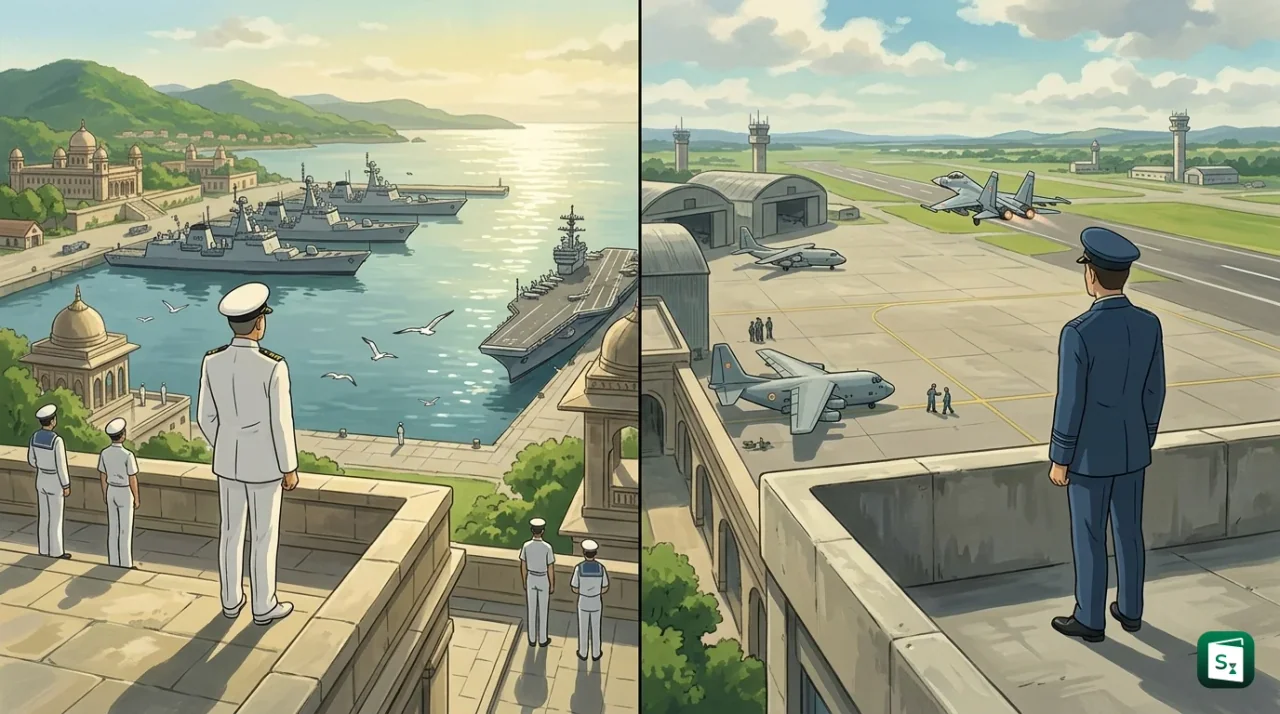
The Indian Navy and the Indian Air Force both saw a change of guard at their headquarters on 1 August 2026, with two three-star officers taking up the key staff appointments of Deputy Chief of the Naval Staff and Deputy Chief of the Air Staff. Vice Admiral AN Pramod assumed charge as the Deputy Chief of the Naval Staff (DCNS), succeeding Vice Admiral Tarun Sobti, while Air Marshal Tejpal Singh took over as the Deputy Chief of the Air Staff (DCAS), succeeding Air Marshal Awadhesh Kumar Bharti. Both officers bring more than three decades of operational experience to these pivotal roles, which sit just below the service chiefs in the military hierarchy.
The Appointments at a Glance
The two appointments were announced on the same day and follow the normal superannuation cycle of the armed forces. Both incoming officers were commissioned into their respective services in 1990, and both outgoing officers completed more than 38 years of distinguished service.
| Appointment | New Incumbent | Outgoing Officer | Date of Charge |
|---|---|---|---|
| Deputy Chief of the Naval Staff | Vice Admiral AN Pramod, AVSM, YSM | Vice Admiral Tarun Sobti, UYSM, AVSM, VSM | 1 August 2026 |
| Deputy Chief of the Air Staff | Air Marshal Tejpal Singh, AVSM, VM | Air Marshal Awadhesh Kumar Bharti, SYSM, AVSM, VM | 1 August 2026 |
Vice Admiral Tarun Sobti superannuated from service on 31 July 2026, while Air Marshal Awadhesh Kumar Bharti retired the same day after 39 years of service. Both the DCNS and DCAS are held by officers in the three-star rank and are among the most important staff positions in their respective services.
Vice Admiral AN Pramod: A Naval Aviator at the Helm
Vice Admiral AN Pramod was commissioned into the Indian Navy on 1 July 1990 after completing the 38th Integrated Cadet Course at the Naval Academy, Goa. He is a specialist in Communication and Electronic Warfare and qualified as a CAT A Sea King Air Operations Officer, a designation that marks him as an expert naval aviator.
His career, spanning more than 36 years, has covered command, operational, instructional and staff appointments both afloat and ashore. He commanded warships including the anti-submarine warfare vessel INS Abhay, the amphibious assault ship INS Shardul, and the Shivalik-class stealth frigate INS Satpura. He also served as the Executive Officer of the guided missile destroyer INS Rajput and as the Fleet Operations Officer of the Western Fleet, participating in operations such as Operation Vijay in 1999 and Operation Parakram in 2001.
Ashore, he commanded the naval air station INS Utkrosh at Sri Vijaya Puram (formerly Port Blair), served on the faculty of the Defence Services Staff College, Wellington, and handled aircraft acquisition at Naval Headquarters. Before reaching flag rank, he held senior appointments at the Naval Academy, served as Assistant Chief of Naval Staff (Air) and as Flag Officer Commanding Maharashtra Naval Area (FOMA).
A Key Role in Operation Sindoor
Immediately before this appointment, Vice Admiral Pramod served as the Director General Naval Operations (DGNO) at Naval Headquarters from December 2023 to July 2026. In this role, he was closely involved in the planning, preparedness and operational readiness of the Indian Navy during Operation Sindoor, the military action launched in May 2025 in response to the terrorist attack at Pahalgam in Jammu and Kashmir.
Operation Sindoor saw the Indian Navy deploy around 36 ships, including a carrier battle group, into the North Arabian Sea, effectively confining the Pakistan Navy to its ports. For his role in shaping these naval operations, Vice Admiral Pramod was awarded the Yudh Seva Medal in 2025, and he had earlier received the Ati Vishisht Seva Medal in 2024. He was also involved in conducting maritime security operations during the ongoing West Asia crisis.
The Role of the Deputy Chief of the Naval Staff
The Deputy Chief of the Naval Staff (DCNS) is a Principal Staff Officer at Naval Headquarters in New Delhi, reporting directly to the Chief of the Naval Staff (CNS), the professional head of the Indian Navy. The appointment is held by a three-star officer in the rank of Vice Admiral.
The DCNS heads the Staff Branch-II at Naval Headquarters, which oversees several key directorates. These include the Director General Naval Operations (the post Vice Admiral Pramod himself held earlier), naval intelligence and foreign cooperation, naval aviation, and air materiel. In effect, the DCNS is responsible for the operational, intelligence and air-related planning of the Navy, working closely with the Vice Chief of the Naval Staff, who runs the overall day-to-day functioning of the service.
Historically, the post was first established in the 1950s as the deputy commander-in-chief of the Royal Indian Navy, was upgraded to two-star rank in 1959 and redesignated as Vice Chief of the Naval Staff in 1967. It was revived as a separate three-star appointment in 1984. The DCNS ranks at No. 24 on the Indian order of precedence, alongside Lieutenant Generals of the Indian Army and Air Marshals of the Indian Air Force.
Air Marshal Tejpal Singh: A Test Pilot’s Ascent
Air Marshal Tejpal Singh was commissioned into the Indian Air Force (IAF) on 16 June 1990 as a fighter pilot. Over a career of more than 36 years, he has accumulated over 3,500 hours of flying experience, largely on MiG-21 series aircraft, and holds two of the most demanding qualifications in the profession: CAT A Qualified Flying Instructor (QFI) and Experimental Test Pilot.
On the day he took charge, he laid a wreath at the National War Memorial in New Delhi to pay homage to fallen servicemen, a customary gesture for officers assuming senior appointments. He has been decorated with the Vayu Sena Medal (awarded in January 2011) and the Ati Vishisht Seva Medal (awarded in January 2021).
From Flying Instructor to Staff Officer
After initial flying training, Air Marshal Singh served in various MiG-21 squadrons. In 1998, he was selected for the Qualified Flying Instructors Course and served as a QFI for two years, before being selected for the Flight Test Course in 2000. He then worked for four years as an experimental test pilot at the Aircraft and Systems Testing Establishment (ASTE) in Bengaluru, where he was involved in evaluating electronic warfare suites and testing the Su-30 MKI fighter aircraft during its induction.
His command and staff career includes commanding No. 23 Squadron at Suratgarh, serving as Air Officer Commanding of No. 11 Wing at Tezpur, and acting as Defence Attaché at the Indian Embassy in Israel. He also served as Air Assistant to the Chief of the Air Staff and, more recently, as Commandant of ASTE and Assistant Chief of the Air Staff (Plans) at Air Headquarters. He took over as the 50th Deputy Chief of the Air Staff.
The Role of the Deputy Chief of the Air Staff
The Deputy Chief of the Air Staff (DCAS) is a Principal Staff Officer at Air Headquarters in New Delhi, reporting to the Chief of the Air Staff (CAS), the professional head of the Indian Air Force. Like the DCNS, the appointment is held by a three-star officer in the rank of Air Marshal.
The DCAS serves as one of the principal advisers to the CAS on operational planning, air defence and force structuring. The post has existed in some form since India’s independence, when Air Commodore Subroto Mukerjee was appointed the Deputy Air Commander of the Royal Indian Air Force in 1947. The appointment was formally designated as Deputy Chief of the Air Staff in 1949, and in 1968 it was upgraded to the three-star rank of Air Marshal. The DCAS also ranks at No. 24 on the Indian order of precedence.
Air Marshal Tejpal Singh succeeds Air Marshal Awadhesh Kumar Bharti, who superannuated on 31 July 2026 after 39 years of service. Air Marshal Bharti had led the Air Force’s contribution to Operation Sindoor in May 2025 and had been a strong advocate of self-reliance in defence manufacturing.
Why These Appointments Matter
These two appointments come at a time of significant transformation in India’s defence establishment. The Navy is led by Admiral Krishna Swaminathan, who took charge as the 27th Chief of the Naval Staff in May 2026, while the Air Force is headed by Air Chief Marshal Amar Preet Singh, the 28th Chief of the Air Staff. Both new deputy chiefs are experienced, operationally tested officers whose careers span critical decades of India’s military modernisation.
For the Navy, the appointment of a naval aviator and electronic warfare specialist as DCNS signals continued emphasis on naval aviation, network-centric operations and maritime domain awareness. The DCNS will oversee the Navy’s operational planning and air arm at a time when India is expanding its carrier capability, inducting new aircraft and strengthening its presence in the Indian Ocean Region.
For the Air Force, an experimental test pilot with deep knowledge of fighter aircraft and flight safety brings hands-on technical understanding to force planning. The DCAS will be central to the Air Force’s ongoing fleet modernisation, including the induction of indigenous aircraft like the Tejas and the operationalisation of advanced air defence systems. Both appointments also reflect the merit-based, seniority-driven system through which the Indian armed forces groom their future service chiefs, since officers who hold the DCNS and DCAS appointments are typically among the front-runners for higher commands.
Key Takeaways
- Vice Admiral AN Pramod assumed charge as the Deputy Chief of the Naval Staff (DCNS) on 1 August 2026, succeeding Vice Admiral Tarun Sobti.
- Air Marshal Tejpal Singh assumed charge as the Deputy Chief of the Air Staff (DCAS) on the same day, succeeding Air Marshal Awadhesh Kumar Bharti.
- Vice Admiral Pramod was commissioned into the Indian Navy on 1 July 1990 and is a specialist in Communication and Electronic Warfare and a CAT A Sea King Air Operations Officer.
- Before this appointment, Vice Admiral Pramod served as Director General Naval Operations and was closely involved in naval planning during Operation Sindoor of May 2025; he holds the Yudh Seva Medal and the Ati Vishisht Seva Medal.
- Air Marshal Tejpal Singh was commissioned as a fighter pilot on 16 June 1990, has over 3,500 hours of flying experience, and is both a CAT A Qualified Flying Instructor and an Experimental Test Pilot.
- Both the DCNS and the DCAS are three-star appointments held at Naval Headquarters and Air Headquarters in New Delhi, ranking at No. 24 on the Indian order of precedence.