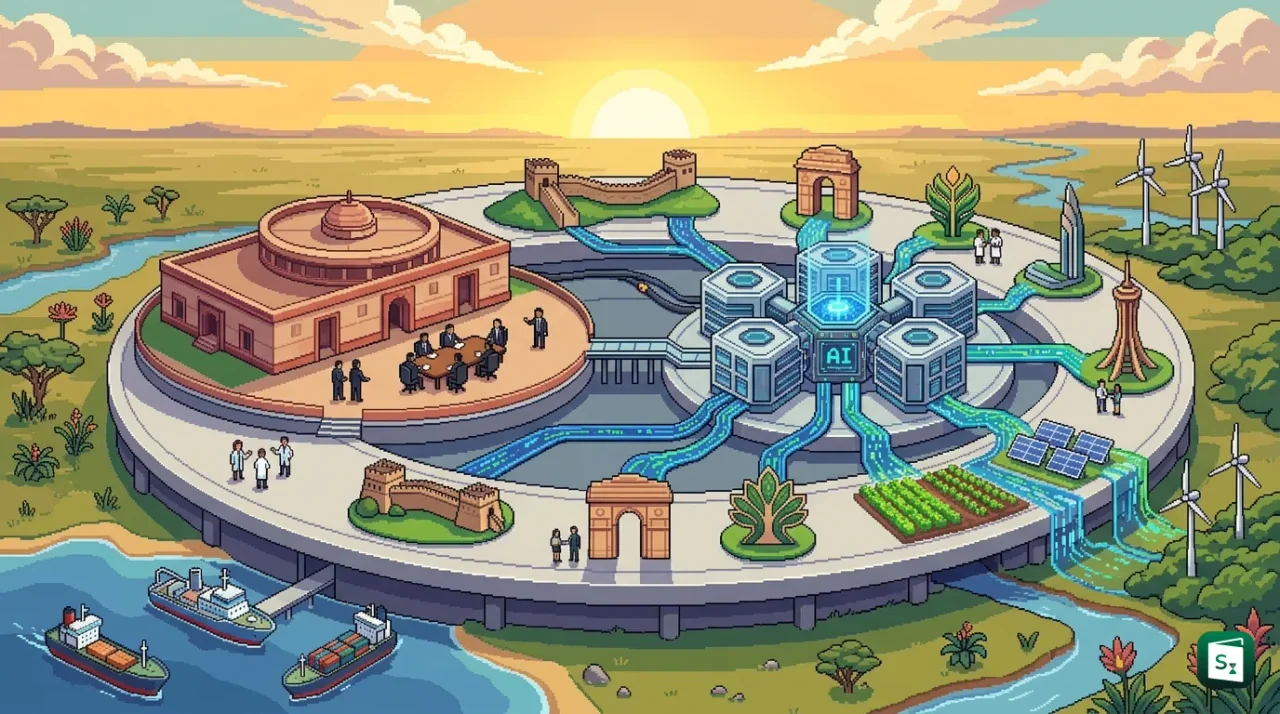
India convened two major BRICS meetings in July 2026 as part of its year-long chairmanship of the grouping. The second meeting of the BRICS Science Academies Forum 2026 was held at the Indian Institute of Technology (IIT) Hyderabad under the theme “Harnessing Artificial Intelligence for Sustainable Development and Strengthening Global South Cooperation”. Around the same time, India also hosted the BRICS Ministers of Interior Meeting in New Delhi.
India’s 2026 BRICS Chairship
India assumed the rotating chairmanship of BRICS, an intergovernmental grouping of major emerging economies, on 1 January 2026, succeeding Brazil. This is India’s fourth chairship, following earlier tenures in 2012, 2016 and 2021. The term BRIC was first coined in 2001 by economist Jim O’Neill of Goldman Sachs, and the grouping was formalised when the foreign ministers of Brazil, Russia, India and China met on the margins of the United Nations General Assembly in New York in 2006. The first BRIC summit was held in Yekaterinburg, Russia, in 2009, and South Africa joined in 2011, turning the acronym into BRICS.
The grouping has since expanded to 11 member countries: Brazil, Russia, India, China, South Africa, Egypt, Ethiopia, Iran, Saudi Arabia, the United Arab Emirates and Indonesia. In 2025, ten more countries, including Belarus, Malaysia, Nigeria and Vietnam, joined as partner countries. Together, members account for over 40 per cent of the world’s population and a significant share of global economic output.
India’s 2026 chairship is guided by the theme “Building for Resilience, Innovation, Cooperation and Sustainability”, a people-centric and humanity-first approach outlined by the Prime Minister at the 2025 Rio Summit. The chairship rests on four pillars: Resilience, Innovation, Cooperation and Sustainability. As part of this mandate, India is hosting a full calendar of ministerial, working-group and people-to-people meetings, culminating in the 18th BRICS Summit scheduled in New Delhi on 12-13 September 2026. The two July meetings are among the key events leading up to that summit.
What Is the BRICS Science Academies Forum?
The BRICS Science Academies Forum is a platform that brings together the national science academies of BRICS countries to discuss shared scientific priorities, foster research collaboration and provide evidence-based inputs to the broader BRICS agenda on Science, Technology and Innovation (STI). STI cooperation has become one of the strongest pillars of BRICS engagement, supported by a well-developed institutional machinery that includes the annual STI Ministerial Meeting, Senior Officials Meetings, working groups and the BRICS STI Framework Programme, a coordinated mechanism that funds multilateral research consortia.
The forum is being organised under India’s 2026 chairship by the Indian National Science Academy (INSA). INSA, established in January 1935 as the National Institute of Sciences of India, is the apex scientific academy of the country, headquartered in New Delhi, and acts as a link between the scientific community and the government. It is also India’s representative in international science bodies.
The 2026 forum is being held in two parts. The first meeting was convened virtually on 8 June 2026, bringing together academies from ten nations to begin work on a draft declaration on responsible and equitable AI development. The second meeting, held in person at IIT Hyderabad, was organised to build on this draft and finalise a consensus statement.
The Forum at IIT Hyderabad
The two-day in-person forum, held on 22-23 July 2026, brought together delegations from seven BRICS member countries, including Brazil, China, Egypt, Ethiopia, Indonesia, Russia and South Africa, along with five partner countries, among them Nigeria, Vietnam, Belarus, Kazakhstan and Malaysia. The Indian National Science Academy (INSA) organised the meeting, which was hosted at the Indian Institute of Technology, Hyderabad, one of India’s leading technology institutions.
The deliberations centred on the “3Cs”, a Collective, Collaborative and Context-sensitive approach to AI. Participants explored how artificial intelligence can be put to practical use in areas where developing countries face the most acute challenges, rather than merely replicating the large-language-model race dominated by the developed world.
Five Priority Verticals for AI Collaboration
The forum identified five priority verticals for joint AI-driven work:
| Priority Area | Focus |
|---|---|
| Advanced Materials and Manufacturing | Accelerating materials discovery, smart manufacturing and supply-chain optimisation |
| Healthcare | Better clinical decision-making, population-scale screening and health research |
| Climate Change and Environmental Sustainability | Long-term forecasting, integrating AI with physical models and risk mitigation |
| Agriculture and Food Security | AI-powered advisories, faster seed research and digital public infrastructure |
| Disaster Prediction and Management | Stronger forecasting, seismic analysis and resource optimisation in emergencies |
Country delegations presented their national perspectives. The Chinese Academy of Sciences stressed data sharing and evidence-based policymaking aligned with the Sustainable Development Goals, while the Russian Academy of Sciences argued for trusted AI systems backed by strong ethics and transparency. South Africa focused on narrowing the digital divide, Egypt called for capacity building and a dedicated BRICS AI network, and several partners underlined concerns around linguistic diversity, local data, employment and cyber safety.
The Road to the Joint Statement
The closing day featured an open discussion on a Joint Statement, chaired by the INSA President, where the academies finalised a consensus communique reflecting their shared recommendations. The statement, expected to be endorsed within a week of the meeting, was slated to be presented at the BRICS Science, Technology and Innovation Ministerial Meeting in August 2026.
The forum’s underlying concern is the growing concentration of AI capability in a handful of advanced economies. A draft declaration on AI for Science and Sustainable Development, presented at the first virtual meeting, highlighted the widening digital divide and called for shared computing infrastructure, collaborative data platforms and multilingual AI models. Participants also agreed on the value of smaller, task-oriented models in high-stakes fields, where a small error can carry heavy consequences.
BRICS Ministers of Interior Meeting
Around the same time, India hosted the BRICS Ministers of Interior Meeting in New Delhi, bringing together the interior and home ministers of BRICS member countries. The meeting focused on strengthening coordination on security, counter-terrorism, combating organised crime and cybersecurity, alongside other shared challenges such as border management, drug trafficking and disaster response. It reflects the growing weight of the security pillar within BRICS cooperation, complementing the track on political and security affairs that also includes the National Security Advisers’ meeting and various joint working groups.
The gathering drew particular attention because of the conflict in West Asia. The Iranian interior minister, attending the meeting, used the platform to call on BRICS members to adopt a clear and firm position condemning attacks on national sovereignty, civilians and critical infrastructure. This came at a time when the bloc has struggled to reach a common line on the conflict, with both Iran and the United Arab Emirates, now members of the grouping, directly affected by it. The meeting’s agenda, however, was anchored on functional security cooperation among law enforcement agencies, an area where member states have historically found it easier to agree than on geopolitics.
The New Delhi meeting was part of a dense cluster of BRICS security-related events hosted by India during its chairship year. In June 2026, India chaired the 16th BRICS National Security Advisers’ Meeting, which discussed non-traditional security challenges such as energy and food security. In July 2026, India also hosted the BRICS Heads of Anti-Drug Agencies meeting in Guwahati, the BRICS Ministerial Meeting on Disaster Risk Reduction and the BRICS Health Ministers’ Meeting in Chandigarh. Together, these meetings illustrate how India is using its chairship to deepen practical, results-oriented cooperation across a wide agenda.
Why Science and Security Diplomacy Matter
The two meetings underline a central theme of India’s chairship: building a voice for the Global South in areas where the international system has left developing countries on the margins. On the science side, the forum is a direct attempt to prevent an AI divide from hardening into a permanent handicap for developing economies. By pooling research, data and infrastructure, BRICS academies hope that AI can accelerate scientific discovery in fields such as drug development, climate modelling and materials science, with benefits that reach their populations rather than only a few technology companies.
This is also significant for India’s own scientific standing. INSA, as the host academy, positions India as a convenor of multilateral science diplomacy, a role the country has exercised since its G20 presidency in 2023. Hosting the forum at IIT Hyderabad, a young and rapidly growing institution, signals India’s confidence in its higher-education and research ecosystem.
On the security side, the interior ministers’ meeting reflects the expansion of BRICS from an economic club into a forum that addresses shared law-enforcement concerns. For India, cooperation on terrorism, organised crime and cyber threats matters practically: transnational criminal and terror networks do not respect borders, and intelligence-sharing arrangements with other large developing countries offer an additional layer of protection. The meetings also carry geopolitical weight, because they keep channels of communication open among countries with sharp differences elsewhere, including over the West Asia conflict.
Both tracks feed into the 18th BRICS Summit in New Delhi in September 2026. The success of the chairship will be judged not just by the leaders’ declarations but by whether the various ministerial tracks, from science to security, produce mechanisms that outlast India’s year at the helm. The July meetings suggest India is working towards that outcome, one sector at a time.
Key Takeaways
- The 2nd BRICS Science Academies Forum 2026 was held on 22-23 July 2026 at IIT Hyderabad under the theme “Harnessing Artificial Intelligence for Sustainable Development and Strengthening Global South Cooperation”.
- The forum was organised by the Indian National Science Academy (INSA), established in January 1935, which is headquartered in New Delhi.
- India hosts the 18th BRICS Summit in New Delhi on 12-13 September 2026 under the chairship theme “Building for Resilience, Innovation, Cooperation and Sustainability”.
- India assumed the BRICS chairmanship on 1 January 2026, its fourth tenure after 2012, 2016 and 2021; the group now has 11 members and 10 partner countries.
- The BRICS Ministers of Interior Meeting in New Delhi focused on counter-terrorism, combating organised crime and cybersecurity.
- The BRIC acronym was coined in 2001 by Jim O’Neill; the first summit was held at Yekaterinburg, Russia, in 2009.