Prime Minister Narendra Modi launched the Nasha Mukt Yuva for Viksit Bharat Sankalp Abhiyan on 2 August 2026, a nationwide campaign to free the country’s youth from substance abuse. Structured as a 100-week Jan Bhagidari movement, the initiative will run sustained weekly activities every Sunday over nearly two years. The launch coincided with more than one crore young people taking the Nasha Mukti Pledge at roughly 10,000 locations across the country, making it one of India’s largest youth-led public campaigns against drugs.
What Is the Nasha Mukt Yuva for Viksit Bharat Sankalp Abhiyan?
The Nasha Mukt Yuva for Viksit Bharat Sankalp Abhiyan translates to the “Drug-Free Youth for Developed India Resolution Campaign”. It is a government-led public movement designed to eliminate substance abuse among young Indians and turn the fight against drugs into a mass people’s movement rather than a routine awareness programme.
The word Sankalp in the name means a firm resolve or pledge, and it captures the campaign’s core idea: a long-term, community-owned commitment rather than a one-time event. Viksit Bharat refers to the national goal of making India a developed nation by 2047, and the campaign treats a healthy, drug-free youth population as an essential condition for that goal.
The campaign is anchored by Mera Yuva Bharat (MY Bharat), the national digital platform for youth engagement, and operates under the Ministry of Youth Affairs and Sports. The ministry, headed by Union Minister Dr. Mansukh Mandaviya, oversees the platform and coordinates the nationwide activities of the movement.
From a Kashi Pilot to a National Movement
The national campaign did not emerge overnight. It grew out of a pilot project started in Varanasi (Kashi) in 2025, the Prime Minister’s parliamentary constituency, under the same name. The pilot was built on the Kashi Declaration, adopted on 20 July 2025 at the Youth Spiritual Summit held in Varanasi.
That summit brought together more than 600 youth leaders and representatives of over 120 spiritual and socio-cultural organisations. The declaration framed substance abuse as a multi-faceted public health and societal challenge and called for a whole-of-government and whole-of-society response, weaving together spiritual, cultural, educational and technological efforts. It also proposed institutional mechanisms such as a joint national committee, annual progress reporting and a national platform linking affected individuals to support services.
From that foundation in Kashi, the initiative expanded with the backing of more than 125 spiritual organisations, non-governmental organisations, youth clubs and industry associations. The Prime Minister described these groups as partners working for the welfare of crores of citizens, and said the Kashi pilot had now evolved into a full national movement under what is referred to as the Kashi Declaration framework.
The Launch on 2 August 2026
The Prime Minister inaugurated the campaign on 2 August 2026 through video conferencing, addressing young participants gathered at over 28,000 connected locations across the country. Union Minister Dr. Mansukh Mandaviya appealed to young people and social organisations to join the movement in the national interest.
In his address, the Prime Minister said substance abuse pushes young people away from their dreams and that a developed India requires a physically fit, mentally strong and self-confident generation free from destructive habits. He described India’s young population as the “Amrit Peedhi”, or the nectar generation, and said their energy, innovation and talent would be crucial to realising the goal of a developed India by 2047.
The Prime Minister warned that drugs destroy careers, weaken families and ultimately harm the nation’s progress, and that hostile forces can use narcotics as a weapon to weaken the country’s future. He urged parents not to conceal a child’s addiction for fear of social prestige but to seek timely medical help, and called on college and university teachers to lead anti-drug campaigns on campuses.
The Nasha Mukti Pledge
A defining feature of the launch was the Nasha Mukti Pledge, a mass pledge against substance abuse. More than one crore youth took the pledge simultaneously at nearly 10,000 locations, reaffirming their commitment to a drug-free society and dedicating themselves as Nasha Mukta Yuva Volunteers.
The pledge was also made available online through the MY Bharat platform, allowing young citizens anywhere in the country to participate digitally. Those taking the pledge are encouraged to act as ambassadors of positive social change in their schools, colleges and communities.
Who Is Driving the Campaign?
The movement draws on a wide network of participants. MY Bharat volunteers and affiliated youth clubs form its core field force, supported by National Service Scheme (NSS) volunteers and NSS-affiliated schools, colleges and universities. Non-governmental organisations, industrial associations and more than 125 spiritual organisations complete the coalition.
This institutional breadth makes the campaign one of the largest youth-led anti-substance public movements the country has seen, connecting government structures with civil society and faith-based organisations at every level.
How the 100-Week Campaign Will Unfold
The campaign is deliberately designed as a sustained movement, not a short-lived drive. For the next 100 weeks, youth-led activities will be organised across the country every Sunday, which the Prime Minister described as the coming 100 strong steps toward a completely drug-free India.
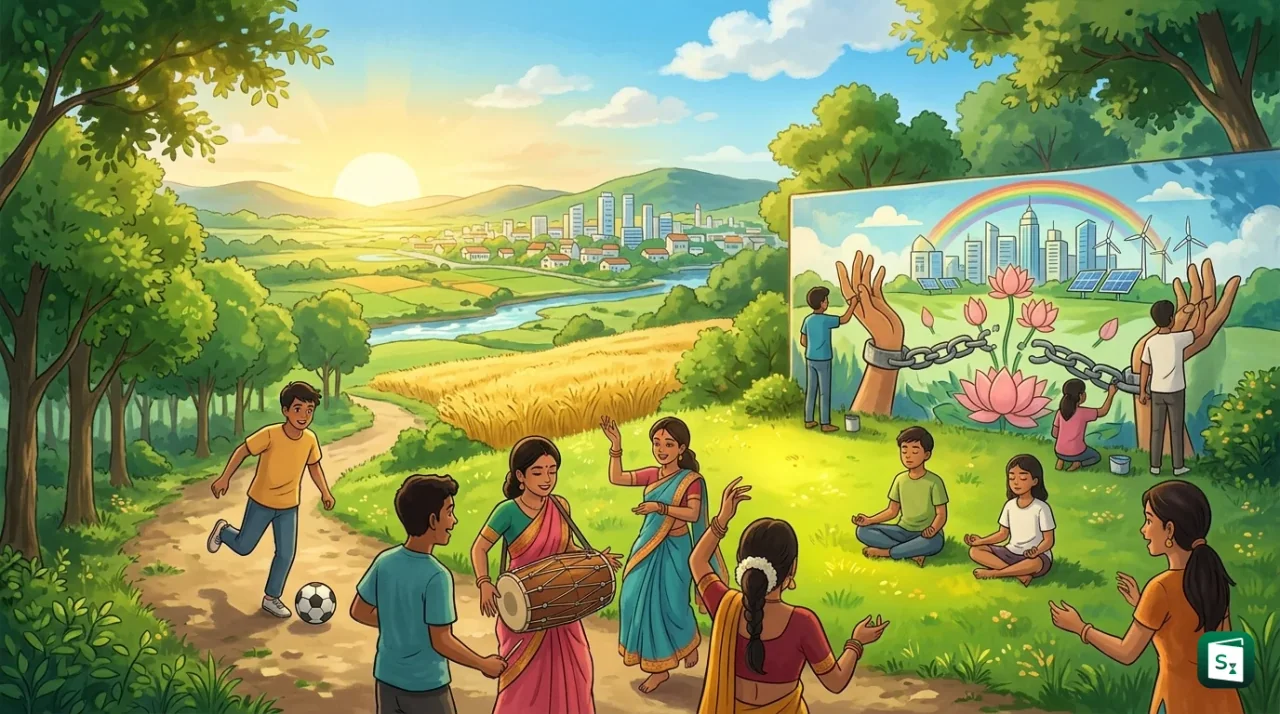
Each Sunday is expected to feature a rotating mix of activities aimed at encouraging healthy lifestyles and channelling youthful energy into constructive nation-building:
| Activity Type | Purpose |
|---|---|
| Sports competitions and walkathons | Promote physical fitness and healthy recreation |
| Meditation sessions | Strengthen mental wellness and self-control |
| Cultural programmes and art competitions | Engage creativity and local traditions |
| Nukkad nataks (street plays) | Spread awareness in communities through street theatre |
| Awareness drives and community engagement | Sensitise society on the harms of substance abuse |
To reward sustained participation, volunteers and organisations making outstanding contributions will be honoured at the 50th, 75th and 100th week milestones of the campaign. These recognition points are meant to keep the movement alive over the long run and reinforce the spirit of public service and collective responsibility.
The Parent Initiative: Nasha Mukt Bharat Abhiyan
The new campaign sits within a broader, older anti-drug architecture. The Nasha Mukt Bharat Abhiyan (NMBA), or Drug-Free India Campaign, was launched by the Ministry of Social Justice and Empowerment on 15 August 2020 to combat the demand for drugs in the country.
NMBA began by targeting 272 districts identified as most vulnerable to drug addiction, based on data on drug availability, consumption and trafficking. It coordinates a full chain of services: prevention, assessment, treatment, rehabilitation, aftercare, public information dissemination and community awareness.
The Abhiyan has since expanded nationwide. Official figures show it has reached over 29.24 crore individuals, including more than 11.15 crore youth and 7.89 crore women, while undertaking outreach activities in lakhs of educational institutions. NMBA also runs the national drug de-addiction helpline 14446, which citizens can call for guidance and support on addiction.
There are important distinctions between the two initiatives. NMBA is a social justice ministry programme focused on prevention, treatment and rehabilitation services. The new Nasha Mukt Yuva for Viksit Bharat Sankalp Abhiyan is a youth affairs ministry campaign built on mass public mobilisation, with the MY Bharat platform as its operational spine and spiritual and community organisations as its partners. The two work together: the older scheme provides the treatment and rehabilitation machinery, while the new movement supplies the people’s movement and awareness push.
How Widespread Is Substance Abuse in India?
The scale of the problem explains why a mass movement has been deemed necessary. The National Survey on Extent and Pattern of Substance Use in India (2019), conducted for the Ministry of Social Justice and Empowerment, remains the most comprehensive estimate of substance use in the country.
Key findings of the survey:
- About 16 crore people (14.6% of the population aged 10 to 75) are current users of alcohol, making it the most widely consumed substance in India.
- Around 3.1 crore people (2.8% of the population) are current users of cannabis, with about 72 lakh needing help for cannabis-related problems.
- Roughly 2.06% of the population uses opioids, and nearly 60 lakh people require treatment services for opioid dependence.
- About 1.18 crore people are current users of sedatives without medical prescription.
- Approximately 18 lakh children need help for inhalant use, and the rate of inhalant use among children and adolescents is markedly higher than among adults.
- An estimated 8.5 lakh people inject drugs, a group especially vulnerable to blood-borne infections such as HIV and hepatitis.
Two patterns stand out for policymakers. First, substance use is a public health issue as much as a law-and-order one, since a large share of users are dependent and need treatment rather than punishment. Second, children and adolescents are a critical risk group, because early initiation is linked to higher dependence and lifelong harm. India’s young demographic profile, with roughly 65% of the population below 35 years of age, multiplies the stakes of prevention.
The Government’s Anti-Drug Framework
The awareness campaign is one pillar of a broader national strategy that combines demand reduction, supply reduction and enforcement. India’s approach to drugs rests on the Narcotic Drugs and Psychotropic Substances (NDPS) Act, 1985, the country’s primary law on drugs, enacted in keeping with India’s obligations under the three United Nations drug conventions.
Supply-side enforcement is led by the Narcotics Control Bureau (NCB), the central nodal agency created on 17 March 1986 under the Ministry of Home Affairs to combat drug trafficking. Coordination across states is managed through the NCORD (Narco-Coordination Centre) mechanism, a four-tier structure that links national, state, district and police-station-level agencies to curb trafficking.
The National Action Plan for Drug Demand Reduction (NAPDDR) translates this framework into services. Implemented by the National Institute of Social Defence (NISD), an autonomous body under the Ministry of Social Justice and Empowerment, NAPDDR funds awareness generation, counselling, treatment and rehabilitation of drug-dependent persons, with a community-based prevention approach.
This is where the new campaign fits. Enforcement alone cannot solve a problem rooted in demand. By mobilising youth, families, educational institutions and spiritual organisations, the Sankalp Abhiyan aims to reduce the demand side of the equation, while enforcement agencies continue to attack the supply side. The Prime Minister reaffirmed this dual approach, assuring the youth that the government would continue its nationwide crackdown on drug traffickers and smugglers even as it expands awareness work.
Significance: Youth, Viksit Bharat and National Security
The campaign’s significance runs across several dimensions. First, it treats the fight against drugs as a social movement rather than a bureaucratic programme. The reliance on peer-to-peer mobilisation through volunteers, youth clubs and spiritual organisations is designed to make awareness self-sustaining, with young people acting as messengers to their own peers.
Second, the campaign is tied directly to the Viksit Bharat 2047 vision. India’s case for becoming a developed nation rests on its demographic dividend, the economic advantage that flows from having a large, young workforce. Substance abuse erodes exactly this asset by lowering productivity, straining health systems and burdening families with avoidable expenditure. A drug-free generation is therefore a prerequisite for the country’s long-term economic ambitions.
Third, the campaign has a national security dimension. The Prime Minister’s remark that narcotics can be used by hostile forces as a weapon reflects the recognition that drug money and trafficking networks are linked to terrorism, cross-border smuggling and organised crime, particularly along India’s borders. Seizures by the Narcotics Control Bureau and other agencies in recent years have involved large quantities of narcotics worth thousands of crores, underscoring the scale of the trafficking threat.
The social dimension is equally important. Addiction carries heavy stigma in Indian society, which often drives families to conceal the problem instead of seeking help. By normalising open conversation, rehabilitation and respect for those who recover, the campaign seeks to shift social attitudes and reduce the shame that keeps addicts from treatment.
The Way Forward
The success of the campaign will ultimately depend on whether the Sunday activities translate into lasting behavioural change. Sustained engagement is the campaign’s central wager: 100 weeks of continuous activity is intended to build habits, create peer accountability and keep the issue in public consciousness far longer than a conventional awareness drive would.
For that to happen, the movement needs measurable outcomes. A critical test will be whether the Nasha Mukti Pledge leads to real participation on the ground, whether the weekly activities maintain momentum beyond the early weeks, and whether volunteers are genuinely mobilised through the MY Bharat platform. The recognition planned at the 50th, 75th and 100th week milestones provides an incentive structure for long-haul commitment.
The campaign must also link awareness to services. Awareness messages only become effective when people who seek help can actually find it, which is why the existing helpline 14446, rehabilitation centres and the treatment machinery of NMBA remain essential complements. The government’s strategy is explicitly two-track: reduce demand through movements like this, while strengthening supply-side enforcement and treatment capacity.
If sustained, the campaign has the potential to become a durable feature of India’s social policy landscape, much as NMBA has since 2020. It carries forward the vision that a healthy, confident and disciplined generation is not just a social good but a foundation stone of the developed India that the country aims to become by 2047.
Key Takeaways
- The Nasha Mukt Yuva for Viksit Bharat Sankalp Abhiyan was launched by PM Narendra Modi on 2 August 2026 as a 100-week Jan Bhagidari movement against substance abuse.
- More than one crore youth took the Nasha Mukti Pledge at nearly 10,000 locations, with participants connected from over 28,000 locations through video conferencing.
- The campaign grew from a pilot project in Varanasi (Kashi) built on the Kashi Declaration, adopted on 20 July 2025 at the Youth Spiritual Summit.
- Weekly activities every Sunday over 100 weeks include sports, walkathons, meditation, cultural programmes, street plays (nukkad nataks) and awareness drives.
- The Nasha Mukt Bharat Abhiyan (NMBA), launched by the Ministry of Social Justice and Empowerment on 15 August 2020, began in 272 vulnerable districts and has reached over 29.24 crore individuals.
- The NDPS Act, 1985 is India’s primary drug law, and the Narcotics Control Bureau (NCB), created on 17 March 1986 under the Ministry of Home Affairs, leads supply-side enforcement.