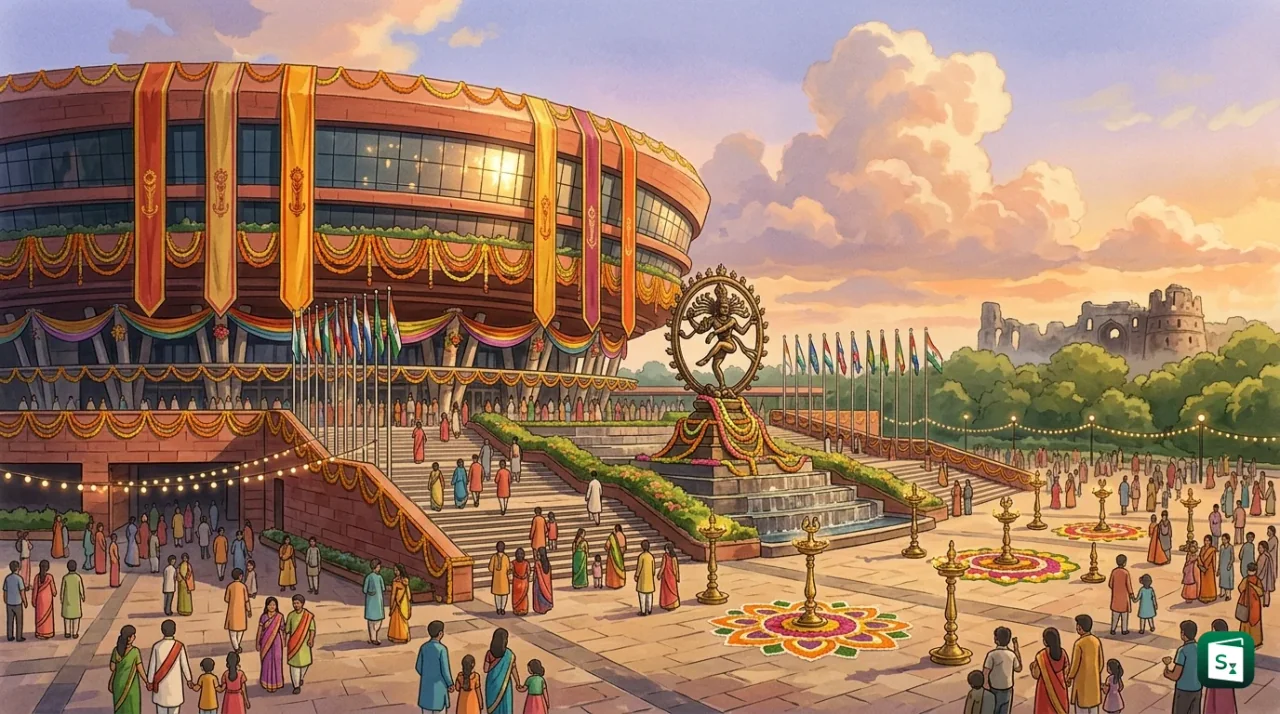
Prime Minister Narendra Modi inaugurated the Chinmaya Amrit Mahotsav Global Sammelan at Bharat Mandapam in New Delhi on 23 October 2026. The three day gathering, held from 23 to 25 October, brought together more than 9,000 participants from India and abroad. It marked the finale of year long celebrations for the 75th anniversary of Chinmaya Mission, founded in 1951 to make Vedanta and the Bhagavad Gita accessible to all.
What Is Chinmaya Mission?
The Chinmaya Mission is an international spiritual organisation devoted to the study and teaching of Vedanta, the school of Hindu philosophy based on the Vedas, the Upanishads and the Bhagavad Gita. Vedanta explores the nature of the self, reality and ultimate truth. The word Chinmaya means pure Knowledge in Sanskrit.
The work began with public talks called Jnana Yajnas. Jnana means wisdom and Yajna means sacred offering, so a Jnana Yajna is an offering of knowledge through scriptural lectures. The first such series began in Pune in December 1951. On 8 August 1953, devotees in Madras, now Chennai, formed the Chinmaya Mission to carry this teaching forward.
The Mission is guided by the motto “To give maximum happiness to the maximum number for the maximum time.” It is administered by the Central Chinmaya Mission Trust (CCMT), registered in Mumbai on 27 June 1964 and headquartered at Sandeepany Sadhanalaya in Powai, Mumbai. The Mission now runs more than 300 centres in India and abroad. After Swami Chinmayananda, leadership passed to Swami Tejomayananda from 1993 to 2017, and then to the present global head Swami Swaroopananda in January 2017.
Who Was Swami Chinmayananda?
Swami Chinmayananda Saraswati, born Balakrishna Menon on 8 May 1916 in Ernakulam in Kerala, founded the Chinmaya movement. He studied English literature, law and journalism, worked as a journalist and took part in the freedom struggle against British rule. His search for purpose led him to Swami Sivananda, founder of the Divine Life Society at Rishikesh.
Swami Sivananda initiated him into sannyasa, the monastic order, on 25 February 1949 and gave him the name Chinmayananda, which means filled with the bliss of pure Consciousness. He then sent him to study Advaita Vedanta under Swami Tapovan Maharaj at Uttarkashi in the Himalayas. Advaita Vedanta teaches the oneness of the individual self and ultimate reality.
Swami Chinmayananda began teaching scriptures in simple English with logic, humour and daily life examples. He conducted 576 Jnana Yajnas across India and the world between 1951 and 1993. He started his first global tour in March 1965, covering 39 cities in 18 countries. To organise work abroad, Chinmaya Mission West was set up in 1975. His best known writings include his verse by verse commentary The Holy Geeta on the Bhagavad Gita.
He launched the Gita Jnana Yajna to take the Upanishads and Vedanta to ordinary households. He opened Sandeepany Sadhanalaya at Powai in Mumbai in 1963 to train Vedanta teachers, called Acharyas. He also gave the first financial contribution for the Vivekananda Rock Memorial at Kanyakumari. He attained Mahasamadhi, the passing of a realised monk, on 3 August 1993 in San Diego in the United States.
What Happened at the Chinmaya Global Sammelan in New Delhi?
Prime Minister Narendra Modi inaugurated the Sammelan at 11 AM on 23 October 2026 at Bharat Mandapam and addressed the gathering. The three day Sammelan, held from 23 to 25 October 2026, brought together Acharyas, scholars, devotees, youth volunteers and families. Organisers expected more than 9,000 people from India and abroad. The programme included discourses, Vedic chanting, discussions on non dualism, the Chinmaya Experience Exhibition and cultural performances.
The Prime Minister described the Chinmaya Mission as living thought rather than a mere institution. He said its decades long journey had been full of sacred resolves, and what is Chinmaya is naturally immortal and full of eternal nectar. A striking moment was his interaction with a Holobot, a 3D holographic presence, of Swami Chinmayananda. The Prime Minister said the experience took him back 33 years to his meeting with Swami Chinmayananda at Vadodara in February to March 1993, when he had gone to invite him to Chicago for the centenary of the Parliament of the World Religions, held 100 years after Swami Vivekananda’s historic 1893 address.
Swami Chinmayananda worked hard to gather support across America for the Chicago event but passed away weeks before it. The Prime Minister recalled that his final conversation with Swami Chinmayananda centred on building youth power for a strong and capable India. He praised 15 young members of Chinmaya Yuva Kendra who had travelled more than 40,000 km over 300 days and met over one lakh youth in the run up to the Sammelan.
Why Bharat Mandapam Hosted the Finale
Bharat Mandapam is the International Exhibition cum Convention Centre (IECC) complex at Pragati Maidan in central New Delhi. The Prime Minister dedicated it to the nation on 26 July 2023. Built at a cost of about ₹2,700 crore with a campus of nearly 123 acres, it is India’s largest meeting, conference and exhibition destination. Its plenary and multipurpose halls together seat about 7,000 people. The centre hosted the G20 Leaders Summit in September 2023. Its shape draws from the Shankha, or conch shell, and its walls depict Surya Shakti, Pancha Mahabhuta and achievements from Zero to ISRO.
Year Long Road to the 75th Anniversary
The Delhi Sammelan closed a full year of celebrations called Chinmaya Amrit Mahotsav. The year long programme was formally launched on 1 January 2026 at Chinmaya Vibhooti, the vision centre of the Mission, by Swami Swaroopananda. The celebrations had in fact begun the previous year, when the Prime Minister released a Tamil versification of the Bhagavad Gita, produced by the Mission with music by Ilaiyaraaja, at Gangaikonda Cholapuram in Tamil Nadu.
| Initiative | What It Covered |
|---|---|
| Chinmaya Gita Samarpanam | More than one lakh people across the world chanted Chapter 15 of the Bhagavad Gita, called Purushottama Yoga, together online |
| Gita Panchamrit | Daily study of five select verses of the Bhagavad Gita to bring its message into homes |
| Chinmaya Amrit Yatra | 15 youth volunteers of Chinmaya Yuva Kendra travelled over 40,000 km across India, holding talks, cultural shows and youth meets |
| Samashti Hanuman Chalisa Havan | Mass fire offerings with collective chanting of the Hanuman Chalisa at many centres in India and abroad |
| Maa Soundarya Chinmayi Temple | Consecration of the new temple in Tripura during the anniversary year |
| Dialogues and conclaves | Talks with spiritual teachers, Vedic chanting by Brahmacharis and a conclave on Advaita, or non dualism, for global understanding |
Chapter 15 is significant because it describes the imperishable supreme self through the image of the inverted Peepal tree. Chapter 12, also widely chanted in Mission programmes, is the Bhakti Yoga chapter on devotion. Together, these mass chantings linked families, children and overseas centres to a single text.
How the Mission Spreads Vedanta and Bhagavad Gita
The Prime Minister noted that more than 100 Chinmaya educational institutions now shape the lives of lakhs of students. These schools and colleges teach modern subjects along with Indian values. This network is only one part of a wider system built to take scriptures to every age group.
Bala Vihar gathers children every week to learn values through stories from scriptures, songs and activities. Chinmaya Yuva Kendra (CHYK), started in May 1975 after a youth camp in Bengaluru, carries the work to youth through camps, treks, theatre, music and social service. Adults join Study Groups of 10 to 15 members that meet weekly for about 90 minutes, and Devi Groups for women seekers. Home study courses on Vedanta allow distant learners to continue when teachers travel.
Those who wish to teach join Sandeepany Sadhanalaya, the residential Vedanta academy. Students observe celibate study for two years and train as Brahmacharis and Acharyas. For deeper research, the Chinmaya International Foundation (CIF) works at Adi Sankara Nilayam at Veliyanad in Ernakulam district of Kerala, the maternal home of Adi Shankaracharya. Swami Chinmayananda proposed the centre during a 1992 lecture tour of 12 American universities.
Higher education is anchored by Chinmaya Vishwa Vidyapeeth, set up in 2016 in the birth centenary year of Swami Chinmayananda. Recognised by the University Grants Commission as a deemed to be university in the de novo category, it has headquarters at Veliyanad and a second campus at Kolwan near Pune called Chinmaya Naada Bindu Gurukula. Its motto is Global Mind, Indian Heart. It blends Sanskrit and Indian knowledge traditions with contemporary subjects such as management, psychology and technology.
Service runs alongside study. The Chinmaya Organisation for Rural Development (CORD), started in 1985 at Sidhbari in Himachal Pradesh, supports health, livelihoods and self help in villages. The Chinmaya Mission Hospital, opened in Bengaluru in 1970 and now a 200 bed hospital, provides modern care. The Mission has also built more than 58 temples in India and abroad.
Why the Sammelan Matters for Culture and National Goals
The Sammelan linked a spiritual milestone to national goals. The Prime Minister recalled the Vedic call Vayam Amritasya Putrah, which means we are the children of immortality. He said India has survived for millennia as a seeker of knowledge because its consciousness is undying. On the 75th anniversary of Independence, India had launched Azadi Ka Amrit Mahotsav. The Chinmaya Amrit Mahotsav now joins that Amrit Kaal, the 25 year journey to Viksit Bharat by 2047, when India completes 100 years of Independence.
Youth stood at the centre of this message. The Prime Minister said youth have remained at the heart of government policies through his 25 years as head of government, first as Chief Minister of Gujarat and then as Prime Minister. He called Mission youth cultural brand ambassadors who carry Indian values to the next generation. He urged all institutions to work for the common goals of national development, unity against divisive forces, self reliance and pride in heritage.
He placed the Mission work within a wider cultural revival. He cited the redevelopment of Kashi Vishwanath Dham, the Shri Ram Temple in Ayodhya, Mahakal Lok in Ujjain, and pilgrim centres at Kedarnath and Badrinath. He said cultural sites are increasingly joining the UNESCO World Heritage List. He added that more than 650 ancient idols and antiquities stolen from India have been brought back from abroad in the past 12 years.
Education policy formed the final link. The Prime Minister said the National Education Policy integrates Indian knowledge traditions, teaching in the mother tongue, modern science and technology. This matches the Mission model, where students receive modern education while imbibing Indian values. In his words, the centenary journey of the Chinmaya Mission and the journey of a developed India will move forward together.
Key Takeaways
- Prime Minister Narendra Modi inaugurated the Chinmaya Amrit Mahotsav Global Sammelan at Bharat Mandapam, New Delhi on 23 October 2026.
- The three day Sammelan from 23 to 25 October 2026 drew more than 9,000 participants and closed year long 75th anniversary celebrations of Chinmaya Mission.
- Chinmaya Mission began with a Jnana Yajna in Pune in December 1951 and was formally formed on 8 August 1953 by devotees of Swami Chinmayananda, born Balakrishna Menon in 1916 in Kerala.
- The Mission is run by the Central Chinmaya Mission Trust in Mumbai and is led by global head Swami Swaroopananda since January 2017, with more than 300 centres and over 100 educational institutions.
- Anniversary initiatives included Chinmaya Gita Samarpanam, where over one lakh people chanted Chapter 15 of the Bhagavad Gita, and the Chinmaya Amrit Yatra by 15 youth covering 40,000 km.
- Chinmaya Vishwa Vidyapeeth, set up in 2016 at Veliyanad in Kerala, is a deemed to be university that blends Indian knowledge traditions with modern subjects.