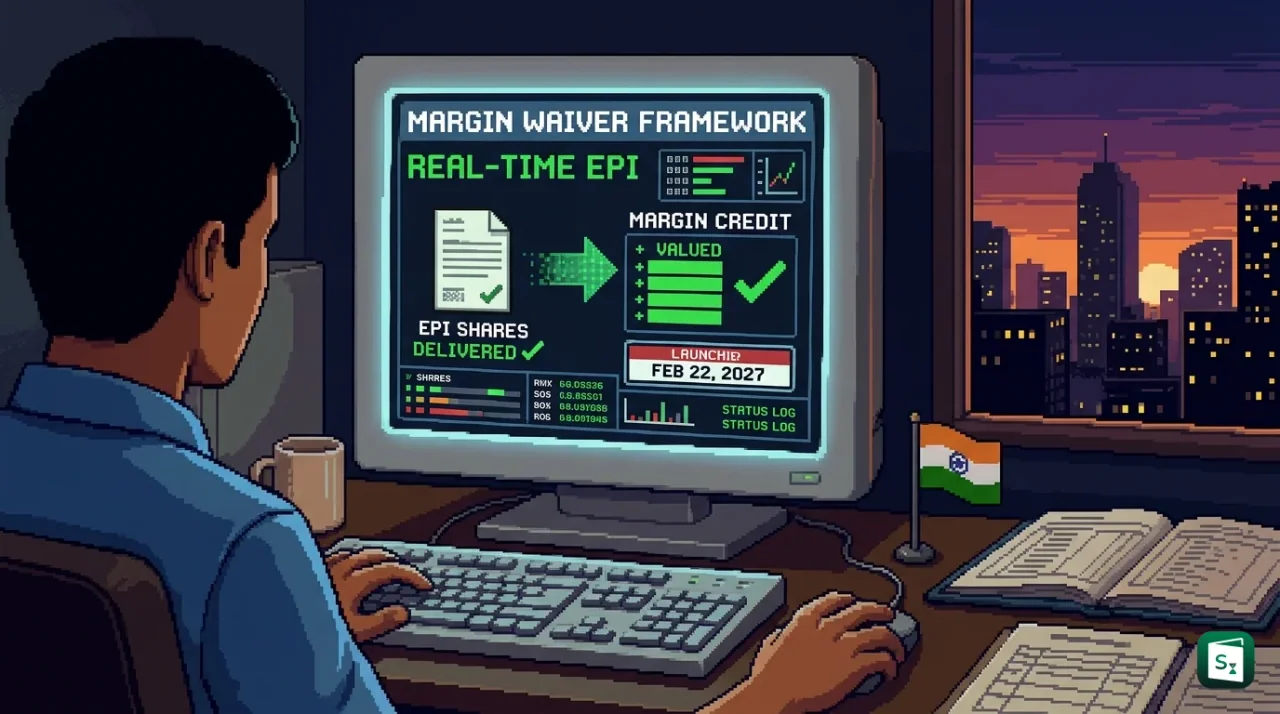
The Securities and Exchange Board of India issued a circular on 22 October 2026 to waive margin on subsequent cash market trades backed by accepted Early Pay-in of securities. Clearing Corporations will recognise this Early Pay-in value on a real time basis from 22 February 2027. The move lets a seller reuse delivered shares instead of arranging fresh funds for the next trade on the same day.
What Is the Real Time Margin Waiver Framework?
The Securities and Exchange Board of India defines the framework in circular number HO(320)2026-MRD-POD2/I/24141/2026 dated 22 October 2026. The circular is titled Margin Waiver on Subsequent Buy and Sell Transactions Post Early Pay-in in Cash Segment. It will come into force four months after issue, on 22 February 2027.
SEBI is the statutory regulator for securities and commodity markets in India. It was set up as a non statutory body on 12 April 1988 and received statutory powers through the SEBI Act, 1992 on 30 January 1992. SEBI works under the administrative oversight of the Ministry of Finance and is headquartered at SEBI Bhavan in Bandra Kurla Complex, Mumbai.
The circular is addressed to recognised stock exchanges, Clearing Corporations, depositories and stock brokers. A Clearing Corporation is the institution that clears and settles trades and acts as the legal counterparty to both buyer and seller. In India, NSE Clearing Limited, a wholly owned subsidiary of the National Stock Exchange which started clearing operations in April 1996, clears NSE trades, while the Indian Clearing Corporation Limited clears BSE trades.
The core rule has two conditions. First, the client must have a net sell obligation in a settlement, which means the client has sold more shares than bought and must deliver shares. Second, the Early Pay-in request for those sold shares must have been successfully accepted by the Clearing Corporation. Early Pay-in, usually called EPI, means the seller delivers shares to the Clearing Corporation before the normal pay-in deadline.
When both conditions are met, the Clearing Corporation will not collect margin from the Trading Member (TM) or Clearing Member (CM) on the subsequent buy or sell positions of that client in the cash segment, up to the amount of accepted EPI. The relief is given on a real time basis on the trade date. The cash segment refers to normal delivery and intraday share trades settled on a T plus 1 cycle, where shares and money change hands one business day after the trade.
| Element of the framework | Detail |
|---|---|
| Circular date | 22 October 2026 |
| Effective date | 22 February 2027 |
| Market covered | Cash segment only |
| Eligibility | Net sell obligation plus EPI accepted by the Clearing Corporation |
| Benefit | No margin collection on subsequent buy or sell positions up to accepted EPI value |
| Mode of calculation | Real time on the trade date |
What Is Margin Trading and How Does Cash Market Margin Work?
Margin trading means buying or selling securities by depositing only a part of the trade value as security, with the broker funding or securing the balance within limits set by SEBI. Margin in the stock market is the cash or approved securities a client must keep with the broker before trading, so that a sudden price move does not lead to a settlement failure.
In the cash market, the main components are Value at Risk (VAR) margin and Extreme Loss Margin (ELM). VAR margin is a statistical estimate of the maximum loss a share is likely to suffer in one day under normal conditions, calculated from its past price volatility with 99 percent confidence. ELM is an extra cushion for price moves larger than normal volatility. Together VAR plus ELM form the upfront margin for equity trades. Clients must generally bring at least 20 percent of the trade value as upfront margin in the cash market.
SEBI enforces this through the peak margin system. The Clearing Corporation takes at least four random snapshots of client positions during the day. The highest margin needed across those snapshots is the peak margin for the day, and the broker must have collected 100 percent of it in advance. This full upfront collection rule has applied since 1 September 2021 after a phased rollout from December 2020. Shortfalls attract penalties, generally 0.5 percent of the shortfall per day for smaller cases and 1 percent for larger shortfalls.
How Margin Pledge and Intraday Margin Fit In
Margin pledge means a client pledges shares held in a demat account with a depository as collateral without transferring ownership to the broker. Since September 2020, brokers can accept securities as margin only through this pledge system with NSDL and CDSL, and the pledged value is taken after a haircut for price risk.
Intraday margin is the same VAR plus ELM margin applied to positions opened and closed on the same day. Before peak margin rules, brokers offered very high intraday leverage. Now a trader must have the full prescribed margin even for a trade held for a few minutes. If the margin falls short, the broker squares off, which means closes, the position by taking an opposite trade.
How Will Clearing Corporations Calculate Available EPI Value?
The Clearing Corporation will compute the available EPI value on the trade date in real time. The value will be the lower of the value of securities for which EPI has been made and the value of securities sold by the client. This cap links the benefit to the actual settlement obligation and stops clients from claiming relief based on a higher unrelated delivery.
For example, if a client sells shares worth ₹1,00,000 and the Clearing Corporation accepts EPI worth ₹80,000, the available value is ₹80,000. If the client delivers EPI worth ₹1,00,000 but the sale value is only ₹90,000, the available value is ₹90,000. When the client takes a fresh position in the cash segment on the same trade date, the Clearing Corporation will check the client margin availability after reducing this available EPI value.
The table below shows how the rule works in common cases.
| Situation on trade date | Benefit allowed |
|---|---|
| EPI accepted for full sale value | Full EPI value can support subsequent cash market positions |
| EPI value lower than sale value | Benefit limited to the lower EPI value |
| EPI value higher than sale value | Benefit limited to the lower sale value |
| Client takes a new cash segment position on the same day | Clearing Corporation adjusts available margin after deducting available EPI value |
| EPI request pending, rejected or only partly accepted | Only the accepted part counts, pending or rejected quantity gets no benefit |
The calculation is position specific and time sensitive. A single end of day credit would overstate relief if orders are modified or cancelled during the day. SEBI therefore requires Clearing Corporations and brokers to update systems to track client code, security, quantity delivered, accepted value, sale value and utilisation in real time.
What Happens If a Client Squares Off the Sale Position?
Square off in the share market means closing an open position by taking an opposite trade. A trader who first sold shares squares off by buying back the same quantity, and a trader who first bought shares squares off by selling them. Profit or loss is fixed only at square off.
SEBI states that if a client squares off the sale position in securities for which EPI benefit has been used, the corresponding EPI value will be removed from the margin calculation. The logic is simple. The waiver exists because delivered shares support the settlement of the original sale. Once that sale is reversed, the delivery no longer supports settlement, so the margin cover also goes away.
The removal can create a margin shortfall at the client level. In that case, the Clearing Corporation will block the shortfall amount from the proprietary collateral of the Trading Member or Clearing Member. Proprietary collateral means the own funds and securities of the broker or clearing member, not the funds of other clients. The broker remains responsible for ensuring that the system can absorb the gap without affecting settlement of other clients.
For example, a client sells shares worth Rs 1,00,000 through EPI and uses Rs 80,000 of that value to take a new buy position without fresh margin. If the client then buys back the original sold shares and closes the sale, the Rs 80,000 cover is withdrawn. The new buy position now needs full margin, and any gap is blocked from the broker proprietary collateral until the client brings fresh margin.
What Safeguards Apply to Brokers and Trade for Trade Securities?
SEBI has directed Trading Members to configure risk management systems so that a client can square off a position backed by EPI or take a new position only if the required client margin is available with the Trading Member. The broker cannot allow a client to increase risk on the strength of EPI value that has already been withdrawn. This keeps the real time waiver from becoming an unchecked intraday loan.
Clearing Corporations must amend their bye laws, rules and regulations, upgrade systems for real time computation, and circulate the new process to members. Stock exchanges must align margin collection and reporting checks with the new method before 22 February 2027.
The square off safeguard will not apply to Trade for Trade (TFT) securities. TFT is a segment where each trade is settled on a gross basis without netting of buy and sell positions, usually for illiquid or surveillance related stocks. Since obligations are not netted, SEBI has kept these securities outside the reversal and collateral blocking condition.
The waiver also does not extend to derivatives, currency or commodity segments. It applies only to subsequent buy or sell positions in the cash segment. Earlier guidelines had already allowed accepted EPI through the block mechanism to count as margin for the sale transaction itself, and in some cases for other positions after ledger credit of sale value. The new circular creates a clear real time waiver for subsequent cash market positions up to the accepted EPI amount, without waiting for ledger entries.
Why SEBI Introduced the Reform Now
SEBI states that the decision follows proposals from the Broker Industry Standards Forum (ISF), recommendations of the Risk Management Review Committee (RMRC) and internal deliberations. The RMRC, chaired by Professor J R Varma, reviews the risk management framework for cash and derivatives segments and advises SEBI on changes to margin systems and related regulations. The ISF is the forum through which brokers submit standard operating suggestions to the regulator and market institutions.
The problem was practical. A client who had already delivered shares through EPI had fully secured the settlement of the sale. Yet if the same client took another cash market position on the same day, the system still demanded full fresh margin for that second trade. This blocked working capital twice against the same economic value and forced active clients and brokers to arrange extra cash or collateral for a few hours.
The reform improves capital efficiency. Eligible clients can reuse the accepted EPI value for the next trade, which lowers funding needs and may support liquidity in the cash market. For brokers, it can modestly reduce upfront margin funding from February 2027, though the gain depends on how many clients use EPI and how systems perform. At the same time, the square off reversal and proprietary collateral block keep a clear risk control, so the relief does not weaken the settlement guarantee provided by Clearing Corporations.
Key Takeaways
- SEBI issued circular HO(320)2026-MRD-POD2/I/24141/2026 on 22 October 2026, effective from 22 February 2027.
- The waiver applies only in the cash segment where a client has a net sell obligation and EPI is accepted by the Clearing Corporation.
- Available EPI value is the lower of EPI value and sale value, calculated in real time on the trade date.
- If the client squares off the original sale, the EPI value is removed and any shortfall is blocked from member proprietary collateral.
- Trade for Trade securities, settled on a gross basis, stay outside the square off condition.