The Department of Social Justice and Empowerment has reported that 1,87,305 candidates received skill training and 96,162 candidates secured placements under the PM DAKSH scheme between 2020-21 and 2023-24. PM DAKSH stands for Pradhan Mantri Dakshata Aur Kushalata Sampanna Hitgrahi and provides free skill training to Scheduled Castes, Other Backward Classes, Economically Weaker Sections, De-notified Tribes and Safai Karamcharis. From 2024-25, the scheme has been merged with the Pradhan Mantri Kaushal Vikas Yojana (PMKVY) to avoid duplication.
What Is PM DAKSH Scheme?
The PM DAKSH scheme is a Central Sector Scheme launched in 2020-21 by the Ministry of Social Justice and Empowerment. A Central Sector Scheme is fully funded by the Union government, with no contribution required from states. The Department of Social Justice and Empowerment (DoSJE) is the nodal department for its implementation.
The main objective of PM DAKSH is to raise the skill levels of marginalised groups so they can earn through wage employment or self employment. It focuses on providing high quality training through good quality institutions, rather than short and low quality courses. The training follows the National Skill Qualification Framework (NSQF) and National Occupational Standards (NOS) fixed by the Ministry of Skill Development and Entrepreneurship (MSDE).
| Feature | Detail |
|---|---|
| Full form | Pradhan Mantri Dakshata Aur Kushalata Sampanna Hitgrahi |
| Launch year | 2020-21 |
| Type | Central Sector Scheme, 100 percent funded by Centre |
| Nodal ministry | Ministry of Social Justice and Empowerment |
| Implementing department | Department of Social Justice and Empowerment |
| Training standard | NSQF and NOS courses, job roles taken from Skill India Digital Hub (SIDH) |
Who Can Apply for PM DAKSH Training?
The Department of Social Justice and Empowerment has fixed clear eligibility rules for PM DAKSH. The applicant must be an Indian citizen aged between 18 and 45 years. The applicant must belong to one of the target groups of the scheme.
The target groups are Scheduled Castes (SCs), Other Backward Classes (OBCs), Economically Weaker Sections (EWS), De-notified, Nomadic and Semi-Nomadic Tribes (DNTs) and Safai Karamcharis including waste pickers and their dependants. These are groups with limited economic assets and poor access to formal training and credit.
Income rules differ by category. There is no income limit for SC, DNT and Safai Karamchari candidates. For OBC and EWS candidates, the annual family income must be below ₹3 lakh. Candidates must also have an Aadhaar card and an Aadhaar linked bank account, and register on SIDH. Each person can take skill training under the scheme only once.
Four Types of Skill Training Under PM DAKSH
The PM DAKSH portal lists four kinds of training programmes. Each type serves a different need, from basic recognition of existing skills to long courses for high paying jobs. All training is free of cost for the trainee, and the cost is paid as per Common Cost Norms fixed by MSDE.
Up-skilling and Re-skilling under Recognition of Prior Learning (RPL) is mainly for Safai Mitras including waste pickers. Many of them are already working but have never received formal certificates. The course covers safe sanitation practices and job specific skills, usually for about 35 to 60 hours. Trainees receive ₹2,500 to ₹3,000 for the full course as compensation for wage loss.
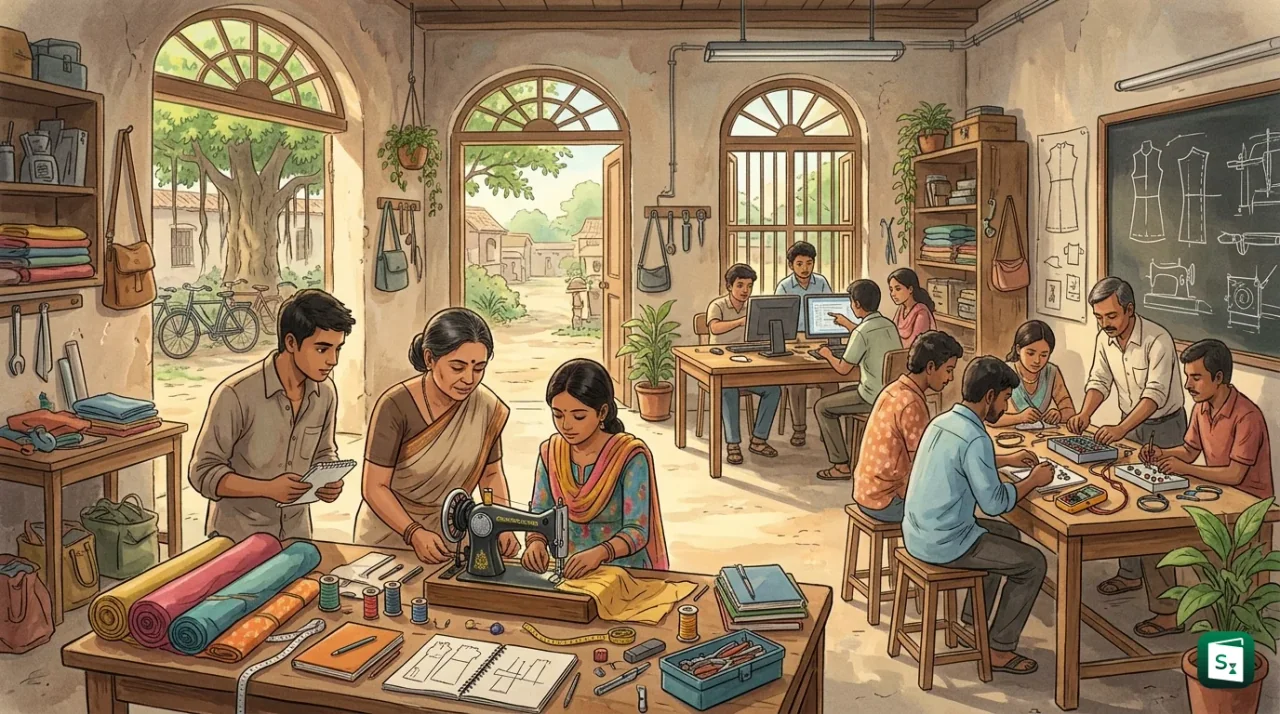
Short Term Training Programmes focus on wage employment or self employment. Courses run for about 300 hours or three months and include tailoring, furniture making, food processing, beautician work, leather work and similar trades, along with financial and digital literacy. Long Term Training Programmes run for about 650 hours or seven months and are meant for youth who have studied up to Class 10 and want jobs in sectors with good demand and higher wages.
Entrepreneurship Development Programmes (EDP) support youth with an interest in business. These courses teach basic business, accounting and market skills to help beneficiaries start small ventures. After training, the three implementing corporations also guide eligible youth to get concessional loans to set up their own projects.
Stipend support is paid directly to the bank account of the trainee through Direct Benefit Transfer (DBT). For non residential short term and long term courses, SC candidates get ₹1,500 per month and OBC, EWS and DNT candidates get ₹1,000 per month. Trainees must have at least 80 percent attendance recorded through biometric attendance to receive the stipend.
How PM DAKSH Is Funded and Run Through Three Corporations
The Department of Social Justice and Empowerment implements PM DAKSH through three public sector corporations. These are the National Scheduled Castes Finance and Development Corporation (NSFDC), the National Backward Classes Finance and Development Corporation (NBCFDC) and the National Safai Karamcharis Finance and Development Corporation (NSKFDC). NSFDC serves SC candidates, NBCFDC serves OBC, EWS and DNT candidates, and NSKFDC serves Safai Karamcharis and waste pickers.
Funds flow from the department to these corporations. The corporations then reimburse the cost to training institutes empanelled under PMKVY. The PM DAKSH portal and app, launched on 7 August 2021 and developed by the National e-Governance Division (NeGD), handles candidate registration, choice of job role and centre, attendance and assessment results.
Training institutes carry a clear placement duty. They must provide wage employment or self employment to at least 70 percent of trained candidates. If an institute fails, the third instalment of 30 percent of the training cost is not released. Institutes must also tie up with relevant industries to improve job chances for trainees.
1.87 Lakh Trained and 96162 Placements Between 2020 and 2024
The latest factsheet released on 22 October 2026 gives the final record of PM DAKSH as a standalone scheme. Between 2020-21 and 2023-24, a total of 1,87,305 candidates were trained and 96,162 candidates received placement offers. Placement here includes both wage jobs and self employment ventures.
Total funds allotted for the four year period were ₹276.47 crore, while actual expenditure reached ₹309.5 crore. The higher spending reflects full payment of training, assessment, stipend and support costs through the three corporations.
An independent evaluation study reported strong results on quality and use. More than 90 percent of beneficiaries said the training matched their career goals and local labour market needs, and that they achieved the intended learning outcomes. Most beneficiaries continued to use the skills, expected income growth over time, and reported better confidence, self esteem and social recognition. These gains were strongest among women and marginalised groups.
Why PM DAKSH Was Merged With PMKVY
From 2024-25, the government decided to merge PM DAKSH with the Pradhan Mantri Kaushal Vikas Yojana (PMKVY). PMKVY is the flagship skill development scheme of the Ministry of Skill Development and Entrepreneurship. The reason was duplication.
All job roles offered under PM DAKSH were already taken from the Skill India Digital Hub (SIDH) portal and were also covered under PMKVY. PM DAKSH was working as an additional support to PMKVY for the same roles and the same digital platform. To save resources and keep one common national framework, the targeted support for SC, OBC, EWS, DNT and Safai Karamchari groups will now flow through PMKVY from 2024-25 onwards.
Key Takeaways
- 1,87,305 candidates were trained and 96,162 placed under the PM DAKSH scheme between 2020-21 and 2023-24.
- PM DAKSH stands for Pradhan Mantri Dakshata Aur Kushalata Sampanna Hitgrahi and is a Central Sector Scheme launched in 2020-21.
- The scheme is run by the Department of Social Justice and Empowerment through NSFDC, NBCFDC and NSKFDC.
- Indian citizens aged 18 to 45 years are eligible, with no income limit for SC, DNT and Safai Karamcharis and a ₹3 lakh family income limit for OBC and EWS.
- From 2024-25, PM DAKSH has been merged with PMKVY of the Ministry of Skill Development and Entrepreneurship to avoid duplication.