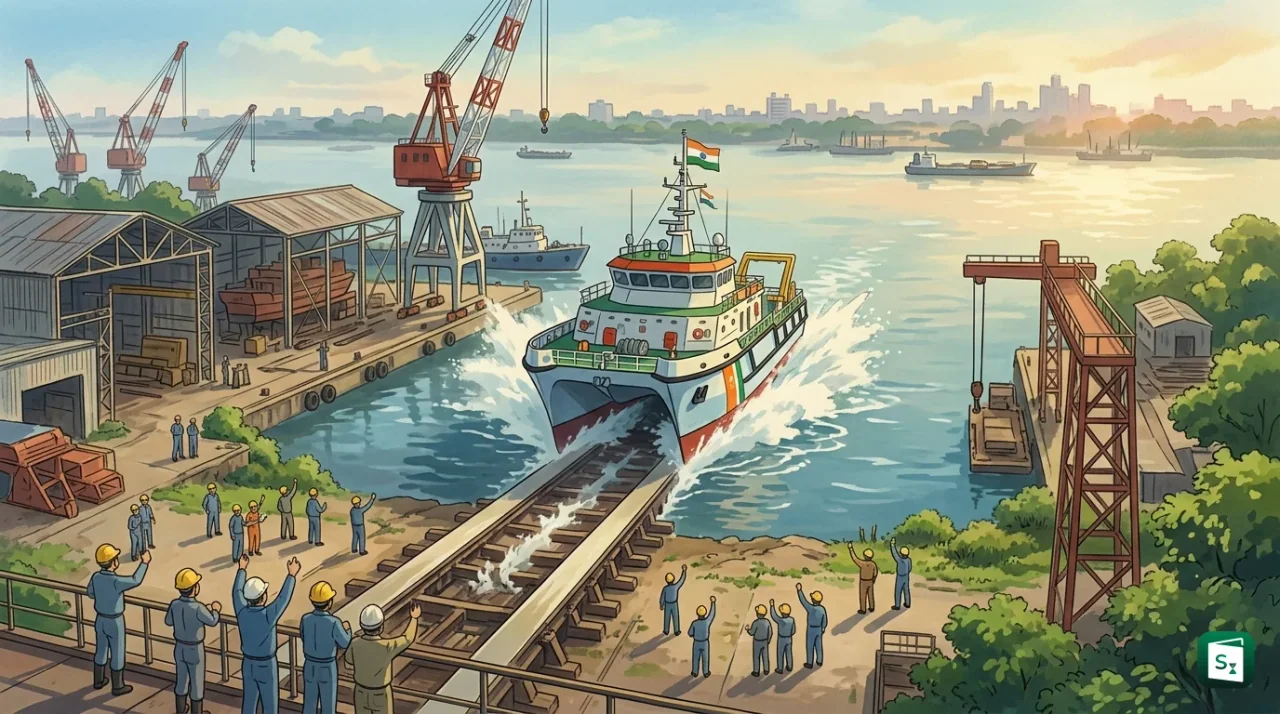
DSC A24, the fifth and final vessel of the five-ship Diving Support Craft (DSC) project, was launched into the Hooghly River at Titagarh, Kolkata, on 1 August 2026. The ceremony was held at the yard of Titagarh Rail Systems Limited (TRSL), the builder of all five ships, in the presence of senior Indian Navy officials. With this launch, the entire project that was contracted in February 2021 has now moved to the outfitting and sea-trials phase, ahead of the delivery of the last few vessels.
The Launch: DSC A24 Enters the Water at Titagarh
The vessel, designated Yard 329, was launched by Mrs Kamal Singh at the Titagarh yard on 1 August 2026. Vice Admiral Gurcharan Singh, the Chief of Personnel of the Indian Navy, was present along with senior officials from the Navy and Titagarh Rail Systems. The ceremony followed full naval traditions and ceremonial splendour, a standard practice for warship launches.
This is the last ship to be launched under the project. The first ship, DSC A20, was launched in August 2023, delivered to the Navy in September 2025 and commissioned at Kochi in December 2025. The launch of a ship marks the moment its hull first touches water, after which it is fitted out with propulsion, electronics and specialized diving equipment before it begins sea trials.
The Diving Support Craft Project: Background
The Diving Support Craft project began on 12 February 2021, when the Indian Navy signed a contract worth approximately ₹174.77 crore with the then Titagarh Wagons Limited (now Titagarh Rail Systems) for the construction of five such vessels. The contract was part of the government’s Make in India initiative and the Navy’s broader drive toward self-reliance in shipbuilding.
The vessels were designed and built indigenously in accordance with the naval rules and regulations of the Indian Register of Shipping (IRS), India’s classification society. The design went through extensive hydrodynamic analysis and model testing at the Naval Science and Technological Laboratory (NSTL) in Visakhapatnam, a DRDO laboratory, before construction began. The first keel was laid in January 2022.
The Five Ships at a Glance
All five ships follow the same design and are named with sequential pennant numbers from A20 to A24. The keel-laying and launch milestones spread over four years:
| Ship | Yard Number | Keel Laid | Launched | Status |
|---|---|---|---|---|
| DSC A20 | 325 | 27 January 2022 | 31 August 2023 | Commissioned (December 2025) |
| DSC A21 | 326 | 5 May 2022 | 30 October 2023 | Launched, outfitting |
| DSC A22 | 327 | 12 August 2022 | 13 September 2025 | Launched, outfitting |
| DSC A23 | 328 | 17 January 2023 | 19 April 2026 | Launched, outfitting |
| DSC A24 | 329 | 31 August 2023 | 1 August 2026 | Launched, outfitting |
Design and Technical Features
Each Diving Support Craft is a 30-metre-long catamaran-hull vessel with a displacement in the range of 300 to 400 tonnes. The catamaran design, which uses twin parallel hulls connected by a deck, gives the ship superior stability, a larger deck area and improved sea-keeping characteristics. This makes it an ideal platform for diving operations in coastal waters.
The craft is fitted with a two-man recompression chamber, which allows divers to be treated for decompression sickness on board and enables safe, extended diving operations. It also carries advanced diving systems and state-of-the-art underwater video monitoring, recording and tracking facilities. Each vessel carries a small crew and a diving team, and is designed to serve the mission needs of the Navy’s diving cadre.
What a Diving Support Craft Actually Does
A Diving Support Craft is a specialized small vessel that acts as a floating base and support platform for underwater work. These ships are built to meet the mission needs of the Navy’s Command Clearance Diving Teams (CCDTs), the specialized squads that perform hazardous underwater tasks close to shore.
Their primary role is to provide diving assistance to all ships inside and near harbours for underwater repair, maintenance and salvage. When a warship or submarine develops a problem underwater, such as a damaged propeller, a fouled anchor or a blocked sea inlet, clearance divers must inspect and fix it. The DSC carries these divers, their equipment and the tools needed for such jobs directly to the location, eliminating the need to dock the vessel at a repair yard.
These craft also support harbour clearances and Explosive Ordnance Disposal (EOD) work, helping divers search for and deal with mines, unexploded bombs and improvised explosive devices in coastal waters. In addition, they can be used to inspect underwater pipelines, well-heads and underwater structures. Their two-man recompression chamber is crucial for this work, as it allows divers who surface too quickly to be treated for decompression sickness, commonly called the bends, without returning to shore.
Analogy · A Floating Workshop for Divers Expand analogy
Think of a Diving Support Craft as a mobile service station that drives to a broken-down car instead of the car being towed to a garage. Just as the service van carries tools, spare parts and a mechanic to the roadside, the DSC carries divers, diving gear and a treatment chamber to the ship that needs underwater repair.
Why This Matters: Aatmanirbhar Bharat in Shipbuilding
The most significant fact about the Diving Support Craft project is its indigenous content. Around 70 percent of the main and auxiliary equipment used in these vessels comes from Indian manufacturers, making them flagships of both the Aatmanirbhar Bharat and Make in India initiatives of the government.
This level of indigenisation matters for several reasons. It reduces India’s dependence on imported defence equipment, protects the country from supply-chain disruptions, and keeps scarce foreign exchange within the country. It also builds the domestic manufacturing ecosystem, creating jobs and nurturing a network of small and medium enterprises that supply components to major shipbuilders. With the induction of these ships, the Navy’s capabilities in diving support, underwater inspection, salvage assistance and coastal operational deployment will be strengthened.
The project also reflects a larger transformation in Indian naval shipbuilding. Since 2014, Indian shipyards have delivered more than 40 indigenous warships and submarines to the Navy, and over the past year a new vessel has been inducted on average every 40 days. Around 67 percent of the Navy’s capital acquisition contracts in the last decade have gone to Indian industries, and the country has moved from being a buyer’s navy to a builder’s navy. Nearly 51 large ships worth about ₹90,000 crore are currently under construction in Indian shipyards.
The Builder: Titagarh Rail Systems Limited
Titagarh Rail Systems Limited (TRSL), headquartered in Kolkata, is one of India’s leading private manufacturers of railway rolling stock, with additional interests in shipbuilding, bridges and defence equipment. The company was founded in 1997 by Jagadish Prasad Chowdhary and is promoted by the Chowdhary family. It is publicly listed on both the Bombay Stock Exchange and the National Stock Exchange.
The company entered the shipbuilding business in 2012 when it acquired a shipyard and merged it into its marine division to build ships for the Indian Navy. Its first defence contract came in 2017. Beyond the Diving Support Craft, TRSL has delivered coastal research vessels and secured orders for other naval vessels. The DSC project, its largest dedicated naval programme so far, positions the company as a growing private-sector player in Indian warship construction, a domain traditionally dominated by public sector shipyards such as Mazagon Dock, Garden Reach Shipbuilders and Cochin Shipyard.
The Way Forward
The launch of DSC A24 completes the construction phase of the project, but several steps remain before the final vessels enter service. Each ship must complete outfitting, harbour trials and sea trials, after which they will be delivered to the Navy and commissioned. The Navy has indicated that the remaining vessels are expected to be commissioned in 2026, and like DSC A20 they will likely be based at Kochi under the Southern Naval Command.
As these ships join the fleet, they will give the Navy a modern, dedicated fleet of diving support platforms that can respond quickly to underwater emergencies along the coastline. The project also sets a useful template for future collaborations between the Navy and private shipyards, where indigenously designed vessels built with Indian equipment strengthen both maritime security and domestic industry.
Key Takeaways
- DSC A24, the fifth and final vessel of the Diving Support Craft (DSC) project, was launched on 1 August 2026 at Titagarh, Kolkata, into the Hooghly River.
- The vessels are built by Titagarh Rail Systems Limited (TRSL), a Kolkata-based private company founded in 1997.
- Each DSC is a 30-metre-long catamaran-hull vessel with a displacement of 300 to 400 tonnes, designed and built under the rules of the Indian Register of Shipping (IRS).
- About 70 percent of the main and auxiliary equipment used in the DSCs is sourced from indigenous manufacturers.
- The contract for five DSCs, worth about ₹174.77 crore, was signed between the Indian Navy and TRSL on 12 February 2021.
- The first ship, DSC A20, was commissioned on 16 December 2025 at Naval Base, Kochi, under the Southern Naval Command.