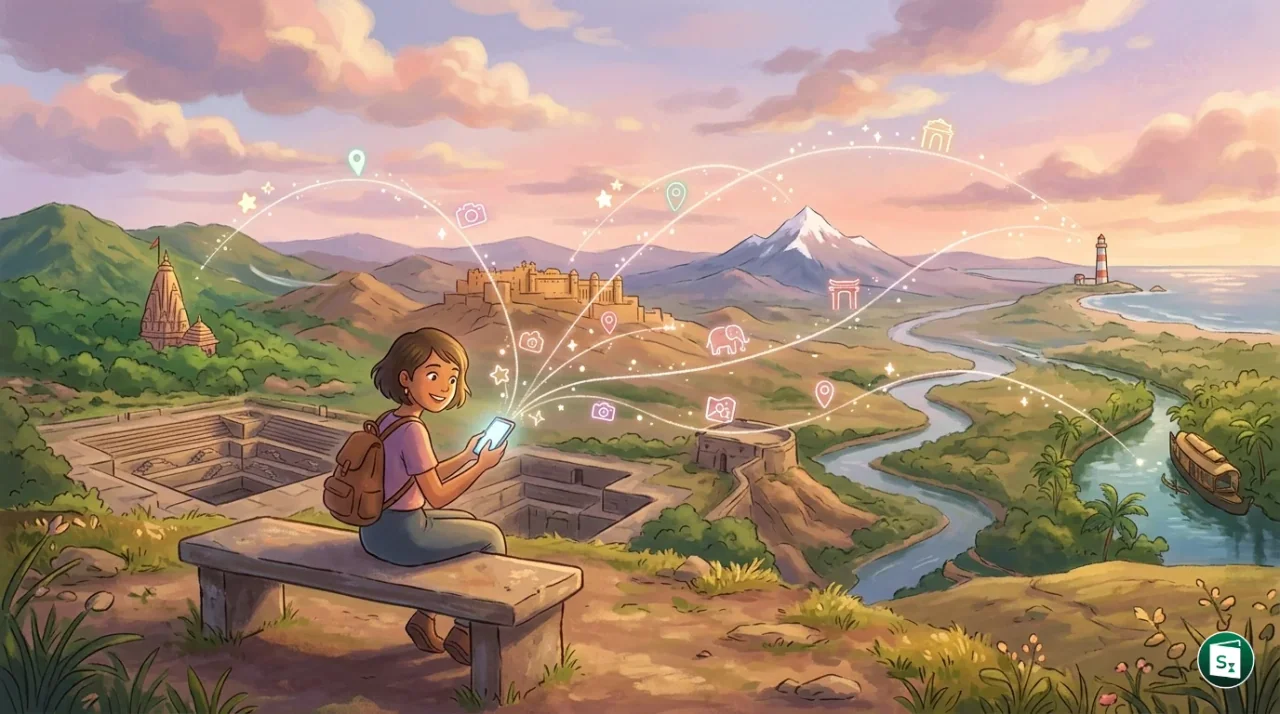
The Ministry of Tourism signed a Memorandum of Understanding with Google India on 30 June 2026 in New Delhi to boost the digital promotion of India’s tourism destinations. The partnership will harness artificial intelligence, data analytics, and Google’s digital ecosystem to improve how travellers discover and engage with India’s cultural and natural heritage. Union Minister for Tourism and Culture Gajendra Singh Shekhawat exchanged the MoU with Preeti Lobana, Country Manager and Vice President of Google India.
What the MoU Entails
The MoU creates a broad framework for cooperation between the Ministry of Tourism and Google India across digital tourism promotion, knowledge sharing, capacity building, and the use of emerging technologies for visitor engagement. It leverages Google’s expertise across its product ecosystem including Search, Maps, YouTube, and Google Arts & Culture to strengthen the visibility of India’s tourism destinations, experiences, and cultural heritage among both domestic and international travellers.
The partnership is structured around three core pillars that together aim to modernise India’s tourism marketing and improve destination discoverability at a global scale.
Travel Insights and Data Analytics
Google will provide the Ministry of Tourism with dashboards that track global travel demand, emerging tourism trends, and traveller behaviour patterns. These data-driven insights will enable the Ministry to design evidence-based promotion strategies, identify high-potential markets, and respond quickly to shifts in traveller preferences. Instead of relying on broad assumptions, tourism officials can now make targeted decisions backed by real-time data from Google’s platforms.
Digital Discovery and Content Distribution
The Incredible India app will explore deeper integration with Google Maps to improve navigation, destination discovery, and on-ground visitor experience. Features such as Live View walking using augmented reality, Address Descriptors powered by machine learning, and Lens integration will help travellers navigate heritage sites and crowded areas with ease. Google will also support the Ministry in expanding its content strategy on YouTube, helping optimise the Incredible India channel to reach wider international audiences through authentic travel storytelling. Immersive 360 degree previews will allow users to explore heritage sites virtually before planning a visit.
Capacity Building and Training
Google will conduct hands-on training programmes for Ministry of Tourism officials and tourism practitioners. These sessions will cover digital marketing tools, campaign optimisation, content creation, and the use of emerging technologies including artificial intelligence. The goal is to equip government teams with the skills needed to plan, execute, and measure digital campaigns independently and effectively.
A Non-Commercial Framework
The Ministry of Tourism clarified that the collaboration is non-commercial, non-binding, and non-exclusive, with no financial implications for either side. This means the agreement is structured as a knowledge-sharing and capability-building partnership rather than a paid contract. Either party can pursue similar arrangements with other organisations, making this an open framework designed for public good rather than commercial advantage.
Notably, this marks the first comprehensive partnership between the Ministry of Tourism and a global technology company, signalling a shift towards technology-driven governance in tourism promotion.
Significance for India’s Tourism Sector
India recorded 9.95 million foreign tourist arrivals in 2024, reflecting a recovery of 4.52% over 2023 but still 8.95% short of pre-pandemic levels seen in 2019. The global tourism market is highly competitive, with countries investing heavily in digital outreach to attract travellers. This partnership positions India to leverage data and technology to regain lost ground and expand its share of international tourism.
The collaboration is expected to help promote lesser-known and rural destinations, reducing the concentration of tourist traffic at a few popular sites. Data-driven insights can identify emerging traveller interests and direct promotional efforts towards offbeat locations, spreading the economic benefits of tourism more evenly across states. For domestic travellers, enhanced digital tools will make trip planning and navigation simpler, encouraging more travel within the country.
From an economic perspective, tourism is a major contributor to India’s services sector and foreign exchange earnings. The Ministry of Tourism estimated foreign exchange earnings of USD 31.33 billion from tourism in 2025. Better digital promotion can help India attract higher-spending international travellers and increase per-tourist expenditure.
The Incredible India Initiative: A Brief Background
The Incredible India campaign was launched in 2002 as the government’s flagship international tourism promotion effort. It was conceptualised by Amitabh Kant, then Joint Secretary in the Ministry of Tourism, in partnership with advertising firm Ogilvy & Mather. The campaign’s distinctive logo, where the exclamation mark forms the ‘I’ of India, became one of the most recognised tourism brands globally.
In its first year, the campaign generated a 16% increase in tourist traffic. Over the years, it has evolved to include domestic tourism promotion and complementary campaigns such as Atithi Devo Bhava (2008), which focused on responsible hospitality towards foreign tourists. The Incredible India campaign operates under the Ministry of Tourism and has a budget allocation that supports its global marketing activities through digital and traditional media channels.
This partnership with Google represents the latest evolution of the Incredible India brand, adding technology and data capabilities to its existing marketing toolkit.
Key Takeaways
- The Ministry of Tourism signed a non-commercial MoU with Google India on 30 June 2026 for digital promotion of tourism destinations.
- The partnership is built on three pillars: travel insights and data analytics, digital discovery via Google Maps and YouTube, and capacity building for Ministry officials.
- The collaboration is non-commercial, non-binding, and non-exclusive, with no financial implications for either side.
- The Incredible India campaign, under which this partnership falls, was launched in 2002 and was conceptualised by Amitabh Kant along with Ogilvy & Mather.
- India recorded 9.95 million foreign tourist arrivals in 2024, and the partnership aims to boost this through targeted digital outreach.
- This is the first comprehensive partnership between the Ministry of Tourism and a global technology company.