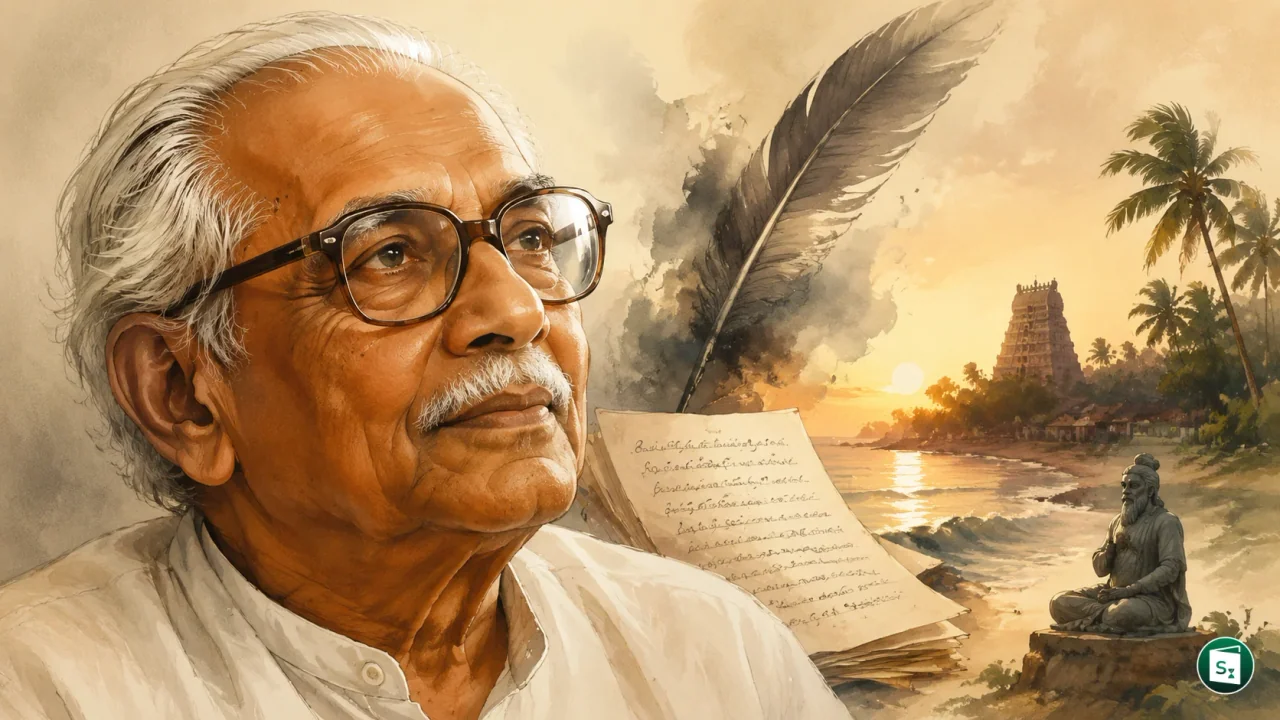
Tamil poet Puviyarasu (born S. Jagannathan), one of the most celebrated voices in modern Tamil literature, died on June 30, 2026 in Coimbatore at the age of 96. He was among a select handful of Indian writers to win the Sahitya Akademi Award twice, once for translation and once for original poetry. His death marks the end of a literary career spanning more than seven decades that shaped modern Tamil poetry and brought world classics to Tamil readers.
Who Was Puviyarasu?
Born as S. Jagannathan in 1930 in Lingavanayakkanputhur village near Udumalpet in present-day Tiruppur district, he later adopted the pen name Puviyarasu, which is the Tamil equivalent of his Sanskrit birth name (Jagannathan meaning “ruler of the world”). His family moved to Coimbatore, where he studied at Government Arts College, Coimbatore and earned his Tamil Vidwan degree from Perur Tamil College. He then worked as a Tamil teacher for more than thirty years, a profession that deeply influenced his writing.
Puviyarasu was a committed Marxist in his political outlook and was actively involved in agitations demanding that Tamil be made the administrative language of Tamil Nadu. He was also part of the border agitations and was imprisoned for his participation in these movements. His political beliefs infused his poetry with a strong sense of social consciousness and a sharp critique of power structures. More than 120 books bear his name across poetry, drama, translation, and fiction.
Literary Career and the Vanambadi Movement
Puviyarasu began publishing poetry in 1952 and soon became a leading figure in the Vanambadi (Skylark) literary movement, which he helped found. The movement emerged in the 1970s as a force that popularised free verse in Tamil, freeing poets from the constraints of traditional metre and grammar. Vanambadi aimed to make poetry accessible to anyone who wished to express their thoughts, and its magazine, also called Vanambadi, ran until 1981, introducing many new poets to the Tamil literary world.
His poetry collections, including Kaioppam (The Signature), Ettu Thisai Kaatru, Kavithaikenna Kelvi, Meendum Zen Kavithaikal, Idu Dhan, and Vaasippu, were acclaimed for their social consciousness and political satire. His poems reflected his Marxist beliefs and his anger at social injustice, making him one of Tamil literature’s most politically engaged voices. In 2004, his work Mukkoodal won the Tamil Nadu government’s Best Poetry Book prize. His poems have been translated into English, Russian, Hungarian, Malayalam, Kannada, Hindi, and Sinhalese, giving him an international readership.
Bringing World Literature to Tamil Readers
Beyond his own poetry, Puviyarasu was celebrated as one of Tamil’s finest translators. He brought the works of literary giants including William Shakespeare, Fyodor Dostoevsky, Khalil Gibran, Omar Khayyam, Osho, and Rabindranath Tagore into Tamil, making world literature accessible to generations of readers. His translations were commercially successful and went through multiple editions and reprints, a rare feat for translated poetry in India.
| Translator’s Work | Original Author | Notable Details |
|---|---|---|
| Puratchikaran | Kazi Nazrul Islam | Translation of “Bidrohi” (The Revolutionary); won Sahitya Akademi Translation Prize 2006-07 |
| Hamlet, Othello, Romeo and Juliet | William Shakespeare | Major Shakespearean tragedies |
| The Brothers Karamazov | Fyodor Dostoevsky | Classic Russian novel |
| The Prophet and other works | Khalil Gibran | Widely read spiritual literature |
| Rubaiyat | Omar Khayyam | Persian poetry classic |
| Gitanjali and other works | Rabindranath Tagore | Tagore’s Nobel-winning poetry |
| The Book of Mirdad | Mikhail Naima | Praised by Osho; translated as “Mirthatin Puththagam” |
He also wrote screenplays for Tamil cinema, including the screenplay for Kamal Haasan’s ambitious but unmade film Marudhanayagam, and appeared as an actor in the film Virumandi (2004) directed by Kamal Haasan.
Two Sahitya Akademi Awards: A Rare Double Honour
Puviyarasu occupies a rare place in Indian literary history as a two-time winner of the Sahitya Akademi Award, India’s highest literary honour. He first won the Sahitya Akademi Translation Prize in 2006-07 for Puratchikaran, his Tamil translation of Kazi Nazrul Islam’s iconic Bengali poem Bidrohi (The Revolutionary). Three years later, in 2009-10, he won the Sahitya Akademi Award for Tamil for his original poetry collection Kaiyoppam (The Signature).
The Sahitya Akademi, India’s national academy of letters, was established in 1954 and is headquartered in New Delhi. It recognises outstanding literary work in 24 Indian languages. Being awarded both the translation prize and the main Akademi award places Puviyarasu in an elite group of writers who have been honoured for both their original work and their translation of others’ works.
He also received the Kalaignar Porkizhi Award in 2008, the Sahitya Puraskar Award from the Kerala Cultural Centre, and the Tamil Nadu government’s Best Poetry Book prize in 2004 for Mukkoodal. In recognition of his contributions to Tamil education, the charitable trust Puviyarasu Tamil Valarchi Mayyam was established in his name to train Tamil teachers properly.
State Honours and Tributes
Tamil Nadu Chief Minister C. Joseph Vijay announced that the poet would be accorded state honours at his final rites, describing his death as an irreparable loss to Tamil literature. In his condolence message, the Chief Minister recalled that Puviyarasu had left an indelible mark through his socially conscious poetry and his translations that brought world literature to Tamil readers. The poet was subsequently laid to rest with full state honours, including a gun salute, in Coimbatore.
Political leaders across the spectrum paid tribute to Puviyarasu. M.K. Stalin, president of the DMK, Kamal Haasan, founder of Makkal Needhi Maiam, and leaders of the Marxist and Communist parties in Tamil Nadu were among those who expressed their condolences. Kamal Haasan, who had worked closely with Puviyarasu on film projects, noted that the poet’s work gave him the courage to try his hand at writing poems.
Key Takeaways
- Puviyarasu (born S. Jagannathan, 1930), one of Tamil literature’s most celebrated poets, died on June 30, 2026 in Coimbatore at the age of 96.
- He was a two-time Sahitya Akademi Award winner, receiving the Translation Prize in 2006-07 for Puratchikaran (translation of Kazi Nazrul Islam’s “Bidrohi”) and the Akademi Award for Tamil in 2009-10 for his poetry collection Kaiyoppam.
- He was a founding member of the Vanambadi literary movement that popularised free verse in Tamil poetry.
- He translated major works of William Shakespeare, Fyodor Dostoevsky, Khalil Gibran, Omar Khayyam, Rabindranath Tagore, and Kazi Nazrul Islam into Tamil.
- He was a Tamil teacher for more than 30 years and was imprisoned for his involvement in agitations demanding Tamil as the administrative language of Tamil Nadu.
- His mortal remains were laid to rest with state honours in Coimbatore, as announced by Tamil Nadu Chief Minister C. Joseph Vijay.