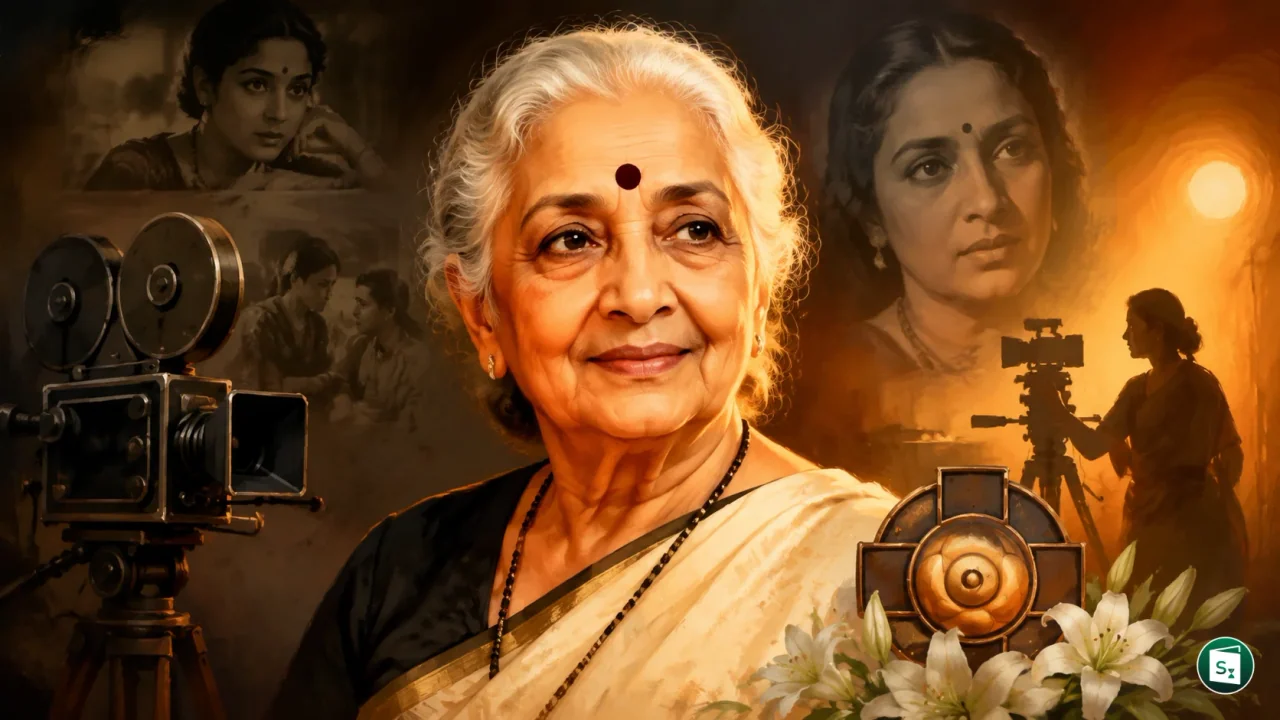
Vijaya Mehta, the pioneering Marathi theatre director, actor and filmmaker, died on 30 June 2026 at her residence in Mumbai following prolonged illness. She was 91. A recipient of the Padma Shri in 1986, Mehta was a defining voice in experimental Marathi theatre and a key contributor to India’s parallel cinema movement.
Who Was Vijaya Mehta?
Born as Vijaya Jaywant on 4 November 1934 in Baroda (now Vadodara), Gujarat, she grew up in a family deeply connected to the arts. Her aunt was actress Nalini Jaywant, and she was related to actors Nutan and Tanuja through family ties. She graduated from the University of Mumbai and trained in theatre under two stalwarts: Ebrahim Alkazi in Delhi and Adi Marzban in Mumbai. She first married Harin Khote, son of veteran actress Durga Khote, and after his early death, married Farrokh Mehta. Her daughter Anahita Uberoi is a well-known theatre personality.
Pioneer of Experimental Marathi Theatre
In the 1960s, Mehta co-founded Rangayan, a Mumbai-based theatre group that became the cradle of experimental Marathi theatre. Alongside playwright Vijay Tendulkar and actors Shriram Lagoo and Arvind Deshpande, she created a platform that broke away from conventional storytelling and embraced socially relevant, avant-garde themes. Rangayan went on to produce some of the most influential plays in modern Indian theatre.
Her stage production of C. T. Khanolkar’s Ek Shoonya Bajirao is widely regarded as a landmark in contemporary Indian theatre. She introduced German playwright Bertolt Brecht to Marathi audiences through Ajab Nyay Vartulacha, an adaptation of Brecht’s The Caucasian Chalk Circle. She also adapted Eugene Ionesco’s Chairs for the Marathi stage. Her other celebrated productions include Barrister, Hamidabaichi Kothi, Shakuntal, Purush, and Wada Chirebandi.
Mehta also worked on international collaborations, including Indo-German theatre projects with German director Fritz Bennewitz, with whom she produced a traditional performance of Bhasa’s Mudrarakshaka featuring German actors. She also briefly worked with renowned theatre director Peter Brook on the film Mahabharata.
Contributions to Parallel Cinema and Television
Though theatre remained her first love, Mehta made a significant mark on Indian parallel cinema. She made her film acting debut in Shyam Benegal’s Kalyug (1981), produced by Shashi Kapoor. She won the National Film Award for Best Supporting Actress for her role as Damayanti Rane in Govind Nihalani’s Party (1984). She also won the Best Actress award at the Asia Pacific Film Festival for the same film.
As a film director, Mehta delivered two critically acclaimed Hindi films. Rao Saheb (1986), based on her own play Barrister, won the National Film Award for Best Supporting Actress for her performance and earned widespread praise. Pestonjee (1988), a slice-of-life film about Mumbai’s Parsi community starring Anupam Kher, Naseeruddin Shah, Shabana Azmi and Kirron Kher, won the National Film Award for Best Feature Film in Hindi.
Her other directorial works include the television film Smriti Chitre (1982), which won the National Film Award for Best Feature Film in Marathi, and the TV series Lifeline (1991), a medical drama that became popular with audiences. She also directed television adaptations of her own stage plays, including Shakuntalam, Haveli Bulund Thi, and Hamidabai Ki Kothi. Decades after her retirement from regular film work, she was last seen in Amol Palekar’s Quest (2006), which won the National Film Award for Best Feature Film in English.
Awards and Recognition
Mehta’s six-decade career was decorated with numerous honours. She received the Sangeet Natak Akademi Award for Direction in 1975, one of India’s highest recognitions in the performing arts. She was awarded the Padma Shri, India’s fourth-highest civilian honour, in 1986 for her contributions to the arts.
In cinema, she won the National Film Award for Best Supporting Actress for Rao Saheb (1986) and the Best Actress award at the Asia Pacific Film Festival for Party (1985). She received the Sangeet Natak Akademi Tagore Ratna in 2012 for her lifetime contribution to the performing arts. She was also honoured with the META Lifetime Achievement Award and the Zee Chitra Gaurav Lifetime Achievement Award in 2004.
| Award | Year | Category |
|---|---|---|
| Sangeet Natak Akademi Award | 1975 | Direction |
| Asia Pacific Film Festival | 1985 | Best Actress (Party) |
| National Film Award | 1986 | Best Supporting Actress (Rao Saheb) |
| Padma Shri | 1986 | Arts |
| Zee Chitra Gaurav Lifetime Achievement Award | 2004 | Lifetime Achievement |
| Sangeet Natak Akademi Tagore Ratna | 2012 | Lifetime Contribution |
Legacy and Mentorship
Fondly known as “Bai” within theatre circles, Mehta was revered as a guru who nurtured generations of performers. She trained and mentored some of the most prominent names in Indian cinema and theatre, including Anupam Kher, Nana Patekar, Vikram Gokhale, Neena Kulkarni, Bharati Achrekar, Ashok Saraf, Reema Lagoo, and Vandana Gupte. Anupam Kher, who worked with her in Rao Saheb and Pestonjee, called her one of the finest theatre minds India has ever produced.
Mehta also served as an administrator for prestigious cultural institutions such as the National Centre for the Performing Arts (NCPA) in Mumbai and the National School of Drama (NSD) in New Delhi. Her autobiography, Abode of Colour, provides a vivid account of her life and the evolution of modern Indian theatre. Her death marks the end of an era in India’s performing arts, leaving behind a body of work that transformed how theatre and cinema are conceived and practiced in the country.
Key Takeaways
- Vijaya Mehta (4 November 1934 - 30 June 2026) was a pioneering Marathi theatre director, actor, and filmmaker.
- She co-founded the Rangayan theatre group in the 1960s alongside playwright Vijay Tendulkar and actors Shriram Lagoo and Arvind Deshpande.
- Her landmark stage production of Ek Shoonya Bajirao is considered a milestone in contemporary Indian theatre.
- She introduced Bertolt Brecht to Marathi audiences through her adaptation Ajab Nyay Vartulacha.
- She was awarded the Padma Shri in 1986 and the Sangeet Natak Akademi Award for Direction in 1975.
- She won the National Film Award for Best Supporting Actress for Rao Saheb (1986) and the Asia Pacific Film Festival Best Actress award for Party (1985).