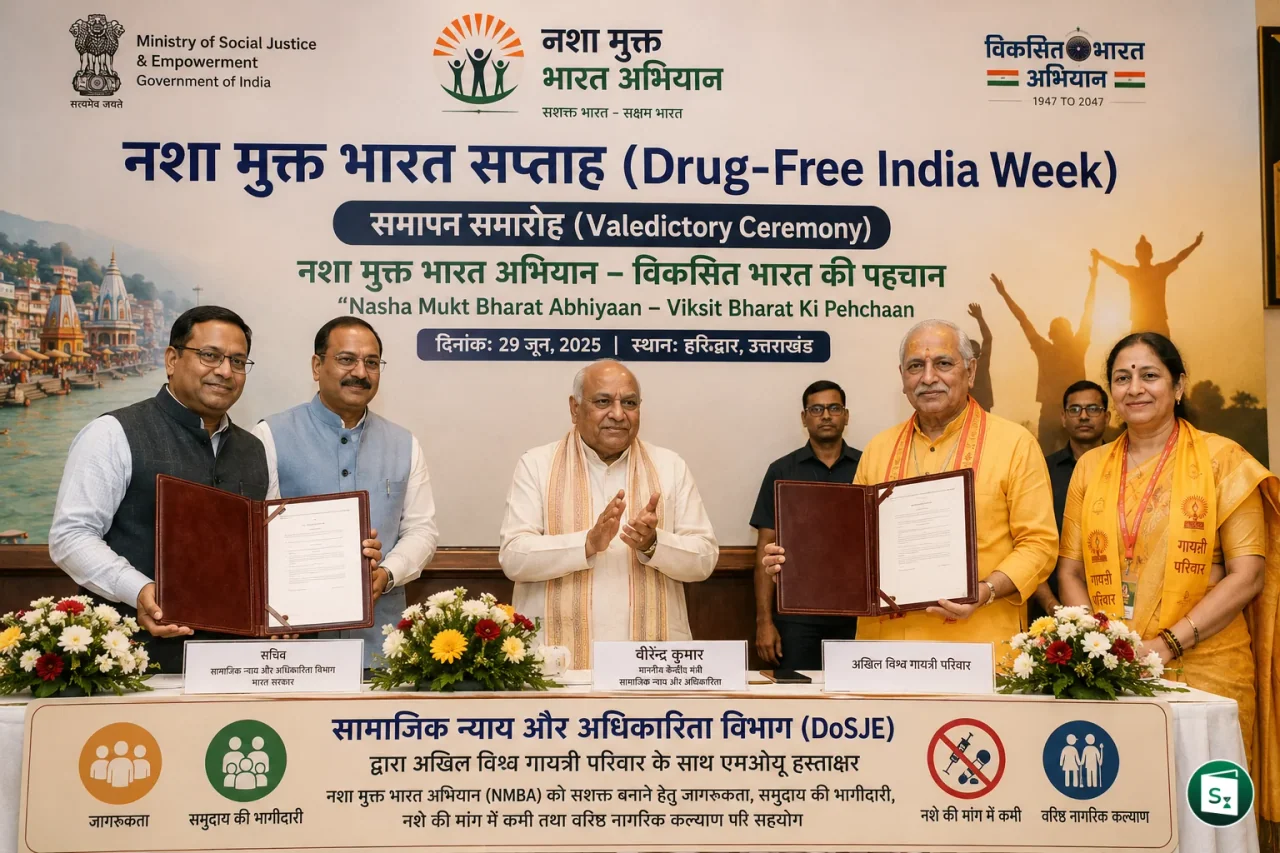
Union Minister for Social Justice and Empowerment Dr. Virendra Kumar presided over the valedictory event of the 10-day Nasha Mukt Bharat Saptah (Drug-Free India Week) at Dev Sanskriti Vishwavidyalaya in Haridwar, Uttarakhand on 26 June 2026. The campaign, held under the theme “Nasha Mukt Bharat Abhiyaan: Viksit Bharat Ki Pehchaan”, drew participation from over 1.31 crore citizens across the country through awareness drives, rallies, and community outreach programmes. At the concluding event, the Department of Social Justice and Empowerment signed two MoUs with the Akhil Vishwa Gayatri Pariwar to strengthen grassroots collaboration in drug demand reduction and senior citizen welfare.
What Is the Nasha Mukt Bharat Abhiyaan?
The Nasha Mukt Bharat Abhiyaan (NMBA) is a nationwide campaign launched on 15 August 2020 by the Ministry of Social Justice and Empowerment to combat substance abuse in India. It was initially rolled out in 272 most vulnerable districts, identified based on inputs from the Narcotics Control Bureau and the findings of the first Comprehensive National Survey on drug use conducted by AIIMS in 2018. The campaign was expanded to 372 districts in August 2022 and has covered all districts across the country since 15 August 2023.
NMBA operates under the umbrella of the National Action Plan for Drug Demand Reduction (NAPDDR), a centrally sponsored scheme of the Ministry of Social Justice and Empowerment. The campaign focuses on five key components: awareness generation programmes, outreach in higher educational institutions and schools, community-level identification of dependent populations, strengthening counselling and treatment facilities in hospitals and rehabilitation centres, and capacity building for service providers.
Since its launch, NMBA has reached over 27.84 crore individuals, including more than 10.39 crore youth and 7.25 crore women, according to official data from June 2026. The campaign has also engaged over 19.70 lakh educational institutions and facilitated the treatment and rehabilitation of over 28.29 lakh persons. A key feature of the campaign is the Nasha Mukti Mitra volunteer network, a force of trained community volunteers who drive grassroots awareness and mobilisation.
Nasha Mukt Bharat Saptah 2026: Key Highlights
The Nasha Mukt Bharat Saptah was observed from 17 June to 26 June 2026 to mark the International Day Against Drug Abuse and Illicit Trafficking, which is commemorated annually on 26 June. The United Nations General Assembly decided in 1987 to observe this day to strengthen global action and cooperation toward a drug-free society. The 2026 UN theme was “World drug problem: persisting issues, new challenges, innovative responses”.
The Saptah was inaugurated virtually by Dr. Virendra Kumar on 17 June, during which he launched a Personal Dashboard for Nasha Mukti Mitra (NMM) to strengthen volunteer engagement and monitoring of grassroots activities. A Short Film on NMBA highlighting collective efforts across the country was also released at the inaugural event.
Throughout the 10-day campaign, a wide range of activities were conducted across all states and Union Territories:
- Nasha Mukti Mitra registration drives to expand the volunteer base
- Seminars, webinars, and training programmes for children and youth
- Street plays, skits, rallies, and yoga sessions to engage local communities
- Signature campaigns, essay and painting competitions, and slogan-writing contests
- E-pledge campaigns and Nasha Mukt rallies in multiple cities
The campaign recorded participation from more than 1.31 crore citizens, demonstrating the growing public ownership of the anti-drug movement. The Ministry of Social Justice and Empowerment described this as a reflection of the campaign’s evolution into a Jan Andolan (people’s movement).
The Valedictory Event in Haridwar
The National Awareness Programme marking the culmination of the Saptah was held at Dev Sanskriti Vishwavidyalaya (DSVV) in Haridwar, Uttarakhand. DSVV is a private university established in 2002 under an Act of the Uttarakhand Legislative Assembly, sponsored by the Shri Vedmata Gayatri Trust, Shantikunj. The university is closely associated with the All World Gayatri Pariwar and offers a blend of modern education with Indian spiritual values.
Union Minister Dr. Virendra Kumar led a massive Nasha Mukt Rally in which nearly 4,000 citizens, mostly youth and volunteers, participated. At the event, he administered two pledges: the Pledge Against Drug Abuse and the Ageing with Dignity Pledge, reaffirming the government’s commitment to building a drug-free and inclusive society.
Representatives from states and Union Territories, line ministries, grant-in-aid institutions, addiction treatment facilities, and civil society organisations attended the programme. The Ministry also recognised the outstanding contributions of Nasha Mukti Mitras, state governments, and winners of awareness competitions for their work in promoting a drug-free society.
MoU with All World Gayatri Pariwar
A key outcome of the valedictory event was the signing of two Memorandums of Understanding (MoUs) between the Department of Social Justice and Empowerment (DoSJE) and the All World Gayatri Pariwar (AWGP), also known as Akhil Vishwa Gayatri Pariwar. These agreements aim to leverage the organisation’s extensive grassroots network for drug demand reduction and senior citizen welfare.
The All World Gayatri Pariwar is a global socio-spiritual organisation founded by Yugrishi Pandit Shriram Sharma Acharya (1911-1990). Headquartered at Shantikunj, Haridwar, the organisation has an estimated 150 million members worldwide with over 5,000 centres across India and abroad. It has been actively involved in social reform, value-based education, and community service for decades. The organisation also runs Dev Sanskriti Vishwavidyalaya, which hosted the valedictory event.
Under the first MoU, AWGP will collaborate with the DoSJE under the Nasha Mukt Bharat Abhiyaan (NMBA) to:
- Conduct mass awareness programmes on the ill-effects of substance abuse
- Mobilise communities at the grassroots level for drug demand reduction
- Engage youth and women in preventive education campaigns
- Strengthen the network of Nasha Mukti Mitras through training and capacity building
This partnership builds on earlier collaborations between the Ministry and spiritual organisations. The Ministry had previously signed MoUs with six other organisations, including The Art of Living, Brahma Kumaris, ISKCON, Sant Nirankari Mission, and Shri Ram Chandra Mission, to amplify the reach of NMBA.
Atal Vayo Abhyuday Yojana and the Ageing with Dignity Initiative
The second MoU signed at the event focuses on senior citizen welfare under the Atal Vayo Abhyuday Yojana (AVYAY). AVYAY is an umbrella scheme of the Ministry of Social Justice and Empowerment launched in April 2021, replacing the earlier National Action Plan for Senior Citizens (NAPSrC). It is a centrally sponsored scheme designed to improve the quality of life of senior citizens, especially those who are indigent.
AVYAY operates through several key components:
| Component | Focus Area |
|---|---|
| Integrated Programme for Senior Citizens (IPSrC) | Establishment and maintenance of Senior Citizen Homes providing shelter, food, medical care, and recreation |
| State Action Plan for Senior Citizens (SAPSrC) | State-level action plans tailored to local needs of the elderly |
| Rashtriya Vayoshri Yojana (RVY) | Provision of assistive living devices (hearing aids, walking sticks, wheelchairs) to senior citizens with age-related disabilities |
| Seniorcare Ageing Growth Engine (SAGE) | Promoting senior-friendly products and services through startup partnerships |
| Elderline (Helpline 14567) | Toll-free helpline launched on 1 October 2021 for information, guidance, emotional support, and intervention in cases of elder abuse |
The AVYAY scheme derives its statutory backing from Sections 19 and 20 of the Maintenance and Welfare of Parents and Senior Citizens Act, 2007, and is guided by Article 41 of the Constitution, which directs the State to make effective provision for public assistance in cases of old age.
Under the MoU, AWGP will collaborate with the DoSJE to promote the Ageing with Dignity initiative, which aims to create awareness about elder care, strengthen intergenerational bonding, and mobilise community support for senior citizens. This partnership recognises the role that spiritual and community organisations can play in providing emotional and social support to the elderly, complementing the government’s institutional efforts.
India’s Three-Pronged Strategy for Drug Demand Reduction
The Ministry of Social Justice and Empowerment is the nodal Ministry for Drug Demand Reduction in India. India’s approach to tackling substance abuse follows a three-pronged strategy that distributes responsibilities across different ministries:
| Pillar | Nodal Agency | Key Functions |
|---|---|---|
| Supply Reduction | Narcotics Control Bureau (NCB), Ministry of Home Affairs | Curbing drug trafficking, controlling illicit cultivation, and dismantling supply networks |
| Demand Reduction | Ministry of Social Justice and Empowerment | Awareness generation, preventive education, community outreach, and capacity building |
| Treatment and Rehabilitation | Ministry of Health and Family Welfare | De-addiction services, medical treatment, and rehabilitation of persons with substance use disorders |
The National Action Plan for Drug Demand Reduction (NAPDDR) serves as the central policy framework guiding all demand reduction efforts. It was formulated for the period 2018-2025 and covers preventive education, treatment and rehabilitation, skill development and livelihood support for recovered users, and research and evaluation.
As part of the treatment infrastructure, the government supports:
- 349 Integrated Rehabilitation Centres for Addicts (IRCAs) providing inpatient de-addiction services
- 154 Addiction Treatment Facilities (ATFs) in government hospitals
- 139 District De-Addiction Centres (DDACs)
- 76 Outreach and Drop-In Centres (ODICs) for community-based support
- A toll-free helpline 14446 that has received over 4.3 lakh calls for counselling and referral services
The number of de-addiction centres has increased from 490 in 2019-20 to over 780 by 2025-26, reflecting the government’s expanding institutional capacity to address substance abuse.
Key Takeaways
- The Nasha Mukt Bharat Abhiyaan (NMBA) was launched on 15 August 2020 by the Ministry of Social Justice and Empowerment and now covers all districts of India.
- Nasha Mukt Bharat Saptah 2026, observed from 17 June to 26 June, recorded participation from more than 1.31 crore citizens across the country.
- Union Minister Dr. Virendra Kumar presided over the valedictory event at Dev Sanskriti Vishwavidyalaya, Haridwar, and led a Nasha Mukt Rally of nearly 4,000 participants.
- Two MoUs were signed between the Department of Social Justice and Empowerment and the All World Gayatri Pariwar under the NMBA and Atal Vayo Abhyuday Yojana (AVYAY) frameworks.
- The All World Gayatri Pariwar, founded by Pandit Shriram Sharma Acharya, is headquartered at Shantikunj, Haridwar, and has over 150 million members worldwide.
- AVYAY, launched in April 2021, is the umbrella scheme for senior citizen welfare, replacing the National Action Plan for Senior Citizens (NAPSrC).
- The International Day Against Drug Abuse and Illicit Trafficking is observed annually on 26 June, as decided by the UN General Assembly in 1987.
- India’s drug demand reduction strategy follows a three-pronged approach involving supply control (NCB), demand reduction (Ministry of Social Justice), and treatment (Ministry of Health).