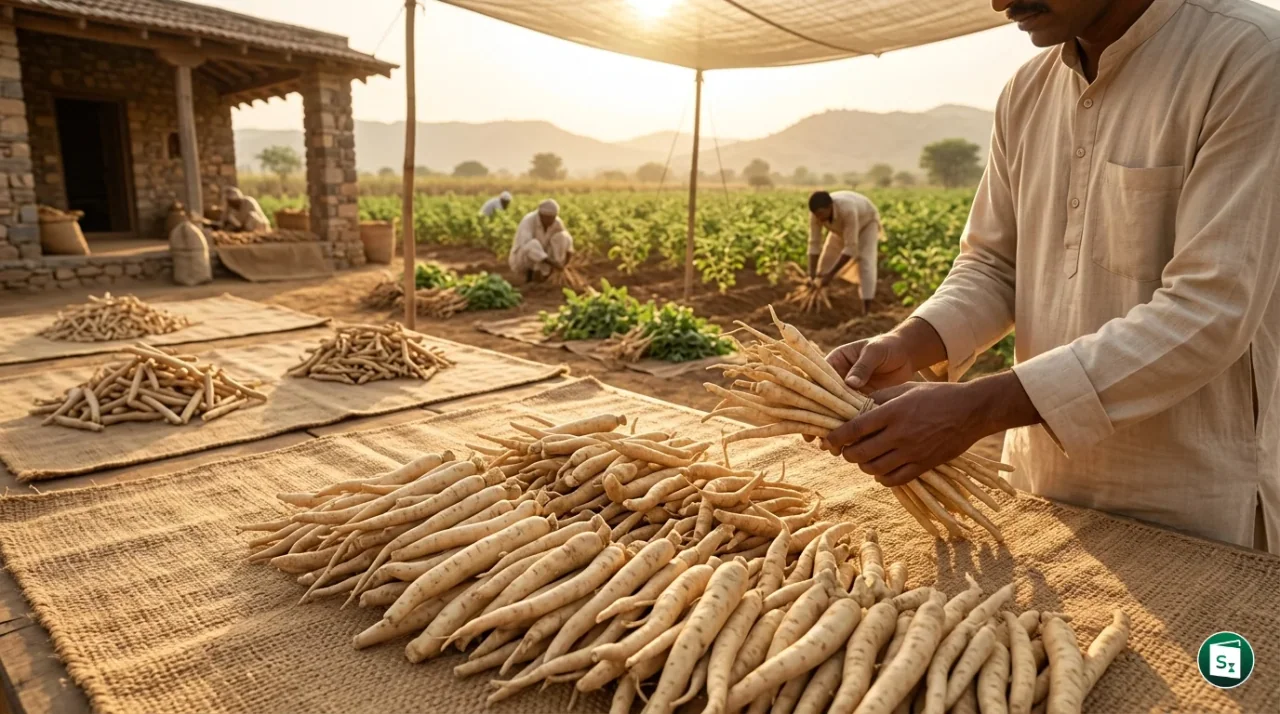
The Food Safety and Standards Authority of India (FSSAI) and the Ministry of Ayush have jointly prohibited the use of leaves and leaf extracts of Ashwagandha (Withania somnifera) in all food products, health supplements, and nutraceuticals. The move, formalised through an FSSAI advisory on April 16, 2026 and a Ministry of Ayush directive a day earlier, restricts manufacturers to using only the roots and root extracts of the herb. Scientific studies cited by the regulators indicate that Ashwagandha leaves contain higher concentrations of certain bioactive compounds that pose potential safety risks, making the root the only permitted plant part for human consumption.
What Is Ashwagandha (Withania somnifera)?
Ashwagandha, also known by its botanical name Withania somnifera, is a perennial shrub belonging to the Solanaceae family, the same family that includes tomato and potato. The plant is native to India, North Africa, and parts of the Middle East. In Ayurveda, the traditional Indian system of medicine, Ashwagandha has been used for nearly 4,000 years as a Rasayana, a rejuvenative tonic believed to promote longevity, vitality, and overall well being.
The name “Ashwagandha” is derived from Sanskrit, where “Ashwa” means horse and “Gandha” means smell, referring to the distinctive horse-like odour of its roots. The species name “somnifera” comes from Latin, meaning “sleep inducing”, reflecting its traditional use as a sedative and sleep aid. The herb is classified as an adaptogen, a substance that helps the body manage stress and restore balance.
Modern scientific research has confirmed many of the traditional claims. Ashwagandha is reported to have anti inflammatory, neuroprotective, immunomodulatory, and anti cancer properties. It is widely used in health supplements for stress reduction, cognitive enhancement, improved sleep, and increased physical performance. The primary bioactive compounds responsible for these effects are a group of steroidal lactones called withanolides, of which Withaferin A and Withanone are the most studied.
Roots Versus Leaves: A Key Distinction
The distribution of withanolides varies significantly across different parts of the plant. Roots are rich in withanosides, which are associated with adaptogenic and stress relieving effects. Leaves, on the other hand, contain higher concentrations of withanolides and withanones, particularly Withaferin A. While Withaferin A has demonstrated potent anti cancer and anti inflammatory activity in laboratory studies, it has also raised safety concerns at higher concentrations. This chemical difference between the root and the leaf is the central reason behind the regulatory action.
What Did FSSAI and the Ministry of Ayush Direct?
On April 15, 2026, the Ministry of Ayush issued a directive to all Ayush drug and product manufacturers mandating that only Ashwagandha roots and root extracts be used in their products. The directive explicitly prohibited the use of leaves in any form crude, extract, or otherwise. It also required manufacturers to clearly identify the plant part used on product labels.
The next day, on April 16, 2026, the FSSAI followed with its own advisory addressed to all Food Business Operators (FBOs). The advisory clarified that under the Food Safety and Standards (Health Supplements, Nutraceuticals, Food for Special Dietary Use, Food for Special Medical Purpose, Functional Food and Novel Food) Regulations, 2016, only the roots and root extracts of Ashwagandha are permitted. Schedule IV of these regulations, which lists the botanicals allowed for use in such products, includes Ashwagandha at entry number 432 but specifies only the root as the permissible plant part.
The FSSAI advisory stated that the use of Ashwagandha leaves in crude or extract or any other form is not permitted under the said regulations. It warned that any deviation from these provisions would attract action under the Food Safety and Standards Act, 2006. The regulator also directed its commissioners of food safety in all states and Union Territories, along with regional directors, to maintain strict vigilance and ensure compliance.
The Regulators Behind the Action
| Organisation | Established | Parent Ministry | Headquarters | Key Role |
|---|---|---|---|---|
| FSSAI | 2008 (under Food Safety and Standards Act, 2006) | Ministry of Health and Family Welfare | New Delhi | Sets science based food standards and regulates manufacture, storage, distribution, and import of food |
| Ministry of Ayush | November 9, 2014 (upgraded from Department of Ayush, established 1995) | Government of India | New Delhi | Promotes and regulates Ayurveda, Yoga, Unani, Siddha, Sowa Rigpa, and Homoeopathy systems |
Why Were Ashwagandha Leaves Prohibited?
The Ministry of Ayush, in its directive, noted that available scientific studies have reported possible safety concerns for Ashwagandha leaves due to higher concentrations of reactive withanolides, particularly Withaferin A. This compound, while valued for its therapeutic potential in controlled settings, has been associated with liver toxicity and cytotoxicity at elevated doses.
A comprehensive AI driven meta analysis published in Frontiers in Nutrition in November 2025 evaluated the safety profiles of Ashwagandha root versus non root parts using quantitative structure activity relationship (QSAR) models. The study found that molecules from the root showed significantly lower liver and reproductive toxicity compared to those from non root parts, including leaves. Molecules such as Tropin and Theophyllin, found in leaves, were predicted to have significant toxicity concerns. The root, by contrast, was found to be remarkably safe, with none of the predicted molecules showing significant toxicity.
| Plant Part | Key Compounds | Safety Profile (per AI meta analysis) |
|---|---|---|
| Root | Withanosides, withanolides | Favourable; no significant liver or reproductive toxicity predicted |
| Leaves | Higher Withaferin A, Withanone, Tropin, Theophyllin | Higher toxicity risk; possible safety concerns at elevated doses |
Another review published in 2023 in the journal Toxicology Mechanisms and Methods noted that while withanolides are more abundant in leaves and withanosides are exclusive to roots, some studies suggest that whole plant formulations may neutralise certain toxic effects. However, the regulators chose to adopt a precautionary approach by restricting usage to roots only, which have a longer and better documented history of safe human consumption.
The FSSAI advisory also addressed the issue of adulteration. It noted that certain manufacturers were using Ashwagandha leaves despite the existing regulatory framework permitting only roots. The directive therefore served both as a clarification of existing law and an enforcement warning to curb non compliance.
The Legal Challenge: Karnataka High Court Stay
The FSSAI advisory and the Ministry of Ayush directive were soon challenged in court. On May 8, 2026, a group of dietary supplement manufacturers, including the US based Kerry Inc, filed petitions before the Karnataka High Court arguing that the restrictions were arbitrary, disproportionate, and unsupported by verified scientific research.
The petitioners, who had been manufacturing and exporting Ashwagandha extracts from both roots and leaves since as early as 1990 under valid FSSAI export licenses, made several key arguments:
- The FSSAI advisory amounted to a blanket prohibition that could only be introduced by formally amending the 2016 Regulations, not through an advisory or directive.
- The advisory and directive were issued without the mandatory public consultation and regulatory impact assessment required under law.
- The scientific studies cited by the ministry did not conclusively establish that Ashwagandha leaves pose a safety concern at the levels used in their products.
- The restriction would severely and irreparably impact their businesses.
On May 12, 2026, a vacation bench of Justice S R Krishna Kumar passed an interim order staying the FSSAI advisory and the Ministry of Ayush directive. The stay was granted specifically in favour of the eight petitioning companies and was to remain in effect until the next hearing, scheduled for June 8, 2026. The court also reserved the right of the government and FSSAI to seek modification or vacation of the interim order.
The Karnataka High Court’s decision highlights a significant legal question about the scope of FSSAI’s power to issue prohibitory advisories without amending the underlying regulations. The outcome of this case could set a precedent for how food safety regulations are enforced in India, particularly for traditional herbal ingredients.
Implications for the Industry and Consumers
The regulatory action has significant consequences for multiple stakeholders. The global dietary supplement industry, which extensively uses Ashwagandha extracts, must now ensure that only root derived ingredients are used in products destined for the Indian market. Companies that had developed proprietary leaf based extracts face the prospect of reformulating their products or losing access to the Indian market.
For consumers, the directive provides clarity. Products containing Ashwagandha on store shelves will now be sourced from roots only, which scientific evidence supports as the safer plant part. The labelling requirement mandated by the Ministry of Ayush also improves transparency, allowing consumers to know exactly which part of the plant has been used in their supplement.
However, the legal challenge has created a temporary carve out. The eight companies that secured the Karnataka High Court stay can continue using leaf based Ashwagandha in their products until the final disposal of the case. If the court ultimately upholds the regulators’ position, the ban will apply universally. If it strikes down the advisory, the regulatory framework may need to be revised through formal amendment procedures.
The case also raises important questions about India’s regulatory approach to traditional herbal ingredients. With the global market for Ayurvedic and herbal products growing rapidly, regulators face the challenge of balancing traditional knowledge with modern safety standards.
Key Takeaways
- The FSSAI (established 2008) and the Ministry of Ayush (established November 9, 2014) jointly prohibited the use of Ashwagandha leaves and leaf extracts in food products and supplements on April 15 and 16, 2026.
- Only the roots and root extracts of Ashwagandha (Withania somnifera) remain permitted for use in health supplements, nutraceuticals, and food products under Schedule IV of the Food Safety and Standards Regulations, 2016.
- The prohibition is based on scientific evidence showing that Ashwagandha leaves contain higher concentrations of Withaferin A and other reactive withanolides associated with potential liver and reproductive toxicity.
- The Karnataka High Court on May 12, 2026 granted an interim stay on the advisory and directive for eight petitioning companies, including US based Kerry Inc, with the next hearing scheduled for June 8, 2026.
- Ashwagandha is a Rasayana herb in Ayurveda, used for nearly 4,000 years, belonging to the Solanaceae family, with the name derived from Sanskrit meaning “smell of horse”.
- The case raises important legal questions about whether FSSAI can impose prohibitions through advisories or whether formal amendment of regulations is required.