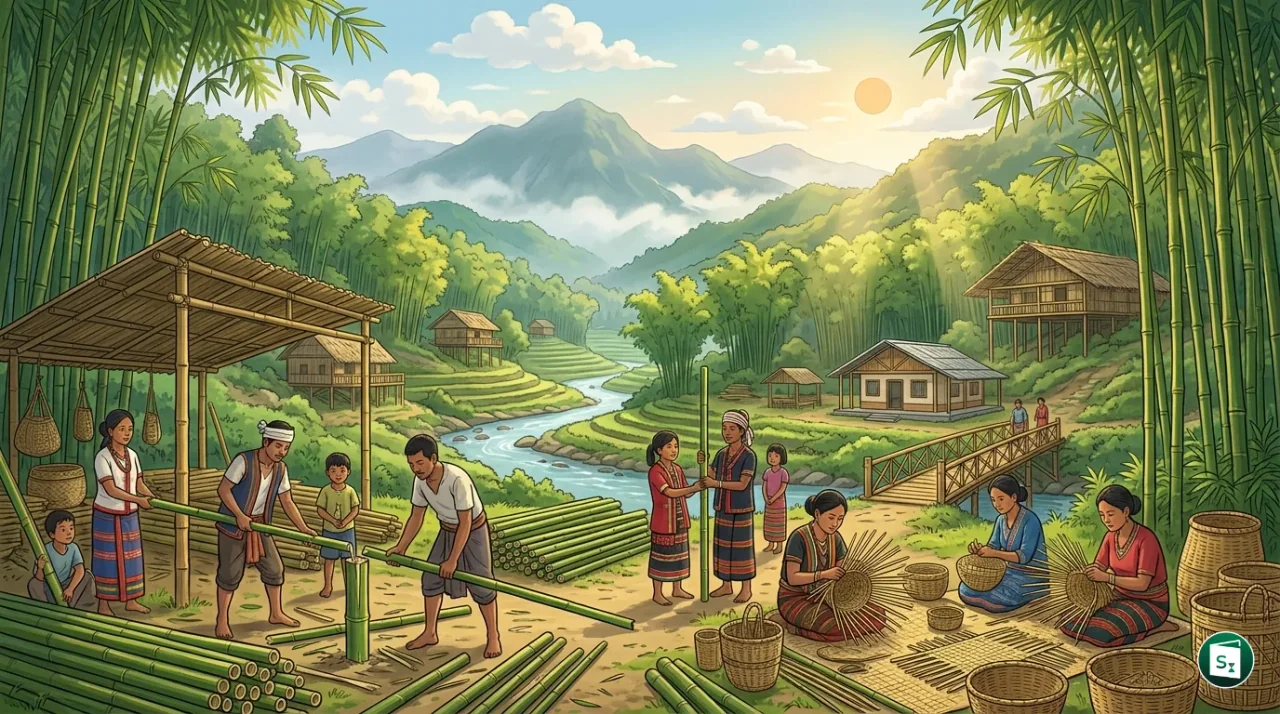
The Asian Development Bank (ADB) has approved a $42.2 million Small Expenditure Financing Facility (SEFF) to develop the bamboo industry across six states in India’s North Eastern Region (NER). The facility will support community-based projects in Assam, Manipur, Meghalaya, Mizoram, Nagaland, and Tripura with a strong focus on women-led manufacturing enterprises. This marks one of the largest multilateral investments aimed at transforming bamboo from a traditional cottage industry into a modern, private sector-led value chain.
What Is the Small Expenditure Financing Facility?
The Small Expenditure Financing Facility (SEFF) is a specialized financial instrument used by the ADB to support projects that involve multiple smaller-scale sub-projects rather than a single large infrastructure investment. Unlike conventional project loans that fund one large asset, SEFF provides financing through multiple subloans that target a range of interconnected activities across a value chain.
In this case, the SEFF is designed to cover the entire bamboo ecosystem from cultivation and nursery development to processing, manufacturing, and digital marketing. The facility will finance community-based projects that improve how bamboo is grown, harvested, managed, and commercially used across the six participating states. This approach allows the ADB to reach grassroots enterprises and rural communities that would otherwise be too small for direct multilateral financing.
The SEFF is structured to be flexible, enabling quick disbursement to viable sub-projects as they are identified and approved. This makes it particularly suited for sectors like bamboo, where the value chain is fragmented across thousands of smallholder farmers, artisan clusters, and micro-enterprises.
India’s Bamboo Paradox: Rich Resources, Underdeveloped Chains
India faces a striking paradox when it comes to bamboo. The country holds 39% of the world’s total forest bamboo resources, making it one of the most bamboo-rich nations on the planet. The North Eastern Region alone accounts for 35.8% of India’s bamboo resources, spread across 5.34 million hectares, even though the region is home to only 3.8% of the country’s population.
Despite this natural abundance, India’s bamboo value chain remains underdeveloped and heavily dependent on imports. Indonesia, Vietnam, and Malaysia are the top suppliers of bamboo and related products to India, with the country importing over $2.3 billion worth of bamboo and wood products in 2024. This import dependence persists largely because India lacks modern processing infrastructure, organized market linkages, and industrial-scale manufacturing capabilities for bamboo.
| Metric | India | China (for comparison) |
|---|---|---|
| Share of global forest bamboo | 39% | (leading producer) |
| Bamboo productivity | 3-6 MT/ha in NER | 30-40 MT/ha |
| Global bamboo export share (as of 2024) | ~14% | ~38% |
| Annual bamboo sector output (FY21) | Rs. 12,507 crore | Significantly higher |
China, by contrast, despite having less forest bamboo area than India, dominates global bamboo trade with a 38% market share. The productivity gap is stark: Indian bamboo farms in the Northeast yield just 3-6 tonnes per hectare, compared to China’s 30-40 tonnes per hectare, pointing to a massive untapped potential that scientific cultivation and modern processing can unlock.
Six States, One Vision: What the Facility Will Fund
The SEFF will operate across six states of the North Eastern Region, each with its own bamboo growing conditions, traditional knowledge, and market potential. The facility is designed as a flexible umbrella under which multiple sub-projects will be financed.
Key Areas of Investment
The financing will support a comprehensive range of activities spanning the entire bamboo value chain:
- Bamboo plantation and nursery development to increase the supply of quality planting material and expand cultivated area
- Integrated bamboo parks and common facility centres for primary and secondary processing near production clusters
- Digital trading platforms and market intelligence systems to connect producers directly with buyers
- Technical assistance and training programmes for scientific cultivation, harvesting, and processing
- Bamboo resource mapping and management using modern tools to assess and optimize the resource base
- Research and training activities in collaboration with technical institutions to develop new products and processes
- Project design and procurement support to ensure sub-projects are bankable and well-executed
- Digital solutions across the value chain, from farm management to e-commerce
Women at the Centre of the Value Chain
A defining feature of the ADB facility is its explicit focus on women’s participation and leadership. The project will establish at least one women-led manufacturing facility in each of the six participating states. Beyond dedicated facilities, women will be employed across nurseries, plantations, and processing units. Self-help groups and women entrepreneurs will be connected to digital marketplaces and training platforms, opening new avenues for income generation and enterprise ownership.
ADB Country Director for India Mio Oka stated that the facility will “diversify income sources for rural households, reducing their dependence on natural hazard-sensitive crops and strengthening economic resilience.” This is particularly relevant in the Northeast, where climate change is making traditional agriculture increasingly unpredictable.
Beyond Handicrafts: High-Value Bamboo Products
The SEFF is not limited to traditional bamboo handicrafts. The project actively promotes bamboo’s use in high-value industrial applications, including:
- Furniture and construction materials such as bamboo mat boards, flooring, and structural components
- Engineered bamboo products like bamboo strand lumber and laminated bamboo
- Bioenergy applications including bamboo-based biomass pellets and briquettes
- Bamboo waste utilization to produce biochar, charcoal, and other circular economy products
This industrial orientation aims to create a modern green manufacturing ecosystem in the region, moving bamboo beyond its traditional role as a raw material for baskets and handicrafts.
The National Bamboo Mission: The Policy Backdrop
The ADB’s SEFF is strategically aligned with India’s flagship National Bamboo Mission (NBM), a centrally sponsored scheme that the Government of India launched to promote the holistic development of the bamboo sector.
About the National Bamboo Mission
The NBM was originally launched in 2006-07 as a centrally sponsored scheme under the Ministry of Agriculture and Farmers Welfare. It was restructured in 2018 with a sharper focus on end-to-end value chain development. The mission aims to increase the area under bamboo plantation on non-forest lands, improve post-harvest management, promote product development, and build market linkages.
| Aspect | Details |
|---|---|
| Nodal Ministry | Ministry of Agriculture and Farmers Welfare |
| Type | Centrally Sponsored Scheme |
| Original Launch | 2006-07 |
| Restructured | 2018 (approved by CCEA on 25 April 2018) |
| Primary Focus | End-to-end bamboo value chain development |
The NBM focuses on states with high bamboo potential, particularly in the North Eastern Region, along with other bamboo-rich states such as Madhya Pradesh, Maharashtra, Chhattisgarh, Odisha, Karnataka, and others. Under the mission, farmers receive a 50% direct subsidy (up to Rs. 1 lakh per hectare) for bamboo plantations, while government agencies and entrepreneurs can access 100% subsidies for establishing product development units.
How the SEFF Complements NBM
The ADB facility directly supports the NBM’s objectives by providing financing for activities that the mission promotes but may lack dedicated multilateral investment for. Specifically, the SEFF will strengthen capacity building for the National Bamboo Mission and State Bamboo Missions, support bamboo resource management and mapping, fund research and training, and develop digital solutions across the value chain.
This complementarity is important. While the NBM provides domestic policy support and subsidy-based incentives, the ADB’s SEFF brings international development financing, private sector participation frameworks, and technical expertise to scale up the mission’s impact.
Why This Matters for India’s Northeast
The North Eastern Region has long been described as India’s economic periphery despite its immense natural wealth. The bamboo sector represents a concrete opportunity to change this narrative.
Economic Diversification and Climate Resilience
Agriculture in the Northeast is heavily rain-dependent and increasingly vulnerable to climate-induced shocks such as floods, landslides, and erratic rainfall. Bamboo, being a hardy perennial grass that thrives in the region’s agro-climatic conditions, offers a more resilient alternative. The ADB itself has noted that bamboo-based livelihoods can reduce dependence on natural hazard-sensitive crops.
The bamboo sector currently supports over 2 million artisans across India and employs approximately 10.3 lakh people directly. According to industry projections, the sector’s output is expected to grow from Rs. 12,507 crore in FY21 to Rs. 52,246 crore by FY33, reflecting a CAGR of 12.65%. This growth could create an additional 30.37 lakh jobs, with half of these expected to go to women.
Reducing Import Dependence
India’s import bill for bamboo and wood products crossed $2.3 billion in 2024. A thriving domestic bamboo industry would not only save foreign exchange but also position India as a competitive exporter. At present, India accounts for about 14% of global bamboo exports, far behind China’s 38%. With the right investments in processing technology, quality standards, and market linkages, India can capture a larger share of the global bamboo market.
A Green Economy Pillar
Bamboo has significant environmental credentials. A single hectare of bamboo can absorb approximately 17 tonnes of carbon dioxide annually, making it a powerful tool for climate mitigation. It grows quickly, can be harvested every three to five years, and grows on degraded or fallow land where conventional crops fail. By promoting bamboo as an industrial raw material and a substitute for plastics and timber, the ADB facility supports India’s larger Net Zero by 2070 commitment and its push for a circular economy.
Building on Recent Momentum
The ADB facility is not an isolated intervention. In January 2026, the Ministry of Development of North Eastern Region (MDoNER) launched two major bamboo projects worth Rs. 82.5 crore in Guwahati, implemented by the North East Cane and Bamboo Development Council (NECBDC). These projects focus on revitalizing artisan clusters and promoting engineered bamboo products, with partnerships with Amazon India, Flipkart, and other private sector players for e-commerce market access. The ADB’s SEFF builds on this momentum by bringing in larger multilateral capital and a structured project framework.
About the Asian Development Bank
The Asian Development Bank (ADB) is a multilateral development bank established on 19 December 1966, with its headquarters in Mandaluyong, Metro Manila, Philippines. It was founded with 31 members and now has 69 member countries, of which 50 are from the Asia-Pacific region and 19 are non-regional members.
| Aspect | Details |
|---|---|
| Establishment | 19 December 1966 |
| Headquarters | Mandaluyong, Metro Manila, Philippines |
| Membership | 69 members (50 regional, 19 non-regional) |
| Current President | Masato Kanda |
| India’s Status | Founding member, 4th largest shareholder |
| Primary Role | Poverty reduction and sustainable development in Asia-Pacific |
India is a founding member of the ADB and its fourth-largest shareholder after Japan, the United States, and China. India is also the ADB’s largest borrower since 2010. To date, ADB has committed over $63.8 billion to India through 683 public sector loans, grants, and technical assistance projects. The ADB’s current Country Partnership Strategy for India (2023-2027) focuses on urban development, industry-aligned skills development, and job creation.
Key Takeaways
- The Asian Development Bank approved a $42.2 million Small Expenditure Financing Facility (SEFF) in June 2026 to develop the bamboo industry across six states in India’s North Eastern Region.
- The facility will support community-based projects in Assam, Manipur, Meghalaya, Mizoram, Nagaland, and Tripura, with at least one women-led manufacturing facility in each state.
- India holds 39% of the world’s forest bamboo but imports over $2.3 billion worth of bamboo and wood products annually due to an underdeveloped domestic value chain.
- The SEFF is aligned with the National Bamboo Mission (NBM), which was originally launched in 2006-07 and restructured in 2018 under the Ministry of Agriculture and Farmers Welfare.
- The North Eastern Region accounts for 35.8% of India’s bamboo resources spread across 5.34 million hectares, yet bamboo productivity in the region is 3-6 MT/ha compared to China’s 30-40 MT/ha.
- The ADB was established on 19 December 1966, is headquartered in Manila, Philippines, and has 69 member countries. India is a founding member and the bank’s fourth-largest shareholder.