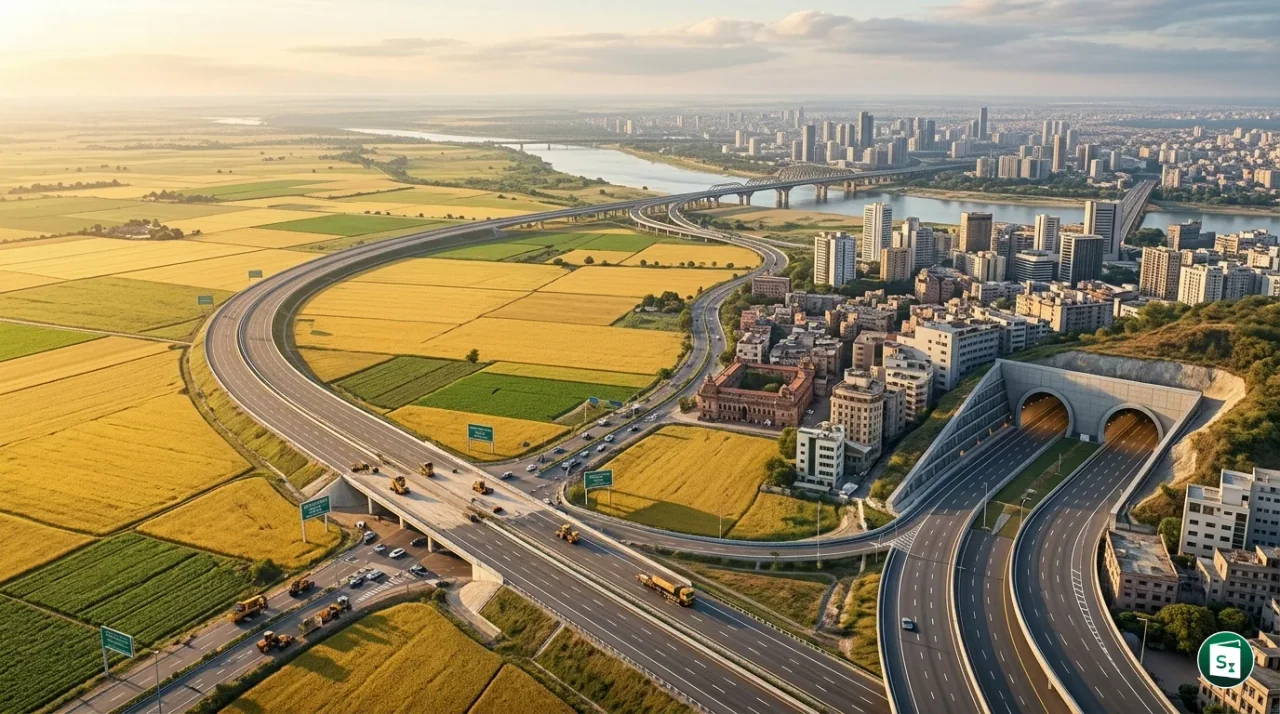
The Cabinet Committee on Economic Affairs (CCEA), chaired by Prime Minister Narendra Modi, approved two major infrastructure projects on 1 July 2026 with a combined investment of Rs 14,114.81 crore. The first is a 117.7 km greenfield highway connecting Kanpur and Kabrai in Uttar Pradesh, forming a crucial link of the proposed Bhopal-Kanpur Economic Corridor. The second is an 8.1 km, six-lane road tunnel in Delhi that will link the Dwarka Expressway with Nelson Mandela Marg in Vasant Kunj, cutting through the Southern Ridge using tunnel boring machine technology.
What Is the Cabinet Committee on Economic Affairs?
The Cabinet Committee on Economic Affairs (CCEA) is one of the highest decision-making bodies in the Union government for economic matters. Established on 14 July 1990, it is chaired by the Prime Minister and includes the Ministers of Defence, Home Affairs, Finance, Road Transport and Highways, Agriculture, External Affairs, Commerce and Industry, and Education, among others. The CCEA reviews economic trends, approves large infrastructure projects, and makes policy decisions related to industry, agriculture, and foreign investment. Both projects approved in this meeting fall under the National Highways (Original) Programme and will be implemented by the National Highways Authority of India (NHAI).
NHAI is an autonomous agency constituted under the NHAI Act, 1988, and it became operational in February 1995. Headquartered in New Delhi, NHAI functions under the Ministry of Road Transport and Highways and is responsible for the development, maintenance, and management of national highways across the country.
The Kanpur-Kabrai Greenfield Highway: Connecting Bundelkhand
The Kanpur-Kabrai Access-Controlled Greenfield Highway is a 117.7 km, four-lane corridor (with structures designed for future expansion to six lanes) estimated to cost Rs 7,145.14 crore. It will be built on the Build-Operate-Transfer (BOT) Toll mode and includes the operation and maintenance of the existing Kanpur-Kabrai section of NH-34. The project is expected to be completed within two and a half years.
A Key Segment of the Bhopal-Kanpur Economic Corridor
This highway forms a critical component of the proposed Bhopal-Kanpur Economic Corridor under the National Highways (Original) Programme. It will provide seamless high-speed connectivity between Kanpur and Kabrai (in Mahoba district) while strengthening onward links to Sagar, Bhopal, and other parts of Madhya Pradesh. The corridor is designed for operating speeds of 80 to 100 km per hour, which will cut travel time between Kanpur and Kabrai from the current 3.5 hours to just 1.5 hours, a reduction of nearly 58%.
Connectivity Network
The highway will integrate with the broader regional road network by connecting with:
| Connection | Description |
|---|---|
| NH-34 and NH-35 | National highways for inter-state movement |
| Bundelkhand Expressway | 296 km expressway inaugurated in July 2022, connecting Chitrakoot to the Agra-Lucknow Expressway |
| Kanpur Ring Road | Orbital road for bypassing city traffic |
| State Highways | SH-46, SH-91, SH-10B, and SH-42 |
The Bundelkhand Expressway, with which this highway will connect, is a four-lane expressway (expandable to six lanes) built at a cost of Rs 14,850 crore across seven districts of Uttar Pradesh. It was inaugurated by the Prime Minister in July 2022 and was completed in a record 28 months.
Economic and Logistics Impact
The Kanpur-Kabrai highway is designed to unlock the economic potential of the Bundelkhand region, which has historically faced challenges of underdevelopment and migration. The corridor will improve access to the Kabrai mining belt, facilitating the movement of minerals, industrial goods, construction materials, and agricultural produce.
The project will improve connectivity to 16 Economic Nodes, including industrial areas in Unnao, Banther, Pankhi, Rania, Jainpur, Rooma, Chakeri, Sumerpur, and Bhuragarh, as well as the Trans Ganga Integrated Township and Growth Centre Jaipur. It will also serve 9 Social Nodes (including tourist and religious destinations) and 10 Logistics Nodes, which include railway stations at Kanpur, Ghatampur, Hamirpur, Mahoba, Kabrai, and Banda, along with airports at Kanpur, Chakeri, and Khajuraho.
The government estimates the project will generate nearly 1.2 crore person-days of direct and indirect employment during construction. Traffic projections indicate the corridor will carry an Annual Average Daily Traffic (AADT) of about 18,069 Passenger Car Units (PCUs) by FY 2028.
The Dwarka Expressway-Vasant Kunj Tunnel: Decongesting South Delhi
The second project approved by the CCEA is an 8.1 km, six-lane road tunnel on NH-148AE connecting the Shiv Murti interchange on the Dwarka Expressway (NH-248BB) with Nelson Mandela Marg in Vasant Kunj, at an estimated cost of Rs 6,969.67 crore. The project will be implemented under the Hybrid Annuity Mode (HAM) and is expected to be completed in five years.
Project Composition
The total 8.1 km project comprises several components designed to ensure smooth traffic flow through one of Delhi’s most congested corridors:
| Component | Length |
|---|---|
| Main carriageway | 6.3 km |
| Twin-tube tunnel | 3.14 km |
| Tunnel approach ramps | 0.98 km |
| Elevated corridor | 2.556 km |
| Reinforced earth wall approaches | 0.554 km |
| At-grade road | 0.870 km |
To address congestion at the busy Nelson Mandela Marg junction, the project also includes a 1.8 km elevated corridor, an additional flyover from Chhatarpur towards Mahipalpur, and an elevated U-turn facility.
Engineering and Environmental Design
The tunnel will be built using Tunnel Boring Machine (TBM) technology, a method that excavates underground with minimal surface disruption. Approximately 1.98 km of the tunnel alignment will run below the Southern Ridge Forest, an ecologically sensitive area that forms the northern extension of the Aravalli mountain range.
The Delhi Ridge is divided into four sections: Northern Ridge, Central Ridge, South-Central Ridge, and Southern Ridge, which is the largest at about 6,200 hectares. In October 2025, the Delhi government declared 41 square kilometres (4,100 hectares) of the Southern Ridge as a reserved forest under Section 20 of the Indian Forest Act, 1927, providing it the highest level of legal protection. By routing the tunnel underground through this area using TBM technology, the project aims to preserve the Ridge’s forest cover and biodiversity while still enabling critical urban connectivity.
Traffic Decongestion and Citywide Connectivity
The tunnel will provide a direct high-speed link for traffic moving between West and South Delhi. Commuters travelling from Gurugram, Dwarka, IGI Airport, and West Delhi towards South Delhi will benefit significantly. The project will also connect with NHAI’s proposed elevated corridor between AIIMS and Mahipalpur, which in turn will link to the Barapullah elevated road, creating an uninterrupted corridor connecting West Delhi, South Delhi, East Delhi, Noida, and Ghaziabad.
The Dwarka Expressway (NH-248BB), which this tunnel extends, is India’s first elevated urban expressway. It spans 27.6 km from Shiv Murti in Mahipalpur to Kherki Daula in Gurugram. The Haryana section was inaugurated in March 2024, and the entire route became fully operational in June 2025.
The government estimates the Delhi tunnel project will generate about 7.54 lakh person-days of direct employment and 9.80 lakh person-days of indirect employment.
BOT vs HAM: Two Different Contracting Models
The two projects have been awarded under different public-private partnership models, reflecting their distinct risk profiles and traffic characteristics.
Build-Operate-Transfer (BOT) Toll Mode
The Kanpur-Kabrai highway will be built on BOT (Toll) mode, where a private developer finances, builds, and operates the highway for a concession period, typically 20 to 30 years. The developer recovers the investment through toll collection and bears the traffic revenue risk. If fewer vehicles use the highway than projected, the developer absorbs the loss. This model was the dominant form of highway development in India before 2014 but declined due to financing difficulties and stressed bank assets. The government has been reviving BOT for high-traffic corridors where toll revenue can sustain private investment.
Hybrid Annuity Model (HAM)
The Delhi tunnel will be built on Hybrid Annuity Mode (HAM), introduced in 2016 specifically to revive private sector interest in highway construction. Under HAM:
- The government contributes 40% of the project cost during construction in milestone-linked instalments
- The developer finances the remaining 60% through equity and debt
- After construction, the government pays semi-annual annuity payments over 15 years covering the developer’s investment plus a fixed return
- The developer is responsible for operation and maintenance during this period
- Toll revenue risk is borne by the government, not the developer
HAM became the dominant model for NHAI projects after 2016 because it balanced risk between the public and private sectors. Over 60% of NHAI’s Bharatmala projects have been awarded under HAM. The key differences between the two models are summarised below:
| Feature | BOT (Toll) | HAM |
|---|---|---|
| Government contribution during construction | None | 40% of project cost |
| Developer’s share | 100% (through equity and debt) | 60% (through equity and debt) |
| Revenue source | Toll collection | Government annuity payments over 15 years |
| Traffic risk | Borne by developer | Borne by government |
| Concession period | 20-30 years | Construction + 15 years O&M |
| Developer’s equity commitment | Higher (25-35% of total cost) | Lower (around 18% of total cost) |
Alignment with PM GatiShakti National Master Plan
Both projects have been aligned with the PM GatiShakti National Master Plan, a digital platform launched in October 2021 for integrated planning and coordinated implementation of infrastructure projects. The plan brings 16 Union Ministries together on a single GIS-based platform to avoid siloed decision-making and reduce project delays.
The Kanpur-Kabrai highway will improve connectivity to 16 Economic Nodes, 9 Social Nodes, and 10 Logistics Hubs, including industrial areas, railway stations, and airports, directly supporting GatiShakti’s objective of multimodal connectivity to economic zones. The Delhi tunnel will integrate with the existing Dwarka Expressway, the proposed AIIMS-Mahipalpur elevated corridor, and the Barapullah elevated road, creating a seamless north-south and east-west urban corridor.
India’s logistics cost currently stands at about 13% of GDP, significantly higher than the global average of around 8%. By improving freight movement efficiency, reducing travel times, and strengthening supply chain connectivity, these two projects contribute to the government’s target of lowering logistics costs to under 10% of GDP.
Key Takeaways
- The CCEA approved two major infrastructure projects on 1 July 2026 at a combined cost of Rs 14,114.81 crore.
- The 117.7 km Kanpur-Kabrai Greenfield Highway will be built on BOT (Toll) mode at Rs 7,145.14 crore and will reduce travel time from 3.5 hours to 1.5 hours.
- It forms a key segment of the Bhopal-Kanpur Economic Corridor and will connect with the Bundelkhand Expressway, which was inaugurated in July 2022.
- The 8.1 km Dwarka Expressway-Vasant Kunj tunnel in Delhi, costing Rs 6,969.67 crore, will be built on Hybrid Annuity Mode (HAM) and is expected to be completed in five years.
- The tunnel includes a 3.14 km twin-tube section using Tunnel Boring Machine (TBM) technology, with 1.98 km passing below the ecologically sensitive Southern Ridge Forest.
- Both projects align with the PM GatiShakti National Master Plan, launched in October 2021, to improve multimodal connectivity and reduce India’s logistics costs.