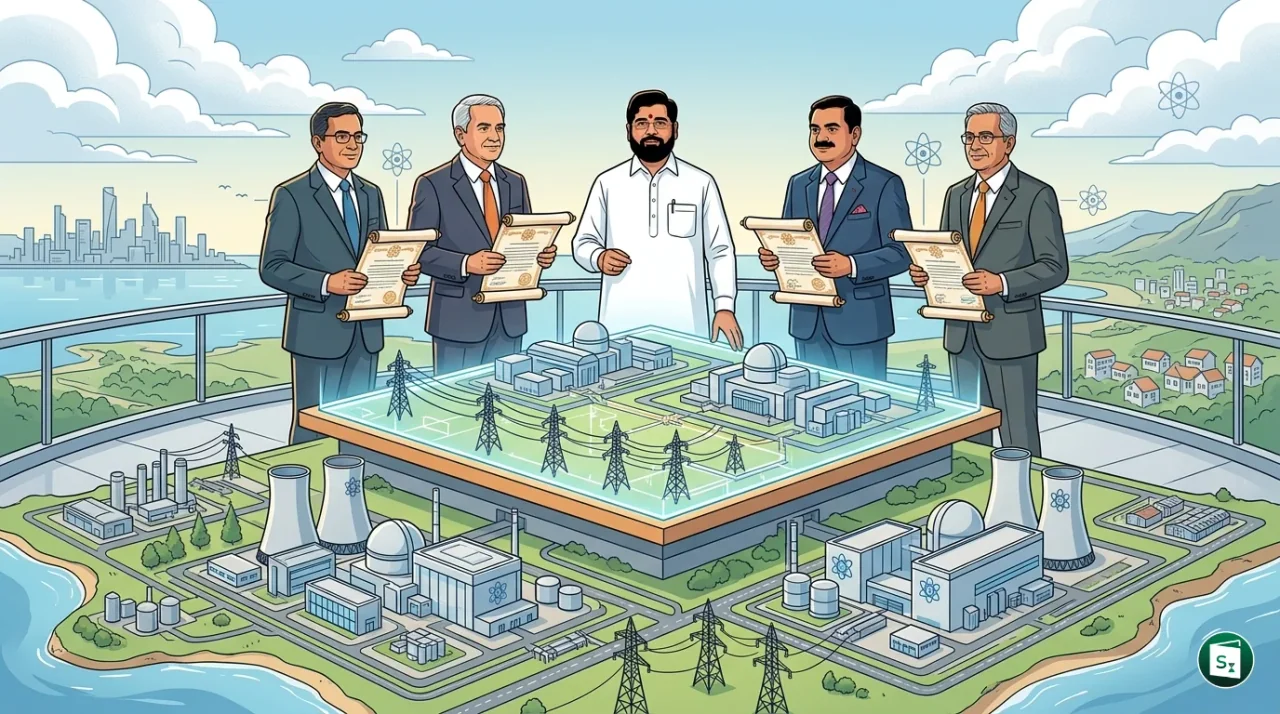
The Maharashtra government has signed landmark Memorandums of Understanding worth ₹6.5 lakh crore with four major energy companies to develop 25,400 MW of nuclear power capacity across the state. This massive investment, involving NTPC, Adani Power, Reliance Industries, and Lalitpur Power Generation Company, marks the first major entry of private players into India’s nuclear energy sector. The move positions Maharashtra as a primary hub for clean energy as the nation transitions toward its ambitious net-zero carbon goals.
A Historic Pivot: Private Sector Entry into Nuclear Power
The signing of these agreements follows the implementation of the Sustainable Harnessing and Advancement of Nuclear Energy for Transforming India (SHANTI) Act, 2025. Passed in December 2025, this landmark legislation effectively ended the six-decade state monopoly on nuclear power generation in India. Previously, the Atomic Energy Act of 1962 restricted the development of nuclear energy to the Department of Atomic Energy (DAE) and public sector units like the Nuclear Power Corporation of India Limited (NPCIL).
Under the new policy framework, private and foreign companies can now build, own, and operate nuclear power plants through joint ventures with the government. The SHANTI Act also resolved long-standing issues regarding supplier liability by capping financial obligations, making nuclear projects more viable for private investment. While the private sector is now permitted to generate power, the central government retains exclusive control over sensitive stages of the fuel cycle, including uranium mining and fuel fabrication.
Breakdown of the Massive ₹6.5 Lakh Crore Investment
The four companies have committed to specific projects that will contribute to Maharashtra’s energy security and industrial growth. The projects are strategically located to take advantage of coastal infrastructure for cooling and logistics.
| Company | Investment | Capacity | Proposed Location |
|---|---|---|---|
| Reliance Industries | ₹2,00,000 crore | 7,200 MW | Purnagad, Ratnagiri |
| Adani Power | ₹1,50,000 crore | 6,000 MW | Barsu, Ratnagiri |
| NTPC Limited | ₹1,00,000 crore | 7,200 MW | Devgad, Sindhudurg |
| Lalitpur Power (LPGCL) | ₹2,00,000 crore | 5,000 MW | To be finalized |
The NTPC Limited project in Devgad is expected to create around 5,000 jobs, while Reliance Industries has projected the creation of over 1,00,000 jobs through its nuclear and auxiliary initiatives. The Maharashtra government has committed to providing full administrative and technical support for site surveys and feasibility studies, which are set to begin immediately.
The Strategic Importance of the Konkan Nuclear Cluster
The concentration of these projects in the Konkan region, particularly in Ratnagiri and Sindhudurg districts, is a strategic choice. These coastal areas provide the necessary water for reactor cooling and simplify the logistics of transporting heavy equipment. The Konkan coast is already home to the Jaitapur Nuclear Power Project, a 9,900 MW facility being developed by the NPCIL in collaboration with the French firm EDF. With these new MoUs, the region is set to become one of the largest nuclear energy clusters in the world.
The push for nuclear energy is driven by the surging demand for baseload power from Maharashtra’s expanding industrial sector. New age infrastructure such as AI data centers and semiconductor fabrication plants requires uninterrupted, 24/7 power that weather dependent renewables like solar and wind cannot always provide. Furthermore, the state government is planning to replace aging, high emission thermal power plants with cleaner nuclear facilities to meet its decarbonization targets.
Understanding Small Modular Reactors (SMRs)
A significant feature of the new MoUs, particularly the one with Reliance Industries, is the focus on Small Modular Reactors (SMRs) and the Bharat Small Reactor (BSR). Unlike traditional large scale nuclear reactors that produce over 700 MW of power and take a decade to build, SMRs are smaller units with a capacity of up to 300 MW per module. These reactors are factory built and can be transported to a site for rapid assembly.
SMRs offer several advantages, including enhanced safety features that allow for passive cooling, meaning they do not always require active operator intervention or external power to shut down safely. Their modular nature also allows for a “plug and play” approach, where additional units can be added as power demand grows. This makes them ideal for captive power use by large industrial complexes or remote regions.
Analogy · Traditional Power Plants vs. SMRs Expand analogy
Think of a traditional nuclear plant as a massive, custom-built mansion that takes years of careful construction on-site. In contrast, an SMR is like a high-quality modular home where individual rooms are built in a factory and then quickly assembled on your land. While the mansion is grand, the modular home is faster to set up, easier to expand, and more adaptable to your changing needs.
India’s Roadmap to 100 GW Nuclear Capacity by 2047
The massive scale of investment in Maharashtra is a critical step toward India’s national nuclear energy targets. The central government has set an ambitious goal to reach 100 GW of nuclear power capacity by 2047, the centenary of India’s independence. Currently, the country’s operational nuclear capacity stands at approximately 8.8 GW, which is less than 2 percent of the total power mix.
To bridge this gap, the government is pursuing a multi pronged strategy that includes the rapid deployment of indigenous 700 MW Pressurised Heavy Water Reactors (PHWRs), the construction of large scale foreign reactors, and the new focus on SMRs. The Maharashtra projects alone represent more than a quarter of the 100 GW target, highlighting the state’s pivotal role. This expansion is essential for India to meet its Net Zero by 2070 commitment while supporting the energy intensive needs of a growing economy.
Key Takeaways
- The Maharashtra government signed MoUs worth ₹6.5 lakh crore with NTPC, Adani Power, Reliance Industries, and LPGCL for nuclear energy development.
- The projects aim to establish a total power generation capacity of 25,400 MW across the state.
- The SHANTI Act, 2025 is the key legislative catalyst that ended the state monopoly and allowed private sector participation in nuclear power.
- Reliance Industries plans to focus on Small Modular Reactors (SMRs) and Bharat Small Reactors (BSR) at its Purnagad site.
- The projects are concentrated in the Konkan region, specifically in the Ratnagiri and Sindhudurg districts, due to coastal advantages.
- India aims to increase its nuclear power capacity from the current 8.8 GW to 100 GW by 2047.