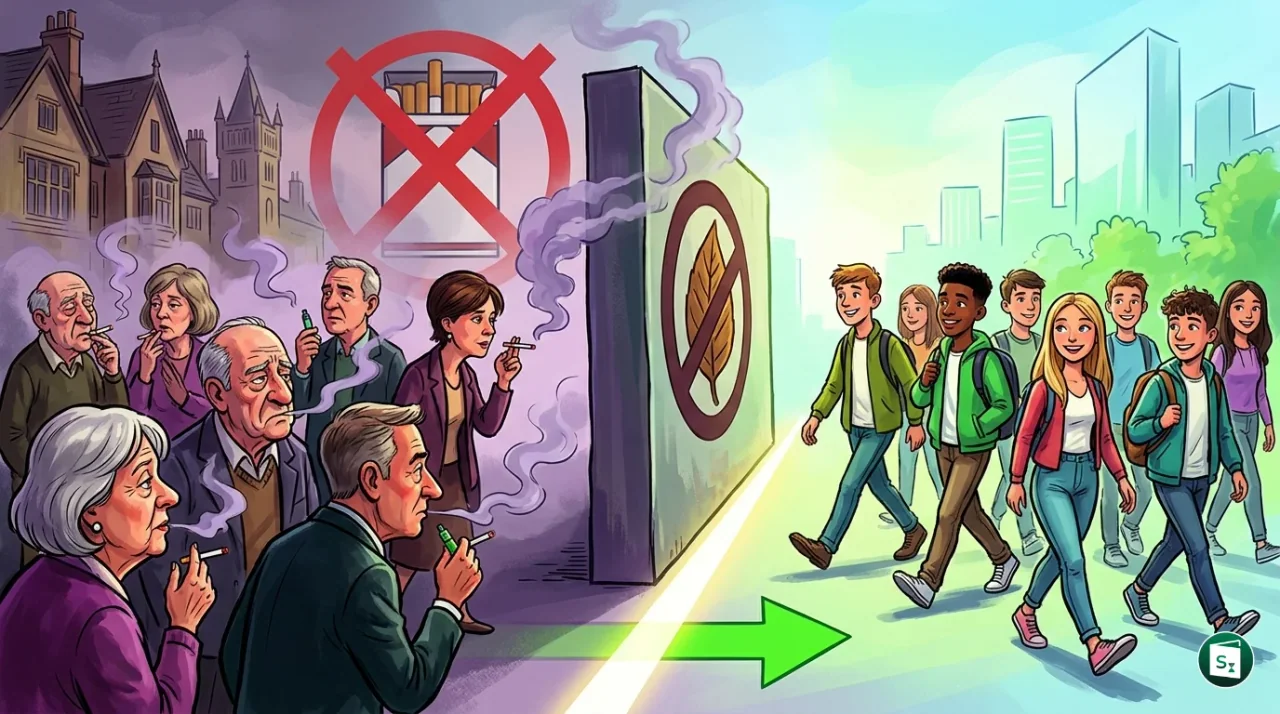
The United Kingdom has enacted the Tobacco and Vapes Act 2026, a world-first legislation aimed at creating a smoke-free generation by permanently banning tobacco sales to those born after 2008. By introducing a rolling age limit that increases annually, the law ensures that today’s children will never legally reach the minimum age to purchase tobacco products. This landmark intervention positions the UK at the forefront of global public health policy, targeting the leading cause of preventable death and economic burden on the healthcare system.
A Historic Milestone: The Generational Smoking Ban
The core provision of the Act is the introduction of a generational smoking ban, which targets individuals born on or after January 1, 2009. Unlike traditional tobacco control measures that set a fixed minimum age, this legislation creates a rolling restriction. Starting in January 2027, the legal age for purchasing tobacco will increase by one year every single year. This ensures that the generation born in 2009 and later will never legally reach the minimum age required to buy cigarettes, effectively phasing out smoking from the population over time.
The law focuses strictly on the sale of tobacco products rather than the act of smoking or possession. Retailers are now legally responsible for verifying the age of customers, with strict penalties for those who sell to the restricted generation. Individuals who already smoke or those born before the 2009 cutoff are not criminalized or prohibited from purchasing tobacco, ensuring the policy remains a forward-looking health intervention rather than a retroactive prohibition.
Strict Regulations on Vaping and E-Cigarettes
Recognizing the rise in youth vaping, the Act introduces aggressive measures to curb the appeal of electronic cigarettes to children. The government has been granted broad powers to regulate vape flavors, packaging, and display in retail stores. This includes potential bans on flavors with confectionery names like “bubblegum” or “cotton candy” and the introduction of plain packaging similar to traditional cigarette boxes.
Furthermore, the legislation has implemented a complete ban on single-use (disposable) vapes, which were previously criticized for their environmental impact and ease of access for minors. To further discourage use, a new vaping products duty will take effect in October 2026, imposing a tax of £2.20 per 10ml of e-liquid. These measures reflect a dual strategy: using traditional tobacco as a target for total elimination while tightly controlling vaping to ensure it remains a smoking cessation tool for adults rather than a gateway for children.
The Health and Economic Imperative for the UK
The driving force behind this unprecedented legislation is the staggering cost of smoking to the British society. Smoking remains the leading cause of preventable death in the UK, accounting for approximately 80,000 deaths annually and causing one in four of all cancer-related deaths. The National Health Service (NHS) handles over 400,000 smoking-related hospital admissions every year, placing an immense strain on medical resources and primary care services.
From an economic perspective, the burden is equally significant. The total societal cost of smoking in England alone is estimated at £21.8 billion per year, including direct costs to the NHS and social care, as well as massive losses in productivity due to illness and premature death. While the government collects roughly £9 billion in tobacco excise duties annually, this revenue is dwarfed by the total economic damage. By phasing out tobacco, the government projects a long-term net benefit of approximately £70 billion by 2100, driven by improved public health and the redirection of consumer spending toward more productive sectors of the economy.
| Metric | Annual Statistic (UK/England) |
|---|---|
| Smoking-related deaths | ~80,000 |
| Cancer deaths caused by smoking | 1 in 4 |
| Smoking-related hospital admissions | Over 400,000 |
| Total societal cost of smoking | ~£25.2 billion |
| Direct cost to the NHS | ~£1.9 billion to £2.6 billion |
| Tobacco tax revenue | ~£9 billion |
Global Divergence: Comparison with New Zealand
The UK’s approach was originally inspired by a similar policy enacted in New Zealand in 2022. However, the two countries have since taken divergent paths. While the UK has successfully enacted its generational ban with rare cross-party support, New Zealand officially repealed its landmark legislation in early 2024. The New Zealand government cited economic concerns, the need for tax revenue to fund other policies, and fears of a burgeoning black market as reasons for the reversal.
In contrast, the UK government has doubled down on the policy, arguing that the long-term savings for the healthcare system far outweigh the immediate loss in tobacco tax revenue. Additionally, the UK Act is notably more aggressive in its regulation of vaping. While New Zealand initially promoted vaping as a primary tool for smoking cessation, the UK has prioritized preventing youth nicotine addiction by banning disposable vapes and restricting child-friendly flavors and branding. This divergence highlights the UK’s commitment to a more comprehensive, “smoke-free” future that addresses both traditional tobacco and modern electronic alternatives.
Key Takeaways
- The Tobacco and Vapes Act 2026 introduces a historic generational smoking ban, making it illegal to sell tobacco to anyone born on or after January 1, 2009.
- The law uses a rolling age limit mechanism, where the legal purchase age will increase by one year every year starting from January 1, 2027.
- In addition to tobacco restrictions, the Act permanently bans single-use (disposable) vapes and introduces new powers to regulate vape flavors and packaging.
- Smoking is responsible for approximately 80,000 deaths per year in the UK and costs the British economy an estimated £21.8 billion annually in England alone.
- A new vaping products duty of £2.20 per 10ml of e-liquid is scheduled to take effect in October 2026 to discourage youth uptake.
- The UK’s policy stands in contrast to New Zealand, which recently repealed its own version of the generational ban due to economic and enforcement concerns.