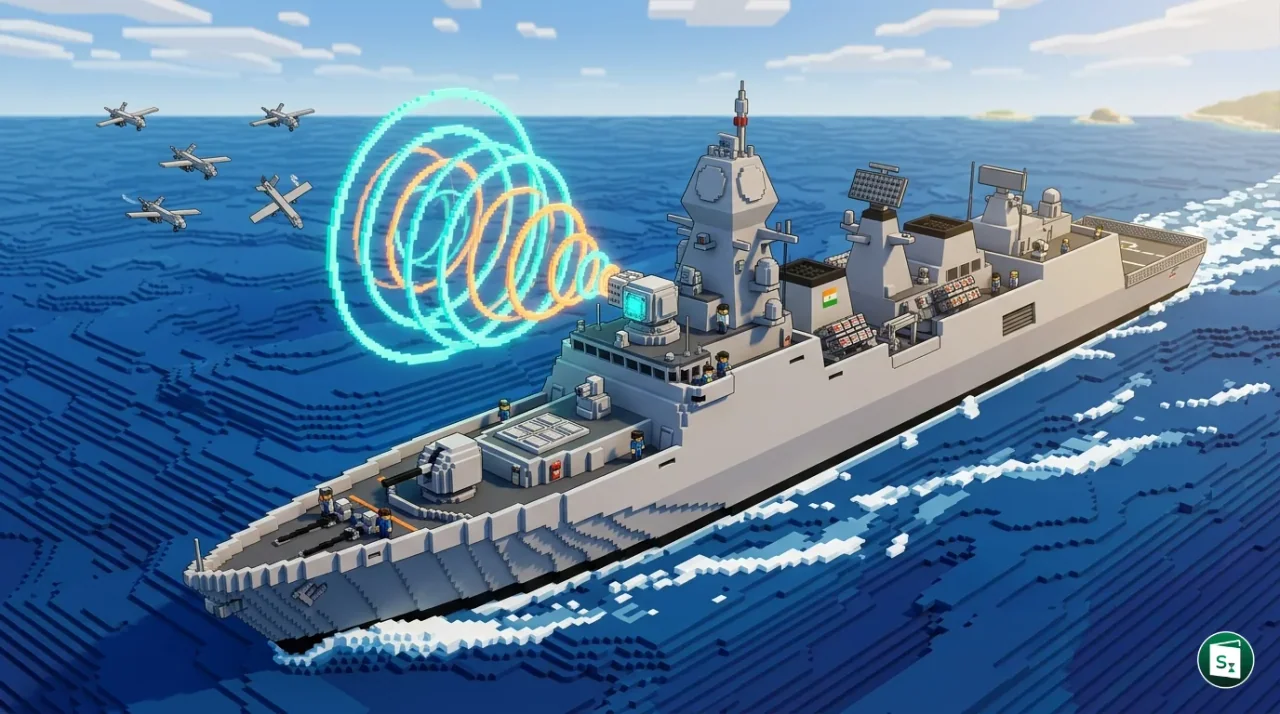
The Indian Navy has awarded a contract to Tonbo Imaging to integrate High Power Microwave (HPM) systems on its naval platforms. Secured under the ADITI 3.0 innovation framework, the project aims to develop indigenous directed-energy capabilities to counter electronic and unmanned threats in maritime warfare. This initiative marks a significant step in India’s transition toward non-kinetic defensive measures and electronic spectrum dominance.
What are High Power Microwave (HPM) Systems?
A High Power Microwave (HPM) system is a type of Directed Energy Weapon (DEW) that utilizes concentrated pulses of electromagnetic energy to neutralize targets. Unlike traditional kinetic weapons that use projectiles or explosives, HPM systems focus on “soft-kill” measures by disrupting, degrading, or permanently damaging the electronic internal components of an adversary’s equipment.
When these microwave pulses hit a target, they induce high-voltage surges in its electronic circuitry. This can instantly disable the navigation systems of unmanned aerial vehicles (UAVs), blind sensors on incoming missiles, or jam communication arrays. The HPM system developed by Tonbo Imaging is particularly unique as it leverages vacuum tube-based sources. While many modern systems use solid-state components, vacuum tubes are essential for generating the extreme peak power and pulse energy required for maritime operations where size and weight constraints are tight.
| Feature | Description |
|---|---|
| Weapon Type | Non-kinetic Directed Energy Weapon (DEW) |
| Mechanism | Electromagnetic pulse induction in electronic circuits |
| Primary Target | Drone swarms, sensors, and electronic guidance systems |
| Key Advantage | Low cost per shot and nearly instantaneous delivery |
ADITI 3.0: Paving the Way for Deep-Tech Sovereignty
The ADITI (Acing Development of Innovative Technologies with iDEX) scheme is a high-impact initiative designed to foster the development of deep-tech strategic technologies for the Indian Armed Forces. Operating under the broader Innovations for Defence Excellence (iDEX) framework and managed by the Defence Innovation Organisation (DIO), ADITI focuses on critical gaps in India’s indigenous defense capabilities.
Launched originally in March 2024 with a budget of ₹750 crore, the scheme provides substantial financial backing to startups and MSMEs. Specifically, under ADITI 3.0, selected partners can receive grants of up to ₹25 crore to fund research, validation, and operational testing. The scheme acts as an “incubation” layer, supporting long-term projects that are too complex for standard innovation challenges. By targeting approximately 30 deep-tech areas, ADITI ensures that the Indian military has access to cutting-edge tools like HPM systems that were previously sourced primarily from foreign vendors.
Strategic Value for the Indian Navy’s Modernization
In modern naval warfare, the threat from asymmetric actors has increased dramatically. Cheap, swarming drones and precision-guided munitions can overwhelm traditional kinetic defense systems like missiles and guns. High Power Microwave systems offer a robust solution to this “swarming” problem. Since they travel at the speed of light and do not require physical ammunition, HPM weapons provide an “unlimited magazine” as long as the ship’s power supply is active.
The integration of these systems onto naval platforms significantly enhances the protection of carrier battle groups and high-value offshore assets. By neutralizing the electronics of incoming threats before they can get close, the Navy can preserve its expensive surface-to-air missiles for more substantial targets. Furthermore, this indigenous development aligns with the Atmanirbhar Bharat vision, ensuring that the Indian Navy retains a technological edge without being dependent on international supply chains for sensitive electronic warfare components.
Tonbo Imaging: Leading the Indigenous Defence Revolution
Headquartered in Bengaluru, Tonbo Imaging is a premier Indian defense technology firm specializing in advanced electro-optics, night vision, and thermal imaging. The company has gained international acclaim for its “intelligent” imaging systems, which are utilized by elite global forces including the US Navy SEALs, NATO, and the Israeli Defense Forces. Its name, “Tonbo,” is the Japanese word for dragonfly, inspired by the insect’s sophisticated compound eyes.
Tonbo Imaging is a crucial player in India’s Atmanirbhar Bharat initiative, with its products actively deployed for monitoring the Line of Control (LoC) and the Line of Actual Control (LAC). The company’s expertise recently secured a place in history when its Night Vision Devices were used by Indian Special Forces during the 2016 Uri surgical strikes. By securing the HPM contract under ADITI 3.0, Tonbo has further solidified its position as a global leader in high-end defense electronics, owning the core intellectual property for the vacuum tube technologies that power these futuristic weapons.
Key Takeaways
- The Indian Navy has awarded a contract to Tonbo Imaging for High Power Microwave (HPM) systems under the ADITI 3.0 innovation framework.
- HPM systems are a type of Directed Energy Weapon (DEW) that neutralize targets by disrupting electronic circuits using high-voltage electromagnetic pulses.
- The ADITI (Acing Development of Innovative Technologies with iDEX) scheme provides financial grants of up to ₹25 crore to startups and MSMEs for deep-tech research.
- iDEX was launched by the Government of India in 2018 to foster innovation and technology development in the defense and aerospace sectors.
- Tonbo Imaging, a Bengaluru-based firm, is one of the few private companies globally to own core IP for the vacuum tube technologies required for HPM systems.
- The project is a major step toward Atmanirbhar Bharat in the domain of non-kinetic and electronic warfare.