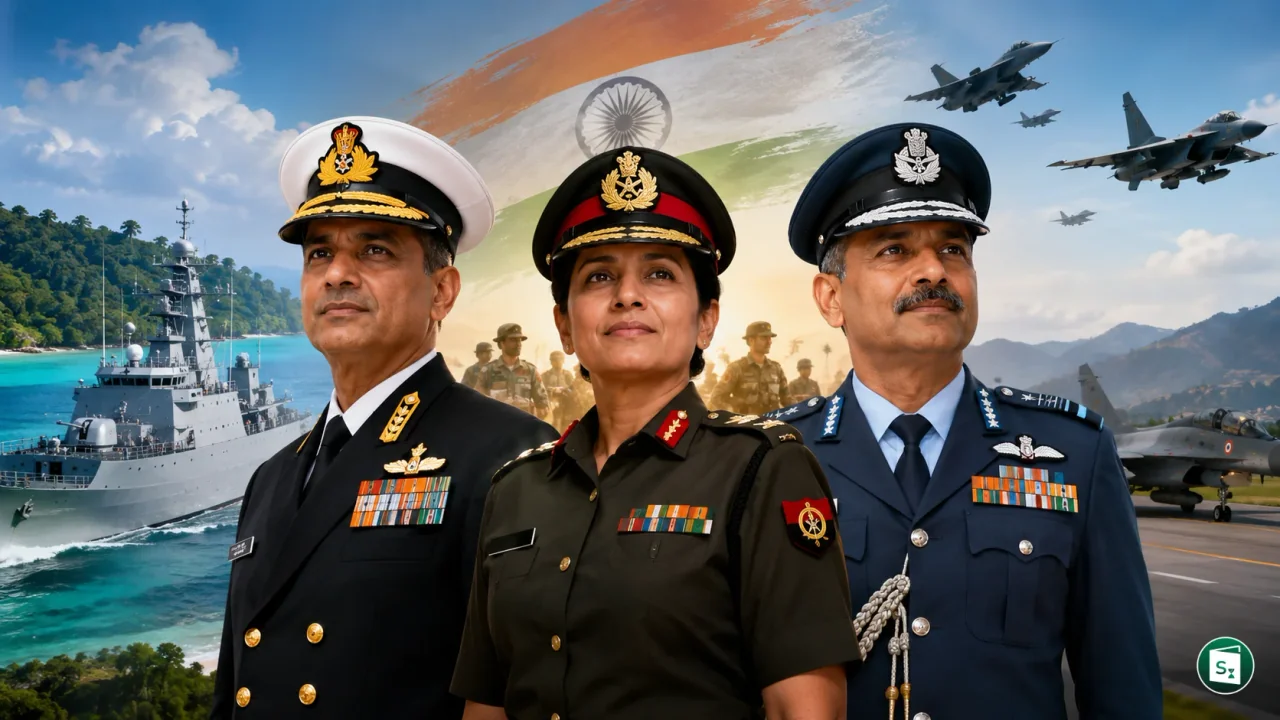
The Indian Armed Forces witnessed a series of high-level leadership transitions on June 1, 2026, across its strategic tri-service command and specialized wings. Vice Admiral Vineet McCarty took charge as the 20th Commander-in-Chief of the Andaman and Nicobar Command, while new heads were appointed for the Military Nursing Service and the IAF’s Central Air Command. These appointments mark a significant shift in India’s operational and medical leadership during a period of heightened focus on maritime security and jointness.
Vice Admiral Vineet McCarty Takes Charge as 20th CINCAN
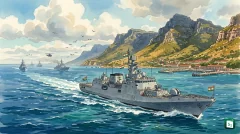
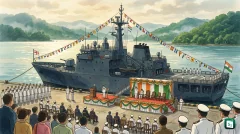
Vice Admiral Vineet McCarty assumed charge as the 20th Commander-in-Chief of the Andaman and Nicobar Command (CINCAN) on June 1, 2026. He succeeds Vice Admiral Ajay Kochhar, who has moved on to a new assignment as the Vice Chief of Naval Staff. The handing over ceremony was held at the INS Utkrosh naval air station in Sri Vijaya Puram (formerly Port Blair), where a ceremonial guard of honour was presented.
Vice Admiral McCarty is a specialist in Gunnery and Missiles, having been commissioned into the Indian Navy on July 1, 1989. His illustrious career includes commanding frontline warships such as the stealth frigate INS Shivalik, INS Khanjar, and INS Ajay. Before taking over the unified command at Port Blair, he served as the Flag Officer Commanding Western Fleet (FOCWF) and was the 10th Commandant of the Indian Naval Academy at Ezhimala. He has also held significant tri-service roles at the Headquarters Integrated Defence Staff (HQ IDS), focusing on policy planning and force development.
Strategic Significance of the Andaman and Nicobar Command
The Andaman and Nicobar Command (ANC), established on October 1, 2001, is India’s first and only integrated tri-service command. It was created based on the recommendations of the Kargil Review Committee (1999) to ensure a unified operational response in the strategically sensitive Bay of Bengal and Andaman Sea. The command integrates the assets and personnel of the Indian Army, Indian Navy, Indian Air Force, and the Indian Coast Guard under a single operational commander.
The ANC is often described as India’s “unsinkable aircraft carrier” due to its proximity to the Strait of Malacca, a vital global maritime choke point. The command is responsible for safeguarding India’s Exclusive Economic Zone (EEZ), which accounts for nearly 30% of the country’s total EEZ due to the sprawling island chain. It also plays a lead role in Humanitarian Assistance and Disaster Relief (HADR) operations and coordinates with regional navies through coordinated patrols and multilateral exercises like MILAN.
New Leadership in Military Nursing Service: Major General Rachel Thomas
Major General Rachel Thomas assumed the appointment of Additional Director General (ADG) of the Military Nursing Service (MNS) on June 1, 2026. She succeeds Major General Lissamma PV, who retired from service on May 31, 2026. Major General Thomas is an alumna of the College of Nursing, Armed Forces Medical College (AFMC), Pune, and was commissioned into the MNS on June 1, 1988.
With a career spanning nearly 38 years, Major General Thomas has held various clinical and administrative roles across the Armed Forces Medical Services (AFMS). Her experience includes serving in border hospitals under the Northern and Eastern Commands, providing critical medical support in operationally sensitive areas. Prior to her current appointment, she served as the Principal Matron at the Army Hospital (Research & Referral) in New Delhi.
The Evolution of the Military Nursing Service
The Military Nursing Service (MNS) is an all-woman, all-officer corps of the Indian Army. While its origins date back to 1888, it was formally constituted as a permanent part of the Armed Forces on October 1, 1926, which is celebrated annually as the MNS Corps Day. The service was the first in the Indian Army to grant commissioned ranks to women, starting during World War II in 1943.
MNS officers play a vital role in providing nursing care in military hospitals during both peace and war. Beyond clinical duties, they are integral to India’s UN Peacekeeping Missions and disaster relief efforts. In a landmark development in early 2026, the Government of India granted Ex-Servicemen (ESM) status to retired MNS officers, ensuring they receive the same post-retirement benefits and welfare schemes as their counterparts in other branches of the military.
Air Marshal Tarun Chaudhry Leads Central Air Command
Air Marshal Tarun Chaudhry assumed charge as the Air Officer Commanding-in-Chief (AOC-in-C) of the Central Air Command (CAC) on June 1, 2026. He succeeds Air Marshal Balakrishnan Manikantan, who retired after a distinguished career of four decades. Air Marshal Chaudhry was commissioned into the Fighter stream of the Indian Air Force in December 1989 and has since accumulated over 36 years of operational and staff experience.
His career highlights include serving as the Defence Attaché at the Indian Embassy in Sweden, with concurrent accreditation to Norway, Finland, and Denmark. He has also held key positions at the Headquarters Integrated Defence Staff (HQ IDS) and Air Headquarters, specializing in acquisition planning and human resource management. Prior to taking the helm at CAC, he served as the Senior Air Staff Officer (SASO) at Headquarters Southern Air Command.
Role and Responsibility of the Central Air Command
Headquartered in Prayagraj (formerly Allahabad), Uttar Pradesh, the Central Air Command (CAC) is one of the five operational commands of the Indian Air Force. It was initially established in 1962 in Calcutta before moving to its current location in 1966. The command is responsible for air operations across a vast region of central India, providing essential strategic depth to both the northern and western fronts.
The CAC oversees several major airbases, including those in Agra, Gwalior, Bareilly, and Gorakhpur. It is the “custodian” of many of the IAF’s high-value strategic assets, including the Mirage 2000 and Su-30MKI squadrons. The command’s motto, Damniyah Atmashatravah (“Destroy the Enemy”), reflects its commitment to air defence and offensive operations. Beyond combat readiness, the CAC is frequently deployed for Humanitarian Assistance and Disaster Relief (HADR), playing a critical role in rescue operations during national emergencies.
Strategic Impact of These Appointments
The concurrent appointments of these senior officers highlight the Indian Armed Forces’ focus on strategic continuity and specialized expertise. The transition at the Andaman and Nicobar Command is particularly crucial as India strengthens its maritime posture in the Indo-Pacific to counter emerging regional challenges. Similarly, the leadership change at the Central Air Command ensures the continued operational readiness of India’s strategic air assets located in the heart of the country.
In the Military Nursing Service, the appointment of Major General Rachel Thomas coincides with a new era for the corps following the recent grant of Ex-Servicemen status. This move not only addresses long-standing disparities but also reinforces the government’s commitment to gender parity and the recognition of women’s contributions to the armed forces. Together, these leadership changes are expected to drive forward India’s goals of inter-service jointness and modernization across all wings of the military.
Key Takeaways
- Vice Admiral Vineet McCarty assumed charge as the 20th Commander-in-Chief of the Andaman and Nicobar Command (CINCAN) on June 1, 2026.
- The Andaman and Nicobar Command, established in 2001, is India’s first and only integrated tri-service command headquartered in Sri Vijaya Puram.
- Major General Rachel Thomas was appointed as the Additional Director General of the Military Nursing Service (MNS), succeeding Major General Lissamma PV.
- The Military Nursing Service, which celebrated its permanent status in 1926, recently secured Ex-Servicemen (ESM) status for its retired officers in 2026.
- Air Marshal Tarun Chaudhry took charge as the Air Officer Commanding-in-Chief of the Central Air Command (CAC) in Prayagraj.
- The Central Air Command is the custodian of the IAF’s strategic squadrons, including the Mirage 2000 and Su-30MKI.