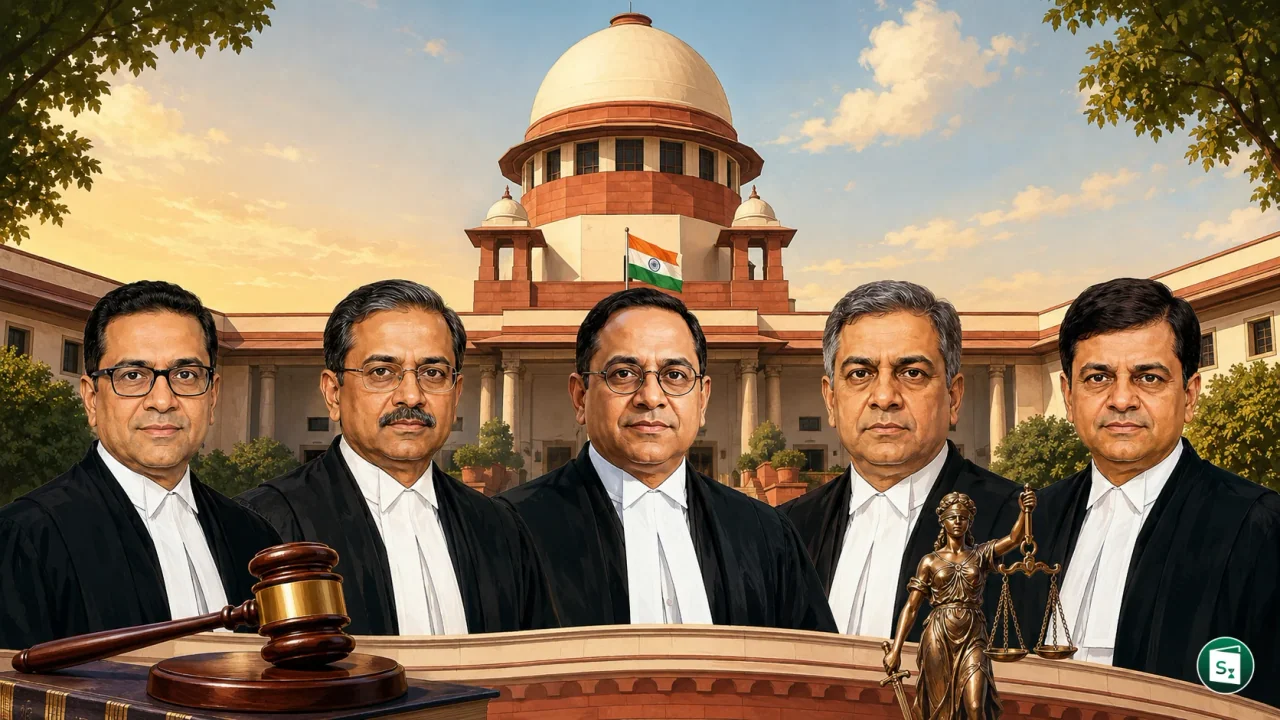
India’s Supreme Court reached a near-full capacity of 37 judges on June 2, 2026, following the appointment of five new jurists to the bench. This expansion, which leaves only one vacancy against the newly sanctioned strength of 38, includes a mix of senior advocates and High Court Chief Justices. The move is seen as a major step toward addressing the mounting case pendency and ensuring the timely functioning of Constitution Benches.
Strengthening the Apex Court: The New Appointments
The five new judges were recommended by the Supreme Court Collegium, led by Chief Justice of India Surya Kant. Their appointments were officially notified by the Central Government on June 1, 2026, following a thorough vetting process. The diversity of the new appointees, coming from both the Bar and the Bench of various High Courts, aims to bring a broad range of legal expertise to the apex court.
| Judge Name | Previous Position |
|---|---|
| Venkita Subramani Mohana | Senior Advocate, Supreme Court |
| Justice Shree Chandrashekhar | Chief Justice, Bombay High Court |
| Justice Sheel Nagu | Chief Justice, Punjab and Haryana High Court |
| Justice Sanjeev Sachdeva | Chief Justice, Madhya Pradesh High Court |
| Justice Arun Palli | Chief Justice, J&K and Ladakh High Court |
Among the appointees, Venkita Subramani Mohana holds a historic distinction. She is only the second woman in Indian judicial history to be elevated directly from the Bar to the Supreme Court bench. The first was Justice Indu Malhotra, who was appointed in 2018. Senior Advocate Mohana has had an extensive practice in the Supreme Court for over three decades and was designated as a Senior Advocate in 2015.
The other four judges have served as Chief Justices of prominent High Courts. Their elevation follows the principle of seniority and representation from different regions, ensuring that the Supreme Court reflects a national character. For instance, Justice Shree Chandrashekhar was the Chief Justice of the Bombay High Court, while Justice Arun Palli headed the High Court of Jammu & Kashmir and Ladakh.
The Constitutional Framework for Judicial Appointments
The appointment of judges to the Supreme Court is governed by Article 124 of the Constitution of India. According to Article 124(2), every judge of the Supreme Court is appointed by the President of India by warrant under his hand and seal. The President makes these appointments after consultation with such judges of the Supreme Court and of the High Courts in the states as the President may deem necessary.
For the appointment of any judge other than the Chief Justice of India (CJI), the consultation with the CJI is mandatory. This ensures that the judiciary has a significant voice in its own composition, maintaining its independence from the executive branch. Over time, through various judicial interpretations, the term “consultation” has been established to mean “concurrence,” making the recommendation of the judiciary virtually binding on the government.
A person is eligible to be appointed as a Supreme Court judge if they are a citizen of India and meet one of the following criteria:
- Has been a judge of a High Court for at least five years.
- Has been an advocate of a High Court for at least ten years.
- Is a distinguished jurist in the opinion of the President.
Upon appointment, a Supreme Court judge holds office until they reach the age of 65 years. They can resign by writing to the President or can be removed by the President only after an address by each House of Parliament, supported by a special majority, on the grounds of proved misbehaviour or incapacity.
Understanding the Supreme Court’s Sanctioned Strength
The sanctioned strength of the Supreme Court is not fixed by the Constitution. Instead, Article 124(1) states that the Supreme Court shall consist of a Chief Justice of India and, until Parliament by law prescribes a larger number, of not more than seven other judges. This means only Parliament has the authority to increase the number of judges in the apex court.
In May 2026, the government promulgated the Supreme Court (Number of Judges) Amendment Ordinance, 2026, increasing the sanctioned strength from 34 to 38 judges (including the CJI). This was the first such increase since 2019, when the strength was raised from 31 to 34. The decision followed a request from the judiciary to address the backlog of over 80,000 pending cases and to allow for more frequent sittings of Constitution Benches, which require at least five judges.
| Year | Sanctioned Strength (including CJI) |
|---|---|
| 1950 | 8 |
| 1960 | 14 |
| 1977 | 18 |
| 1986 | 26 |
| 2009 | 31 |
| 2019 | 34 |
| 2026 | 38 |
The expansion to 38 judges is a strategic move to ensure that the judiciary can handle complex legal questions and fundamental rights cases without delaying regular appellate work. With 37 judges now in office, the court is operating at its highest-ever working strength.
Role and Significance of the Collegium System
While the Constitution provides for judicial appointments, the specific method used today is the Collegium system. This system is not mentioned in the text of the Constitution but has evolved through a series of Supreme Court judgments known as the Three Judges Cases. The system ensures that the senior-most members of the judiciary have the primary say in selecting judges for the higher courts.
The evolution of the Collegium system is summarized through these landmark cases:
- First Judges Case (1981): The court ruled that the term “consultation” used in Article 124 did not mean “concurrence,” giving the executive the ultimate power in appointments.
- Second Judges Case (1993): The court reversed its earlier position, ruling that “consultation” meant “concurrence.” This established the Collegium system, initially consisting of the CJI and two senior-most judges.
- Third Judges Case (1998): On a reference from the President, the court expanded the Collegium to its current form, consisting of the Chief Justice of India and four senior-most judges of the Supreme Court.
The Collegium system is often defended as a safeguard for the Independence of the Judiciary, which the Supreme Court has declared as part of the Basic Structure of the Constitution. In 2015, the Supreme Court struck down the National Judicial Appointments Commission (NJAC) Act, which sought to give the executive a greater role in appointments, further cementing the primacy of the Collegium.
The current appointments of June 2026 were made based on the recommendations of a Collegium led by CJI Surya Kant. The process involves the Collegium identifying candidates, the government conducting background checks via the Intelligence Bureau, and the final notification by the Law Ministry. If the Collegium unanimously reiterates a recommendation that the government has returned, the government is constitutionally bound to appoint that person.
Key Takeaways
- The working strength of the Supreme Court of India reached 37 judges on June 2, 2026, following five new appointments.
- The sanctioned strength of the Supreme Court was increased from 34 to 38 in May 2026 through an ordinance amending the Supreme Court (Number of Judges) Act, 1956.
- Venkita Subramani Mohana became the second woman in history to be elevated directly from the Bar to the Supreme Court bench.
- Under Article 124(1) of the Constitution, only Parliament has the authority to increase the number of judges in the Supreme Court.
- The Collegium for Supreme Court appointments consists of the Chief Justice of India and the four senior-most judges of the apex court.
- A Supreme Court judge holds office until the age of 65 years, as prescribed under Article 124(2) of the Constitution.