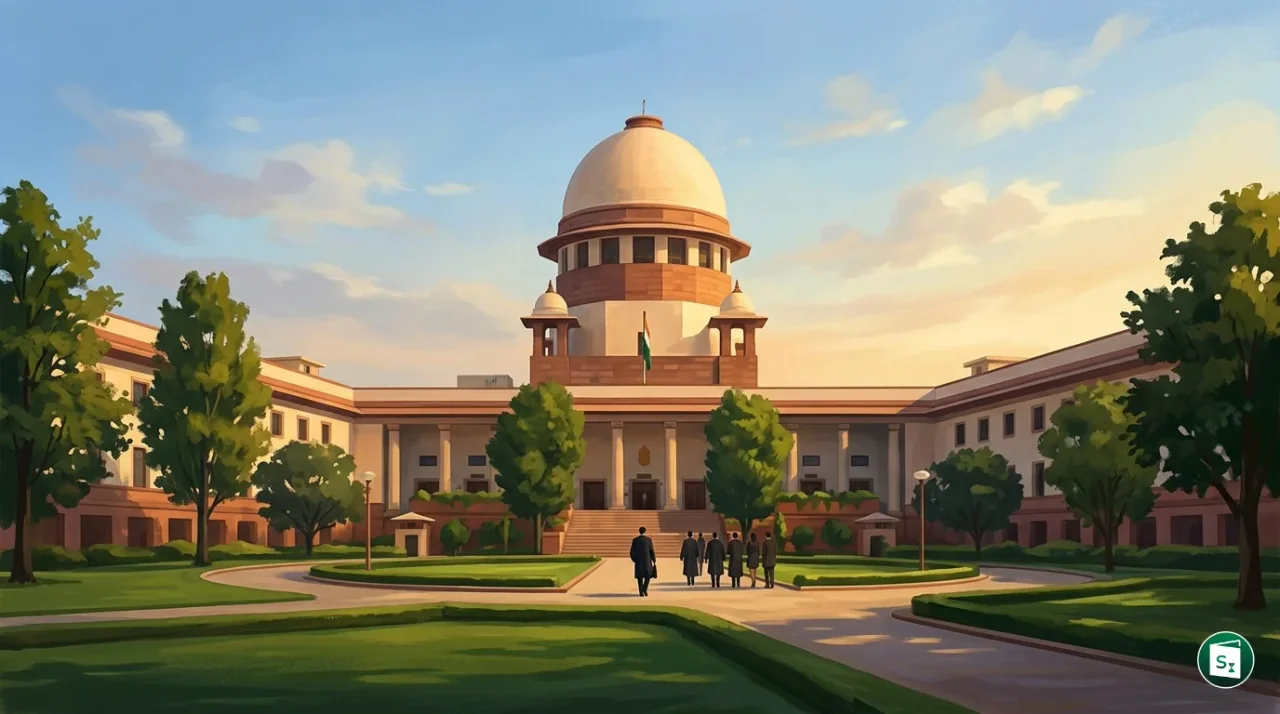
The Appointments Committee of the Cabinet has approved the reappointment of senior advocate Tushar Mehta as the Solicitor General of India for a further three-year term, effective from July 1, 2026. The ACC has also renewed the terms of five Additional Solicitors General for the Supreme Court: Aishwarya Bhati, Vikramjit Banerjee, KM Nataraj, Suryaprakash V Raju, and N Venkataraman. Mehta, who first assumed charge as Solicitor General in October 2018, will by the end of this term have served nearly eleven years in the country’s second highest law office.
Understanding the Law Officers of India
The legal architecture of the Union government is built around a hierarchy of law officers. At the top is the Attorney General for India, a constitutional office established under Article 76 of the Constitution. The Attorney General is the first law officer of the country, appointed by the President, and holds office during the pleasure of the President. The current Attorney General is R. Venkataramani, who took office in October 2022.
Below the Attorney General is the Solicitor General of India, the second highest law officer. Unlike the Attorney General, the post of Solicitor General is not a constitutional office. The Constitution does not mention it. The office exists under the Law Officers (Conditions of Service) Rules, 1987, which were framed under the proviso to Article 309 of the Constitution. The Solicitor General is appointed for a fixed term of three years, which can be renewed.
Further down are the Additional Solicitors General, who assist both the Attorney General and the Solicitor General in handling the government’s caseload before the Supreme Court and various high courts. There is no fixed number of ASGs; the government appoints them based on need. Currently, several ASGs serve in the Supreme Court and different high courts across the country.
The key distinction is that the Attorney General has a constitutional right of audience in all Indian courts under Article 76(4) and can speak in Parliament under Article 88. The Solicitor General and ASGs do not enjoy these constitutional privileges. Their duties and conditions are entirely governed by executive rules.
Who Is Tushar Mehta?
Tushar Mehta was born on 11 September 1964 in Jamnagar, Gujarat. After his father’s death when Mehta was twelve, the family moved to Ahmedabad. He completed his B.Sc. in 1983 and then pursued law at L.A. Shah Law College, Gujarat University, where he earned five gold medals for academic excellence. He enrolled as an advocate with the Bar Council of Gujarat in 1987, beginning his career under senior advocate Krishnakant Vakharia at the Gujarat High Court.
Mehta was designated as a Senior Advocate by the Gujarat High Court in 2008 and was appointed the Additional Advocate General for Gujarat in December 2008, a role he held until June 2014. When the NDA government came to power at the Centre in 2014, he was appointed as an Additional Solicitor General of India on June 7, 2014. He served in that capacity until October 2018, handling several high-profile cases including those involving constitutional and criminal law.
On 10 October 2018, Mehta was appointed the Solicitor General of India, succeeding Ranjit Kumar. The post had remained vacant for nearly a year. Since then, his term has been extended regularly. With this latest reappointment, he will have served as Solicitor General for nearly eleven years by the end of his new term, making him one of the longest serving holders of the office after C. K. Daphtary, who was the country’s first Solicitor General from 1950 to 1963.
During his tenure, Mehta has represented the Union government in several landmark cases covering constitutional interpretation, Centre State relations, national security, taxation, electoral reforms, citizenship issues, and digital regulation. He has appeared in matters such as the challenge to Article 35A, the Rohingya deportation case, the B. H. Loya death investigation case, and multiple cases related to the government’s policy decisions.
The Five Reappointed Additional Solicitors General
The ACC simultaneously approved the reappointment of five Additional Solicitors General for the Supreme Court, each for a three-year term. The reappointments ensure continuity in the government’s legal team at a time when several significant constitutional and policy matters are being heard.
| ASG | First Appointed as ASG | Fresh Term Effective From |
|---|---|---|
| Vikramjit Banerjee | 5 March 2018 | 1 July 2026 |
| KM Nataraj | 14 January 2019 | 1 July 2026 |
| Suryaprakash V Raju | 30 June 2020 | 30 June 2026 |
| N Venkataraman | 30 June 2020 | 30 June 2026 |
| Aishwarya Bhati | 30 June 2020 | 30 June 2026 |
Among the reappointed ASGs, Aishwarya Bhati stands out as a notable figure. She is the youngest woman advocate to be designated as a Senior Advocate by the Supreme Court of India, earning that recognition in March 2019. She is also only the fourth woman to hold the position of Additional Solicitor General of India. Before her appointment as ASG, Bhati served as the Additional Advocate General for the State of Uttar Pradesh in the Supreme Court. She has been recognised for her work in cases related to women’s rights, children’s rights, rights of persons with disabilities, and anti-tobacco litigation. She also represented women officers of the Indian Armed Forces in their case for permanent commission and command positions.
In a related order, the ACC also approved the reappointment of senior advocate Chetan Sharma as Additional Solicitor General for the Delhi High Court for a further term of six months with effect from July 1, 2026.
The Appointments Committee of the Cabinet
The ACC is one of the eight Cabinet Committees constituted by the Government of India. It is an extra-constitutional body, meaning it is not mentioned in the Constitution. It is formed under the Transaction of Business Rules, 1961, which govern how the government conducts its affairs.
The committee has a compact two-member composition. It is chaired by the Prime Minister, with the Home Minister as the sole other member. This small size reflects the need for quick, centralised decision making on senior appointments. The Department of Personnel and Training (DoPT) functions as the secretariat for the ACC and issues the official orders after its decisions.
The ACC handles appointments to top positions in the Union government, including Secretaries, Additional Secretaries, and Joint Secretaries. It also approves appointments to key posts in public sector undertakings, regulatory bodies, and autonomous organisations. The appointment of law officers such as the Solicitor General and Additional Solicitors General also falls within its purview, as does the appointment of the chiefs of the armed forces and the Governor of the Reserve Bank of India.
Why This Reappointment Matters
The reappointment of Tushar Mehta and the five ASGs ensures continuity in the Union government’s legal representation before the Supreme Court. Law officers play a critical role in defending government policies, statutes, and executive actions in court. A change in the legal team often requires new counsel to spend considerable time studying case histories, which can affect the quality of representation in high stakes litigation.
Mehta’s extended tenure is particularly significant. Over nearly eight years as Solicitor General, he has developed an in-depth understanding of the government’s legal positions across a wide range of subjects. The government benefits from this accumulated experience, especially in cases that have been argued over multiple hearings across several years. His reappointment signals the government’s confidence in his ability to handle the complex legal challenges that lie ahead.
For the ASGs, the renewals mean that the Supreme Court benches dealing with government cases will continue to be handled by lawyers already familiar with the briefs. This is especially important for long-pending matters involving constitutional questions, tax disputes, and regulatory issues where the same counsel has been appearing for years.
Key Takeaways
- The Appointments Committee of the Cabinet has approved the reappointment of Tushar Mehta as Solicitor General of India for a three-year term from 1 July 2026.
- Tushar Mehta was first appointed as Solicitor General on 10 October 2018 and will have served nearly eleven years in the post by the end of his latest term.
- The Solicitor General of India is the second highest law officer of the country, subordinate to the Attorney General. Unlike the Attorney General, which is a constitutional post under Article 76, the Solicitor General is a statutory post governed by the Law Officers (Conditions of Service) Rules, 1987 under Article 309.
- Five Additional Solicitors General for the Supreme Court have also been reappointed for three-year terms: Vikramjit Banerjee, KM Nataraj, Suryaprakash V Raju, N Venkataraman, and Aishwarya Bhati.
- Aishwarya Bhati is the youngest woman advocate to be designated a Senior Advocate by the Supreme Court and is only the fourth woman to serve as an Additional Solicitor General of India.
- The Appointments Committee of the Cabinet is an extra-constitutional body chaired by the Prime Minister with the Home Minister as its only other member.