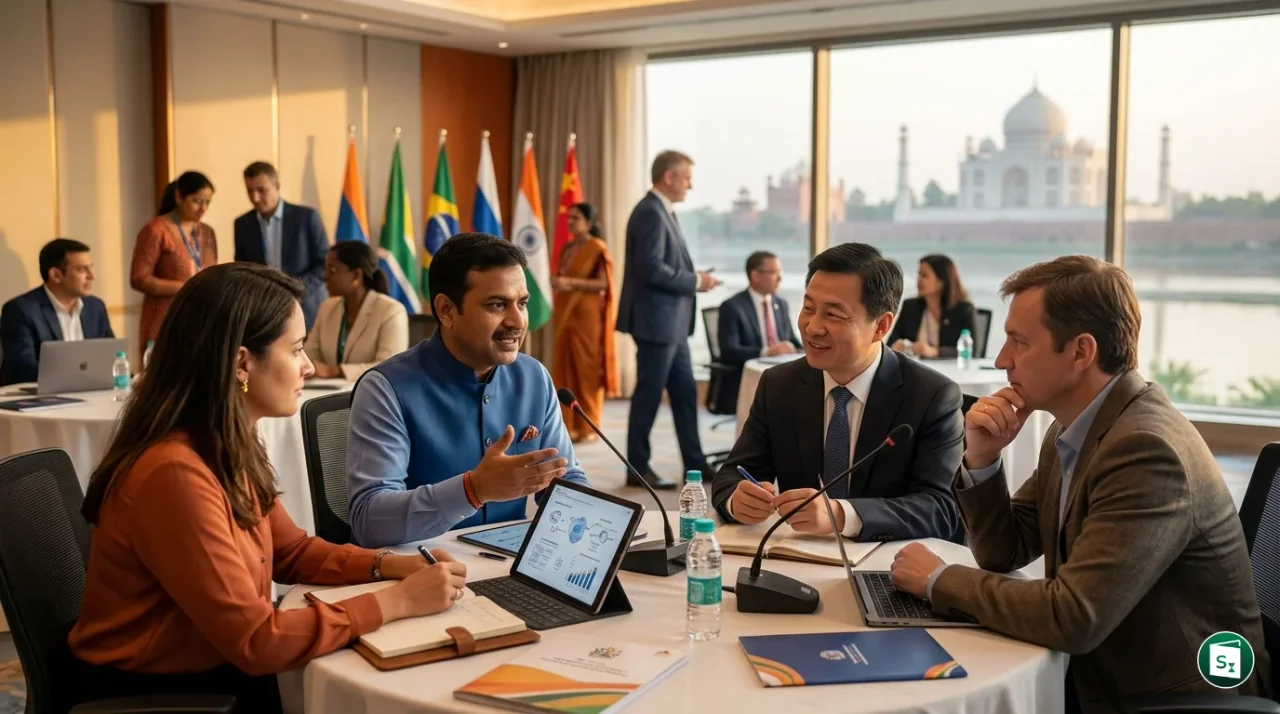
India hosted the inaugural BRICS MSME Forum and the Third SME Working Group Meeting in Agra, Uttar Pradesh, on 19 June 2026, under the overarching theme “Building for Resilience, Innovation, Cooperation and Sustainability”. The Ministry of MSME convened policymakers, industry leaders and delegates from BRICS member and partner countries to deepen cooperation on small enterprise development. The event represented a significant milestone under India’s 2026 BRICS Chairship, showcasing the country’s MSME ecosystem as a benchmark for emerging economies.
BRICS and India’s 2026 Chairship
BRICS began as BRIC, a term coined by economist Jim O’Neill in 2001 to describe the fast-growing economies of Brazil, Russia, India and China. The grouping formalised with its first summit in 2009 and South Africa joined in 2010, making it BRICS. The bloc underwent a transformative expansion in 2024, when Egypt, Ethiopia, Iran and the UAE joined as full members. Indonesia formalised its membership in January 2025, bringing the total to ten members.
India assumed the rotating BRICS Chairship for 2026, setting the agenda for ministerial and working group tracks across multiple domains. The chairship theme, “Building for Resilience, Innovation, Cooperation and Sustainability”, reflects India’s vision for the grouping during its tenure. This is India’s fourth turn as chair, having previously led BRICS in 2012, 2016 (Goa Summit) and 2021.
The BRICS chairship rotates annually among member states in the order decided by the leaders. During its tenure, the chair country hosts the annual summit, sets thematic priorities, and convenes meetings across various tracks including finance, trade, foreign affairs, and industry. India’s 2026 chairship has placed special emphasis on MSME cooperation, technology access for small businesses, and sustainable industrial development.
The BRICS PartNIR Framework
The BRICS Partnership on the New Industrial Revolution (PartNIR) was established at the 10th BRICS Summit in Johannesburg in 2018 to deepen cooperation among member nations in digitalisation, industrialisation, innovation and investment. PartNIR serves as the primary platform for BRICS countries to collaborate on Fourth Industrial Revolution technologies, including artificial intelligence, the Internet of Things, big data, and advanced manufacturing.
A key operational arm of PartNIR is the SME Working Group, created during Russia’s BRICS presidency in 2024. The working group functions as a dedicated forum for member countries to exchange best practices, policy experiences, and successful case studies on MSME development. During its chairship, India is mandated to convene three SME Working Group meetings and the inaugural BRICS MSME Forum.
The first SME Working Group meeting under India’s chairship was held online on 24 April 2026, focusing on “Access to Finance for MSMEs”. The second meeting, convened on 26 May 2026, centred on “Enhancing Access to Technology for MSMEs”, with discussions on technology commercialisation and skilling of industry-ready manpower. The third meeting, held in Agra, completed this year’s series under the PartNIR track.
India also formally joined the BRICS Centre for Industrial Competencies (BCIC) in February 2026, a one-stop centre that provides integrated support to manufacturing companies and MSMEs across BRICS nations with a focus on Industry 4.0 competencies.
India’s MSME Sector: Size and Significance
India’s MSME sector comprises over 8.6 crore enterprises and is a cornerstone of the country’s economic growth. The sector contributes more than 31.1% to the national GDP, accounts for 35.4% of manufacturing output, and contributes over 48.58% of India’s exports. It is the second largest employer after agriculture, generating large-scale employment across the country.
Legal Framework and Classification
The Micro, Small and Medium Enterprises Development (MSMED) Act, 2006 provides the legal framework for the promotion and development of MSMEs in India. The Act, which came into force on 2 October 2006, established the National Board for Micro, Small and Medium Enterprises as the apex advisory body.
The classification of MSMEs was revised in 2020 under the Atmanirbhar Bharat package, replacing the earlier investment-only criterion with a composite criterion of investment and turnover. The limits were further revised in April 2025:
| Enterprise Type | Investment in Plant and Machinery or Equipment | Annual Turnover |
|---|---|---|
| Micro | Up to Rs 2.5 crore | Up to Rs 10 crore |
| Small | Up to Rs 25 crore | Up to Rs 100 crore |
| Medium | Up to Rs 125 crore | Up to Rs 500 crore |
The composite criterion means an enterprise must satisfy both investment and turnover limits for its category. If it crosses either limit, it moves to the next higher category. Export turnover is excluded from the turnover calculation, encouraging MSMEs to export without losing their classification benefits.
Key Institutional Structure
The Ministry of MSME was formed on 9 May 2007 through the merger of the Ministry of Small Scale Industries and the Ministry of Agro and Rural Industries. It is headquartered at Kartavya Bhavan, New Delhi. The ministry operates through several attached and subordinate offices, including the Office of the Development Commissioner (MSME), and organisations such as the National Small Industries Corporation (NSIC) , established in 1955, and the Khadi and Village Industries Commission (KVIC) . Major schemes under the ministry include PM Vishwakarma (launched 2023, outlay Rs 13,000 crore), Prime Minister’s Employment Generation Programme (PMEGP) , and the Credit Guarantee Fund Trust for Micro and Small Enterprises (CGTMSE) scheme.
What Happened at the Agra Forum?
The day-long event on 19 June 2026 began with the inauguration of an exhibition showcasing the diversity and excellence of MSMEs across sectors. Delegates from BRICS member and partner countries participated, including Brazil, China, Egypt, Ethiopia, Indonesia, Iran, Russia, South Africa, the UAE, Belarus, Cuba, Kazakhstan, Malaysia, Nigeria, Thailand, Uganda and others.
Union MSME Minister Jitan Ram Manjhi addressed the forum, stressing the need for collective action to shape the future of MSMEs across BRICS nations. He underlined that challenges related to financing, technology adoption, sustainability and market access require collaborative solutions. Bharat Khera, Secretary of the Ministry of MSME, emphasised the role of MSMEs as engines of innovation, employment and regional development. Dr Rajneesh, Additional Secretary and Development Commissioner (MSME), presented the key outcomes from the three SME Working Group meetings held during India’s chairship.
Third SME Working Group Meeting
The Third SME Working Group Meeting deliberated on the theme “Building MSME Ecosystem: Sustainable Roots to Global Routes”. Member countries shared their policy experiences and interventions aimed at strengthening MSME ecosystems, with a focus on creating pathways for small enterprises to integrate into global value chains while maintaining sustainable business practices at the grassroots level.
This meeting completed the series of three SME Working Group sessions planned under India’s chairship. The first meeting in April covered access to finance, the second in May addressed technology access, and the third in Agra focused on building sustainable and globally connected MSME ecosystems.
Private Sector Stakeholder Deliberations
Parallel to the working group meeting, private sector stakeholders and industry associations from BRICS member countries held dedicated sessions on three critical themes:
- Access to Finance for MSMEs: Discussions centred on bridging credit gaps, financial inclusion, and the role of fintech in expanding lending to small enterprises.
- Technology Access for MSMEs: Delegates explored digital transformation pathways, technology commercialisation, and the skilling of workforce for technology adoption.
- Growth of Sustainability-oriented MSMEs: Sessions examined how small enterprises can adopt sustainable manufacturing practices and align with global environmental standards.
These parallel tracks allowed for direct engagement between government policymakers and private sector representatives, facilitating knowledge exchange on practical solutions rather than remaining at the level of policy declarations alone.
Significance and the Way Forward
The first BRICS MSME Forum marks a structural shift in how the bloc approaches small business cooperation. Previously, MSME issues were discussed within broader economic tracks without a dedicated forum. The creation of a standalone MSME forum, along with a permanent SME Working Group, signals recognition that small enterprises are central to achieving inclusive and sustainable economic development across BRICS economies.
For India, hosting this forum serves multiple strategic purposes. It positions India’s MSME ecosystem, with its 8.6 crore enterprises and robust digital public infrastructure, as a model for other developing economies. The Udyam registration platform, the PM Vishwakarma scheme, and the CHAMPIONS grievance redressal system are examples of India’s comprehensive approach to MSME formalisation and support that can be shared with partner nations.
The outcomes of the Agra forum are expected to feed into India’s broader BRICS chairship agenda, culminating in the BRICS Summit later in 2026. The discussions on access to finance, technology adoption, and sustainability are likely to shape the BRICS SME Working Group Action Plan for 2025-2030, which already includes provisions for annual BRICS MSME Forum meetings, comprehensive mapping of MSME and startup ecosystems, and establishment of trade and market intelligence sharing mechanisms among member countries.
Key Takeaways
- India hosted the first BRICS MSME Forum and the Third SME Working Group Meeting in Agra, Uttar Pradesh, on 19 June 2026, under its BRICS Chairship.
- The theme of India’s 2026 BRICS Chairship is “Building for Resilience, Innovation, Cooperation and Sustainability”.
- The BRICS Partnership on the New Industrial Revolution (PartNIR) was established at the 10th BRICS Summit in Johannesburg in 2018.
- India’s MSME sector contributes over 31.1% to the national GDP and accounts for more than 48.58% of the country’s exports.
- The MSMED Act, 2006 is the enabling legislation for MSMEs in India, and the Ministry of MSME was formed in 2007 through the merger of two earlier ministries.
- Under the revised classification effective from April 2025, a Medium Enterprise is defined by investment up to Rs 125 crore and turnover up to Rs 500 crore.