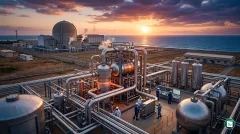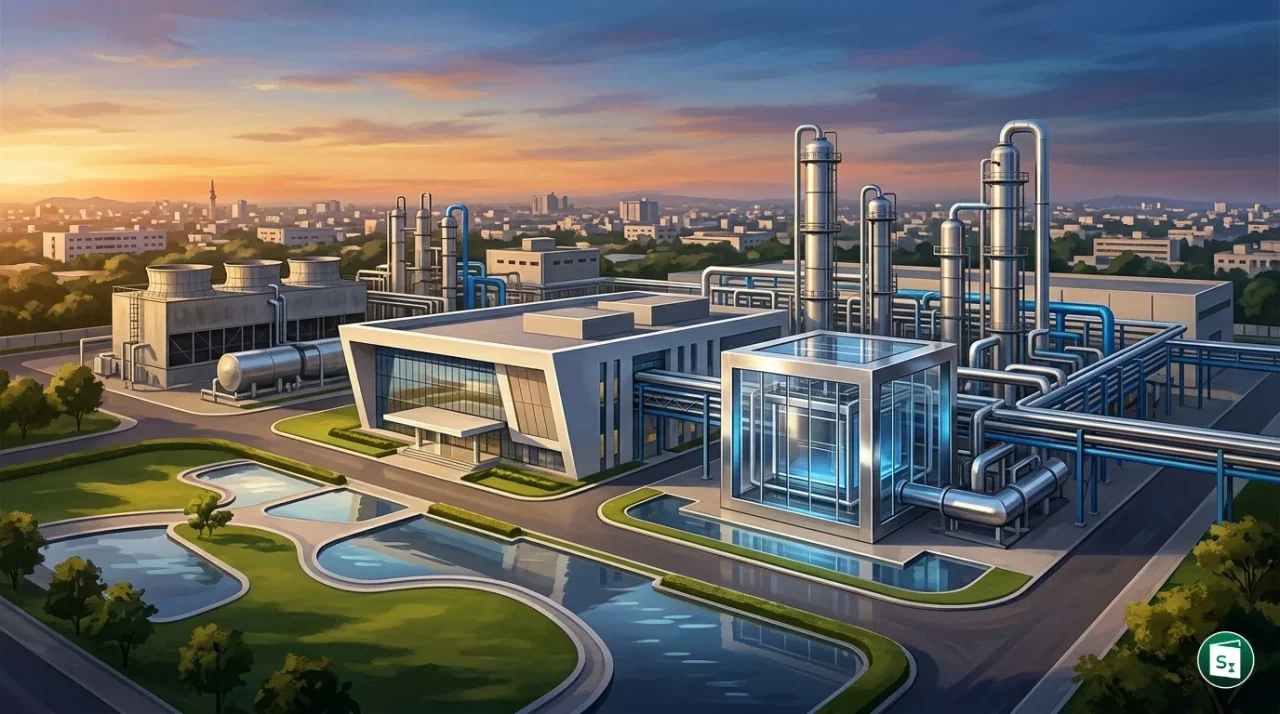
The Department of Atomic Energy (DAE) has inaugurated the Versatile Deuterated Compounds Production Plant (VDPP) and commissioned a 24 kA Prototype Sodium Cell at the Heavy Water Board Facilities (HWBF) in Vadodara, Gujarat, on June 21, 2026. The VDPP will produce high-purity deuterated compounds for advanced scientific research and strategic applications, while the sodium cell enables indigenous production of nuclear-grade sodium for India’s fast breeder reactors. Together, these facilities strengthen India’s nuclear self-reliance under the three-stage nuclear programme and the vision of Atmanirbhar Bharat.
Heavy Water Board and the Department of Atomic Energy
The Department of Atomic Energy (DAE) was set up on August 3, 1954, through a Presidential Order under the direct charge of the Prime Minister. It operates under the Atomic Energy Act, 1948 and is responsible for India’s nuclear programme, from research and power generation to the production of strategic materials. The Atomic Energy Commission (AEC), headed by the Secretary of DAE, is the apex policy body.
The Heavy Water Board (HWB) is a constituent unit of DAE under its Industries and Minerals Sector. Its mandate is to manage the production of heavy water (deuterium oxide) and specialty materials required for India’s nuclear programme. HWB began its journey in 1963 with a pilot plant at BARC and now operates seven plants across India. It is the largest producer of heavy water in the world, meeting domestic requirements and exporting to countries operating pressurised heavy water reactors. HWB is headquartered in Mumbai.
The Heavy Water Board Facilities (HWBF) in Vadodara are integrated with the Gujarat State Fertilizer and Chemicals Ltd (GSFC) complex. This facility already produces deuterated compounds, potassium metal, deuterium gas for optical fibre manufacturing, and various organo-phosphorus solvents. The inauguration of the VDPP and the prototype sodium cell marks a major expansion of its capabilities.
Versatile Deuterated Compounds Production Plant
The Versatile Deuterated Compounds Production Plant (VDPP) has been set up to produce high-purity deuterated solvents and other deuterium-labelled compounds entirely through indigenous technology.
Deuterium is a stable isotope of hydrogen with twice the mass of ordinary hydrogen. When deuterium replaces ordinary hydrogen in a chemical compound, the resulting deuterated compound has slightly different physical and chemical properties that are valuable in multiple high-tech applications.
Applications of Deuterated Compounds
| Application | Use |
|---|---|
| NMR Spectroscopy | Deuterated solvents like Chloroform-d and DMSO-d6 are essential for determining molecular structures in analytical chemistry |
| Pharmaceuticals | Deuterated Active Pharmaceutical Ingredients (APIs) can improve drug metabolism and reduce side effects |
| Optical Fibres | Deuteration reduces transmission losses from water absorption and extends cable life |
| Semiconductors | Used in manufacturing processes for advanced electronic components |
| OLED Displays | Deuterium enhances the efficiency and lifespan of organic light-emitting diodes |
India currently imports most of its deuterated solvents despite having a large pharmaceutical and chemical manufacturing base. The VDPP addresses this gap by establishing scalable, high-purity production domestically. The HWBF Vadodara has existing expertise in this area, having produced deuterated compounds such as Chloroform-d, DMSO-d6, Acetone-d6, Acetonitrile-d3, and Benzene-d6, which are supplied through the Board of Radiation and Isotope Technology (BRIT). The VDPP will significantly scale up this production capacity.
The 24 kA Prototype Sodium Cell
The 24 kA (kiloampere) Prototype Sodium Cell is an electrochemical cell designed for the industrial-scale production of nuclear-grade sodium through the electrolysis of molten sodium chloride (the Downs process). The commissioning of this cell marks a major technological milestone towards achieving self-reliance in a critical material for India’s nuclear programme.
Why Nuclear-Grade Sodium Matters
Sodium serves as the primary coolant in fast breeder reactors (FBRs), which form the second stage of India’s three-stage nuclear programme. Liquid sodium is chosen as a coolant because it has excellent heat transfer properties, a high boiling point (882 degrees Celsius), and importantly, it does not moderate or slow down neutrons. This is essential for maintaining the fast neutron spectrum needed for breeding fissile material.
India’s fast reactor programme is centred at the Indira Gandhi Centre for Atomic Research (IGCAR) in Kalpakkam, Tamil Nadu. The Fast Breeder Test Reactor (FBTR), a 40 MWt sodium-cooled loop-type reactor, has been operating at Kalpakkam since 1985, providing decades of experience in sodium handling and reactor operation. The Prototype Fast Breeder Reactor (PFBR), a 500 MWe pool-type reactor at the same site, is India’s next step towards commercialising fast reactor technology.
Each 500 MWe fast breeder reactor requires hundreds of tonnes of high-purity sodium. The 24 kA prototype cell at HWBF Vadodara is a crucial step towards establishing a domestic supply chain for nuclear-grade sodium, reducing dependence on imports for this strategically important material.
India’s Three-Stage Nuclear Programme
India’s nuclear power strategy, conceived by Dr. Homi J. Bhabha in the 1950s, is built around a three-stage programme designed to utilise the country’s limited uranium reserves and abundant thorium resources.
| Stage | Reactor Type | Fuel | Key Objective |
|---|---|---|---|
| Stage 1 | Pressurised Heavy Water Reactors (PHWRs) | Natural uranium | Produce plutonium-239 as a byproduct |
| Stage 2 | Fast Breeder Reactors (FBRs) | Plutonium-based fuel (MOX) | Breed more fuel than consumed; convert thorium to uranium-233 |
| Stage 3 | Thorium-based reactors | Uranium-233 from thorium | Exploit India’s large thorium reserves for long-term energy security |
India has successfully operationalised Stage 1 through PHWRs, with many units currently in operation. Stage 2 is the current focus area. The 24 kA Prototype Sodium Cell directly supports Stage 2 by enabling indigenous production of nuclear-grade sodium coolant for FBRs. The VDPP supports advanced nuclear research across all stages by providing deuterated compounds for scientific investigation.
The Prototype Fast Breeder Reactor (PFBR) at Kalpakkam, which recently achieved first criticality, is India’s flagship Stage 2 demonstration project. A fleet of FBRs is planned to follow, each requiring nuclear-grade sodium. The establishment of domestic sodium production capability at HWBF Vadodara is therefore a strategic imperative that aligns with the national goals of Atmanirbhar Bharat and Viksit Bharat.
Key Takeaways
- The Versatile Deuterated Compounds Production Plant (VDPP) and 24 kA Prototype Sodium Cell were inaugurated at the Heavy Water Board Facilities in Vadodara, Gujarat on June 21, 2026.
- The VDPP produces high-purity deuterated solvents used in NMR spectroscopy, pharmaceuticals, semiconductors, OLEDs, and optical fibre manufacturing.
- The 24 kA Prototype Sodium Cell enables indigenous industrial-scale production of nuclear-grade sodium, the primary coolant for fast breeder reactors.
- The Heavy Water Board (HWB), established in 1963, is the largest producer of heavy water in the world and operates under the Department of Atomic Energy (DAE).
- India’s three-stage nuclear programme uses Pressurised Heavy Water Reactors (Stage 1), Fast Breeder Reactors (Stage 2), and thorium-based reactors (Stage 3).
- The Fast Breeder Test Reactor (FBTR) at Kalpakkam, commissioned in 1985, is India’s first sodium-cooled fast reactor and provided the foundation for the current fast breeder programme.