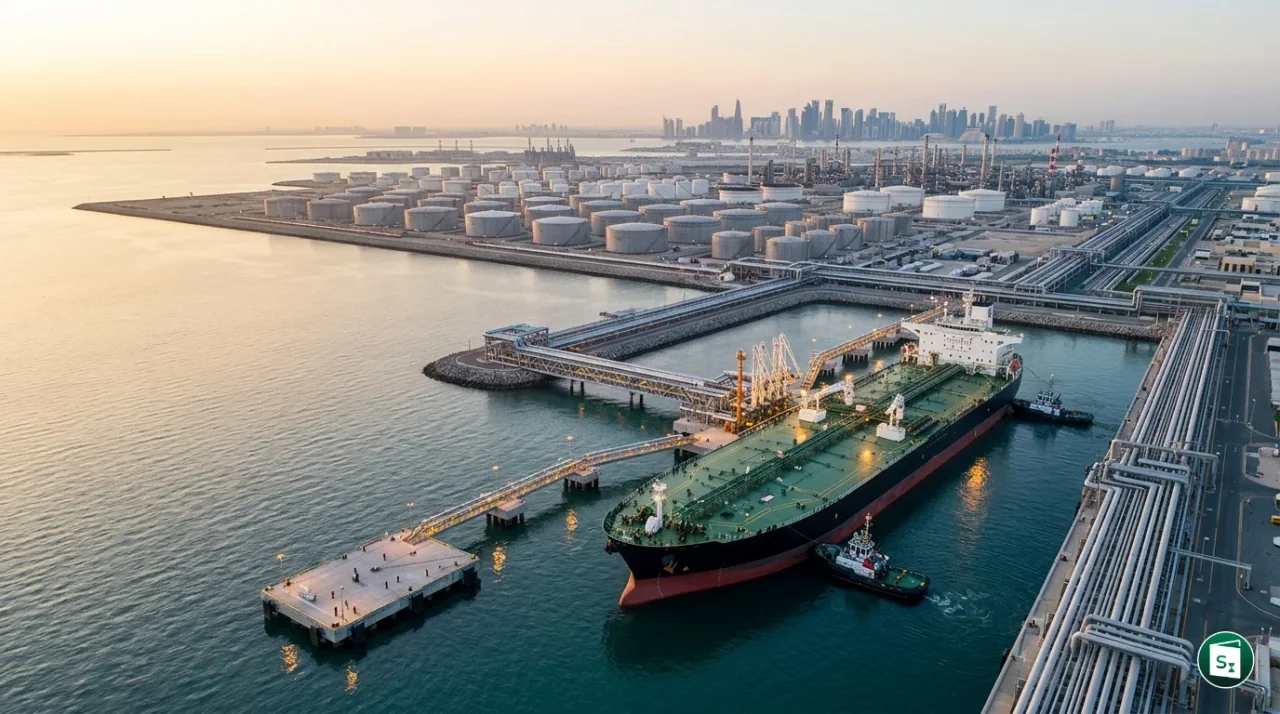
Essar Group signed a $500 million crude sourcing and product supply facility with Abu Dhabi-based International Resources Holding (IRH) on 16 June 2026 for its Stanlow refinery in the United Kingdom. The agreement, executed between Essar Energy Transition Fuels and IRH Global Trading, will diversify crude procurement and product marketing options while optimising working capital. The deal comes at a time of heightened volatility in global energy markets, triggered by the prolonged disruption in the Strait of Hormuz and the closure of two refineries in the UK in 2025.
Essar Group and the Stanlow Refinery
The Essar Group, founded in 1969 by brothers Shashi Ruia and Ravi Ruia in Chennai, has grown from a construction contractor into a multinational conglomerate with annual revenues of approximately $15 billion. The group operates across energy, infrastructure, metals and mining, and technology and retail sectors, with a presence in more than 20 countries.
Essar’s journey in the energy sector includes owning the Stanlow Refinery at Ellesmere Port in North West England, which it acquired from Shell in 2011 for $1.3 billion. The refinery processes 200,000 barrels of crude oil per day and supplies more than 16% of the UK’s transport fuel demand, making it a critical piece of national energy infrastructure. The refinery is operated by Essar Energy Transition Fuels (EETF), the group’s vehicle for low-carbon energy investments.
Under its Essar 2.0 strategy, the group has committed $3.6 billion over five years to convert the Stanlow site into a low-carbon energy hub. This includes a $2.4 billion investment in a 1 GW Vertex Hydrogen project and the installation of the UK’s first hydrogen-ready furnace. After paying off $25 billion in debt through asset sales, including the $12.9 billion sale of Essar Oil to a Rosneft-led consortium in 2017, the group is now debt-free and repositioning itself as an investor in transition energy.
International Resources Holding: From Mining to Energy Trading
International Resources Holding (IRH) is an Abu Dhabi-based natural resources investment platform incorporated in 2022. It operates as a subsidiary of the 2PointZero Group, which is backed by the International Holding Company (IHC) , one of the UAE’s largest conglomerates by market value.
IRH describes itself as a mine-to-market operator, investing across the entire mining value chain from upstream exploration to downstream distribution. Its portfolio includes controlling stakes in Mopani Copper Mines in Zambia, acquired for $1.1 billion in 2024, and Alphamin Resources in the Democratic Republic of Congo, a 56% stake bought for $367 million that makes it one of the world’s largest tin producers. The company is also building a copper trading book targeting 1 million tonnes per year by 2030.
Through its wholly owned subsidiary IRH Global Trading, the company has expanded beyond metals into crude oil and refined products trading, positioning itself as a global energy liquidity provider. The trading arm is led by CEO Vineet Mehra and has built a team of about 50 traders. The $500 million facility with Essar marks IRH Trading’s first major entry into crude oil sourcing and product supply, extending its footprint from metals into the broader energy complex.
What the $500 Million Agreement Entails
The agreement is structured as a $500 million crude sourcing facility and product supply facility between Essar Energy Transition Fuels and IRH Global Trading. Under the arrangement, IRH Global Trading will supply crude oil feedstock to the Stanlow refinery and also help market refined products such as gasoline and diesel produced at the site.
For Essar, the deal achieves three objectives: diversifying the sources from which it buys crude, expanding the markets for its refined products, and optimising its working capital arrangements. The facility gives EETF greater flexibility to respond to changing market conditions and capture value across its refining and trading activities.
The agreement was signed in Abu Dhabi by Prashant Ruia, Chairman of Essar Energy Transition, and Vineet Mehra, CEO of IRH Global Trading. It was executed in the presence of Ravi Ruia, Vice Chairman of Essar Group; Ali Rashed Al Rashdi, CEO of IRH; and Anshuman Ruia, Director of Essar Group.
Strategic Importance Amid Global Energy Volatility
The deal acquires special significance against the backdrop of severe disruptions in global energy markets. The Strait of Hormuz, through which about one-fifth of the world’s oil and gas supplies pass, faced an effective closure during the US-Iran conflict in early 2026. This forced Indian and European refiners to scramble for alternative crude sources. The UAE, which exited OPEC in April 2026, used its Abu Dhabi Crude Oil Pipeline (ADCOP) to bypass the strait and ship crude from the port of Fujairah, becoming India’s second-largest oil supplier after Russia.
Simultaneously, the UK’s refining sector has been under pressure. Two of Britain’s six refineries closed in 2025, making the remaining ones, including Stanlow, even more critical for the country’s fuel security. The IRH deal ensures that Stanlow has reliable feedstock access even if global supply routes face further disruptions.
For IRH, the agreement marks its entry into the crude oil value chain. The company is leveraging its financial strength and UAE connections to build a global energy trading business that extends beyond its core mining expertise. By linking an Abu Dhabi-based trader to a UK refinery operated by an Indian conglomerate, the deal creates a triangular energy corridor connecting the Gulf, Europe, and India.
Deeper India-UAE Energy Ties
The Essar-IRH agreement is the latest in a series of deepening energy ties between India and the UAE. During Prime Minister Narendra Modi’s visit to Abu Dhabi in May 2026, India and the UAE signed strategic agreements covering crude oil storage, LPG supply, and energy security. The Abu Dhabi National Oil Company (ADNOC) agreed to expand its crude storage in Indian strategic petroleum reserves by up to 30 million barrels, nearly a fivefold increase from the existing storage at Mangaluru.
India imports approximately 88% of its crude oil requirements and nearly half of its natural gas demand, making energy security a top strategic priority. The UAE has emerged as India’s second-largest crude supplier, with shipments reaching 942,500 barrels per day in May 2026, a near 41% jump from the previous month. The two countries signed a Comprehensive Economic Partnership Agreement (CEPA) in 2022, which boosted bilateral trade by 14.7% in 2025.
The Essar deal demonstrates that energy cooperation between India and the UAE now extends beyond state-to-state agreements to include private sector partnerships. An Indian conglomerate’s UK asset is being secured through a UAE trading house, reflecting the globalised nature of modern energy supply chains.
Key Takeaways
- Essar Group, founded in 1969 by Shashi and Ravi Ruia, signed a $500 million crude sourcing and product supply facility with IRH Global Trading for its Stanlow Refinery in the UK.
- IRH is an Abu Dhabi-based mine-to-market platform incorporated in 2022, backed by the International Holding Company (IHC) .
- The facility enables Essar to diversify crude sourcing, expand product marketing, and optimise working capital for the 200,000 barrels per day Stanlow refinery.
- The agreement comes amid the Strait of Hormuz disruption and the closure of two UK refineries in 2025, underscoring the value of supply chain resilience.
- The UAE exited OPEC in April 2026 and has become India’s second-largest crude supplier, shipping 942,500 barrels per day in May 2026.
- India imports 88% of its crude oil requirements, and the India-UAE energy partnership has deepened through the CEPA (2022) and strategic petroleum reserve agreements signed in May 2026.