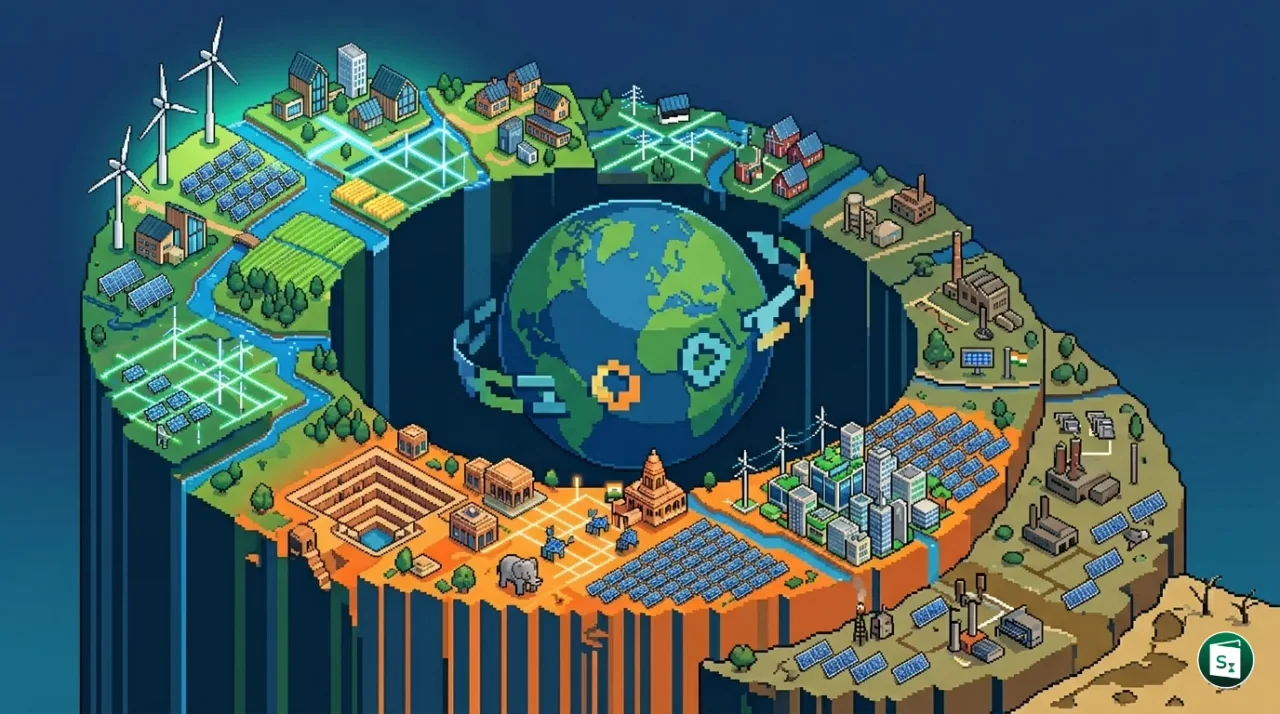
India has been ranked 70th out of 120 countries in the World Economic Forum’s Energy Transition Index (ETI) 2026, with an overall score of 54.9 out of 100. The country recorded one of the strongest improvements in transition readiness globally, driven by significant gains in infrastructure, human capital, and renewable energy deployment. Released in collaboration with Accenture, the report noted that India’s score improved by 1.9 percent over the previous year, positioning it as a key player in the next phase of global energy transition.
What Is the Energy Transition Index?
The Energy Transition Index (ETI) is an annual benchmarking framework published by the World Economic Forum (WEF) in collaboration with Accenture. It assesses and ranks countries on their progress toward building secure, sustainable, equitable, and inclusive energy systems. The ETI has been published for 16 years and is built on over a decade of country-level energy system benchmarking.
The index evaluates countries across two sub-indices. The system performance sub-index, which carries a 60 percent weight, measures how well a country’s energy system performs on three dimensions: energy security (reliability and diversification of supply), energy equity (accessibility and affordability of energy), and environmental sustainability (decarbonisation and clean energy adoption). The transition readiness sub-index, carrying a 40 percent weight, assesses the enabling environment through factors such as regulatory frameworks, political commitment, finance and investment, innovation capacity, infrastructure development, and human capital.
The ETI 2026 edition assessed 120 countries using 44 indicators. Each country receives a score on a 0 to 100 scale, where 100 represents the highest possible performance. The WEF, headquartered in Geneva, Switzerland, first launched the Energy Architecture Performance Index in 2013, which later evolved into the ETI.
Key Highlights of the 2026 Index
Global Trends: A Stalled Transition
The 2026 edition paints a mixed picture of the global energy transition. While 56 percent of countries improved their overall ETI scores, the average global score rose by just 0.2 percent year on year, reflecting a broad slowdown. More concerning, global transition readiness declined for the first time in over a decade, driven by rising geopolitical risks, tighter financing conditions, and infrastructure constraints.
Only 24 percent of countries managed to advance simultaneously across all three system performance dimensions of security, sustainability, and equity, down from 28 percent in 2025. Global electricity demand grew by 3 percent, driven by electrification, cooling needs, digital infrastructure, and artificial intelligence. Emerging economies accounted for nearly 80 percent of this demand growth but continued to face financing costs two to three times higher than those in advanced economies. About 75 percent of global clean energy financing remained concentrated in a small number of economies.
Record global energy investment of $3.3 trillion, including $2.3 trillion in clean energy, failed to translate into proportional transition progress, highlighting a growing disconnect between capital deployment and actual transition readiness.
Top Performers and Regional Leaders
Sweden retained the top position globally for the third consecutive year with a score of 75.3, reflecting decades of political commitment, a clean energy mix dominated by renewables and nuclear power, and advanced energy infrastructure. Finland secured second place, followed by Denmark, Estonia, and Norway, underscoring the continued dominance of Nordic countries in the energy transition landscape.
Advanced economies held 14 of the top 20 positions. Six G20 economies featured in the top 20: Germany (9th), France (10th), the United Kingdom (11th), China (14th), Brazil (17th), and the United States (19th). Among major economies, China continued to scale clean energy investment at record levels, while the US maintained strong energy security performance despite slipping modestly overall.
Singapore was among the biggest climbers, rising 10 places to 42nd, driven by new regulations and stronger political commitment. At the bottom of the index, the Democratic Republic of the Congo ranked 120th with the lowest score.
India’s Performance
India ranked 70th with an overall ETI score of 54.9, advancing two places from the previous year. The WEF identified India as “one of the strongest improvers globally” in the 2026 index. The country recorded a 1.9 percent improvement in its score, well above the global average, with the gains concentrated in transition readiness rather than just system performance.
India’s improvement was broad-based. The country registered sharp gains in infrastructure, human capital, and improvements in equity, sustainability, and financial investment. The report specifically noted that India’s progress was driven by investments in energy security and affordability, alongside a rapid scale-up of renewable energy capacity.
Why India Improved: Drivers of Progress
Infrastructure and Human Capital Gains
The WEF report attributed India’s strong performance to sharp improvements in infrastructure and human capital indicators. India has invested heavily in modernising its power transmission and distribution network. The Green Energy Corridor (GEC) programme, aimed at integrating renewable energy into national and state grids, has added more than 3,000 km of transmission lines, with further phases under development. Transmission and distribution investment reached $26 billion in 2026, growing at 15 percent annually over the past five years.
On the human capital front, India’s expanding workforce in renewable energy manufacturing, installation, and grid management contributed to higher readiness scores. The country’s domestic solar PV module manufacturing capacity surged to about 172 GW, supported by the Production Linked Incentive (PLI) scheme for solar manufacturing, reducing import dependence and building technical expertise.
Record Renewable Energy Expansion
India added a record 55.29 GW of non-fossil fuel-based power capacity in 2025-26, the highest single-year addition in the country’s history and nearly double the 29.5 GW added in the previous financial year. By March 2026, India’s total non-fossil installed capacity stood at 283.46 GW, comprising 274.68 GW from renewable sources and 8.78 GW from nuclear power.
Solar power led this expansion with a record 44.61 GW of new capacity in 2025-26, an 87.2 percent jump over the previous year. India’s cumulative solar capacity crossed 150 GW by March 2026, a 53-fold increase from the 2.82 GW it had in 2014. Wind energy added 6.05 GW, the highest annual wind addition in the country’s history. The IRENA Renewable Energy Statistics 2026 confirmed that India has overtaken Brazil to become the world’s third-largest renewable energy nation, behind only China and the United States.
In June 2025, India achieved 50 percent of its cumulative installed power capacity from non-fossil fuel sources, fulfilling its Nationally Determined Contribution (NDC) commitment under the Paris Agreement five years ahead of its 2030 deadline.
Policy and Investment Environment
India’s energy investment reached a record $170 billion in 2026, according to the International Energy Agency’s World Energy Investment 2026 report. The country now invests three dollars in renewables and nuclear power for every dollar spent on fossil fuel-based generation, up from $1.50 five years ago. Solar PV investment alone rose 25 percent annually over the past five years, reaching $20 billion in 2025.
Key policy drivers included the PM Surya Ghar Muft Bijli Yojana (PMSGMBY) for rooftop solar, which added 7.6 GW of distributed capacity in 2025-26, and the PM-KUSUM scheme for solarising agricultural pumps, extended until March 2027. The government also exempted basic customs duty on lithium-ion cell manufacturing until 2028 to boost domestic battery storage capacity, addressing the intermittency challenge of renewable energy.
India’s Clean Energy Journey: Key Targets and Achievements
India’s energy transition is anchored in long-term policy clarity and progressively ambitious climate targets. The country has updated its climate commitments through successive Nationally Determined Contributions (NDCs) under the Paris Agreement, to which India is a signatory. The key targets and achievements are summarised below.
| Target / Achievement | Detail | Target Year | Status |
|---|---|---|---|
| 500 GW non-fossil fuel capacity | Total installed non-fossil capacity target | 2030 | In progress (283.46 GW as of March 2026) |
| 50% non-fossil installed capacity | Achieved in June 2025 | 2030 (original NDC) | Achieved 5 years ahead of schedule |
| 60% non-fossil installed capacity | Updated NDC target | 2035 | In progress |
| 45% emissions intensity reduction | Reduce emissions per unit of GDP from 2005 levels | 2030 | In progress (36% achieved by 2020) |
| 47% emissions intensity reduction | Updated NDC target from 2005 levels | 2035 | In progress |
| Carbon sink of 3.5 to 4 billion tonnes | Additional carbon sink through forest and tree cover | 2035 | In progress |
| Net Zero emissions | Economy-wide net zero target | 2070 | Long-term goal |
India’s renewable energy capacity has grown 3.6 times since 2014, from 76.38 GW to 274.68 GW. The country’s total power generation in 2025-26 reached 1,845.92 billion units, with non-fossil sources contributing 538.97 billion units, or 29.2 percent of total generation. In July 2025, renewable energy met 51.5 percent of India’s total electricity demand on a single day, the highest share ever recorded.
The Central Electricity Authority’s National Generation Adequacy Plan projects that India’s non-fossil capacity will reach 786 GW, or 70 percent of total installed capacity, by 2035-36, requiring an estimated transmission investment of ₹7.93 lakh crore.
Significance of the ETI for India
The ETI serves as an important global benchmark that signals India’s progress to international investors, climate finance institutions, and multilateral bodies. India’s recognition as one of the strongest improvers in transition readiness enhances its credibility in global climate negotiations and strengthens its case for concessional climate finance and technology transfer from developed countries under the UNFCCC framework.
The index also highlights areas that need attention. Despite strong readiness gains, India’s overall rank of 70th reflects the structural challenges of a developing economy with high energy demand growth, significant dependence on coal for baseload power generation, and financing constraints. Coal still accounts for about 67.7 percent of India’s electricity generation, and per capita emissions, while well below the global average, continue to rise with economic growth.
The WEF report noted that emerging economies account for 80 percent of global electricity demand growth but face financing costs two to three times higher than advanced economies. For India, bridging this investment gap through mechanisms such as green bonds, multilateral climate funds, and the Green Climate Fund will be critical to sustaining the momentum of its energy transition. The country’s focus on domestic manufacturing, battery storage deployment, and grid modernisation will determine whether it can convert its strong transition readiness into sustained system performance improvements in future editions of the index.
Key Takeaways
- The World Economic Forum’s Energy Transition Index (ETI) 2026 ranked India 70th out of 120 countries with a score of 54.9.
- India was among the strongest improvers globally, recording a 1.9 percent score improvement driven by gains in infrastructure, human capital, and renewable energy.
- Sweden topped the index for the third consecutive year with 75.3 points, followed by Finland, Denmark, Estonia, and Norway. The Democratic Republic of the Congo ranked last at 120th.
- The ETI assesses countries on system performance (60% weight) across energy security, equity, and sustainability, and transition readiness (40% weight) covering regulation, investment, infrastructure, innovation, and human capital.
- India added a record 55.29 GW of non-fossil capacity in 2025-26, with total non-fossil installed capacity reaching 283.46 GW by March 2026.
- India achieved 50 percent of its installed power capacity from non-fossil sources in June 2025, meeting its 2030 NDC target five years ahead of schedule.