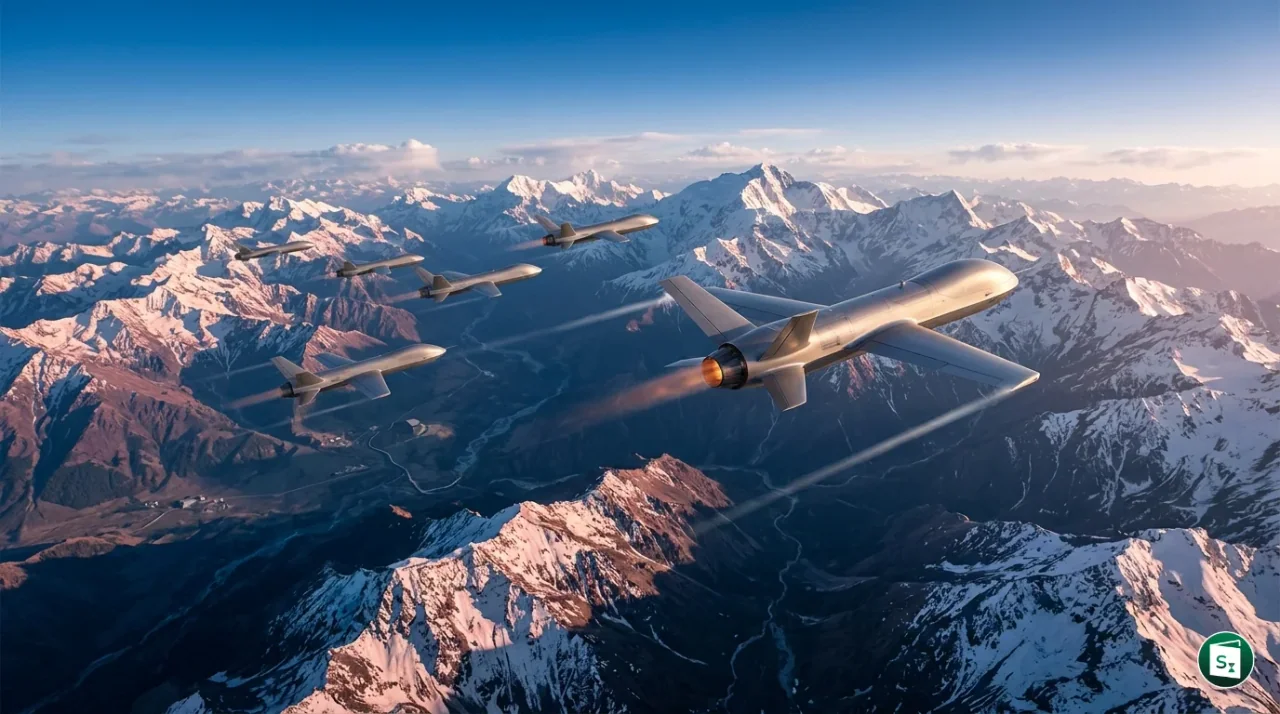
The Indian Army has inducted 106 jet-powered Peacekeeper (Agniveg) kamikaze drones delivered by domestic defence manufacturer SMPP Ltd, with the consignment comprising 100 operational units and six training variants. The turbojet-powered loitering munition, capable of striking targets up to 180 kilometres away at speeds of 450 kmph, fills a critical gap between conventional artillery and long-range missile systems. Developed in collaboration with Belarus-based KB Indela and partially localized in India, the induction marks a significant step in the Army’s push for indigenous precision-strike capabilities under the Atmanirbhar Bharat initiative.
Understanding Kamikaze Drones or Loitering Munitions
A loitering munition, commonly called a kamikaze or suicide drone, is an unmanned aerial vehicle that carries an explosive warhead and is designed to be destroyed on impact with its target. Unlike reconnaissance drones that return after a mission, these systems can loiter in the air for extended periods, search for targets using onboard sensors, and then dive in to strike when the operator confirms the engagement.
The term loitering munition comes from the system’s ability to wait or patrol over a battlespace before committing to an attack. This gives commanders flexibility to engage time-sensitive targets that may appear, relocate, or disappear. The Ukrainian-Russian war has demonstrated the battlefield effectiveness of these systems, which offer a cost-effective alternative to cruise missiles for striking high-value assets such as radar installations, command centres, air defence systems, and logistics hubs.
Modern loitering munitions bridge the capability gap between conventional artillery, which has limited range, and long-range precision missiles, which are significantly more expensive. They provide ground commanders with a responsive, precision-guided option that minimises risk to personnel and reduces collateral damage through accurate targeting.
Peacekeeper (Agniveg): Specifications and Capabilities
The Peacekeeper (Agniveg) is a turbojet-powered loitering munition designed for deep-penetration strikes against high-value enemy assets. It was developed through a technology partnership between SMPP Ltd and Belarus-based KB Indela, with partial localization of manufacturing in India. The name Agniveg translates to “speed of fire” in Sanskrit, reflecting the system’s high-speed attack profile.
| Parameter | Specification |
|---|---|
| Type | Turbojet-powered loitering munition (kamikaze drone) |
| Operational Range | 180 km |
| Maximum Speed | 450 kmph |
| Warhead | 10 kg high-explosive fragmentation |
| Wingspan | 2.8 metres |
| Launch Method | Catapult (no runway required) |
| Guidance | Autonomous with GNSS/INS, resistant to jamming and spoofing |
| Accuracy | Circular Error Probable of less than 5 metres |
| Delivered Units | 100 operational + 6 training drones |
During user trials conducted at the Pokhran test range, the Peacekeeper demonstrated a Circular Error Probable (CEP) of less than five metres even while operating in a heavily jammed and spoofed electronic warfare environment. CEP is a standard measure of weapon accuracy; a CEP of five metres means that half of all strikes will fall within a five-metre radius of the intended target. This level of precision allows operators to engage specific sections of a military facility while minimising damage to surrounding civilian structures.
The drone is designed to operate in contested electromagnetic environments where adversaries deploy jamming to disrupt communication links and GPS spoofing to mislead navigation systems. According to SMPP, the system can continue mission execution despite such countermeasures, making it reliable in high-intensity conflict scenarios. Once a target is designated, the drone can conduct fully autonomous precision strikes without requiring further human intervention.
The Peacekeeper is designed to engage a wide range of military objectives, including command and control centres, radar installations, air defence systems, logistics hubs, artillery positions, and critical infrastructure deep inside enemy territory. Its catapult launch mechanism enables deployment from forward positions without the need for runways or fixed infrastructure.
SMPP: From Ballistic Protection to Precision Strike
SMPP Ltd is an Indian defence manufacturing company headquartered in New Delhi’s Okhla Industrial Estate. Founded in 1985 by IIT graduate Dr SC Kansal, the company initially focused on manufacturing combustible cartridge cases for tank and artillery ammunition before becoming one of India’s largest suppliers of ballistic protection systems. It is currently led by CEO Ashish Kansal, also an IIT graduate.
The company has supplied over 1.86 lakh bulletproof jackets and more than 2 lakh ballistic helmets to the Indian Army and paramilitary forces including the BSF, CRPF, ITBP, and NSG, commanding an estimated 95% market share in India’s personal ballistic protection segment. SMPP’s products use in-house manufactured boron carbide ceramic, one of the hardest materials known, which is also used in India’s military helicopters and transport aircraft.
The Peacekeeper drone represents SMPP’s entry into precision strike platforms, expanding its portfolio beyond protection systems into drone technology, counter-drone systems, and large-calibre ammunition. The company completed delivery of the 106 drones within six months of receiving the order, following successful user trials.
The drone was developed in partnership with KB Indela, a Belarusian unmanned systems design bureau. According to available records, SMPP acquired the systems through a technology transfer arrangement with the Belarusian state arms export agency. The warhead and certain components have been localized in India, while the basic airframe and turbojet engine originate from the Belarusian supply chain. KB Indela’s Mirotvorets platform, on which the Peacekeeper is based, has been previously exported to Russia, Venezuela, and Algeria. SMPP also recently signed a teaming agreement with European defence firm KNDS at the Eurosatory exhibition in Paris to manufacture advanced loitering munitions including the VELOCE and RODEUR systems in India.
Strategic Significance for India
The induction of the Peacekeeper drone addresses a critical operational gap in the Indian Army’s strike capabilities. Conventional artillery systems typically have a range of 30 to 40 kilometres, while long-range missile systems such as the BrahMos are designed for targets beyond 300 kilometres. The Peacekeeper’s 180-kilometre range places it in an intermediate zone where the Army previously had limited organic precision-strike options.
Loitering munitions also offer a significant cost advantage. A single kamikaze drone costs a fraction of a cruise missile or a manned aircraft sortie, making it economically viable for engaging high-value targets that do not warrant expensive missile launches. Their autonomous capability reduces the risk to personnel, as pilots are not required to fly into heavily defended airspace.
The acquisition aligns with the Indian Army’s broader modernisation push. In April 2026, the Army released a comprehensive technology roadmap for unmanned aerial systems and loitering munitions, calling for 30 distinct drone variants and thousands of locally manufactured systems over five years. The Peacekeeper induction is among the first major deliveries under this evolving framework.
The deployment of these drones also enhances India’s deterrence capability along the northern and western borders. In a high-intensity conflict scenario, the ability to rapidly neutralise enemy radar, air defence, and command infrastructure in the opening hours of a campaign can provide a decisive advantage. The system’s resistance to electronic warfare measures adds to its utility in contested environments where China and Pakistan have invested heavily in jamming and signals intelligence capabilities.
The Way Forward
SMPP has already proposed an upgraded variant of the Peacekeeper drone capable of reaching speeds of 750 kmph, significantly higher than the current 450 kmph version. The company has also offered an enhanced version with extended operational range for future procurement consideration. If developed, the upgraded variant would reduce the time window for enemy air defence systems to intercept the drone, increasing its survivability in heavily defended airspace.
The company is also pursuing a parallel track with European defence major KNDS to manufacture next-generation loitering munitions in India. Signed in June 2026 at the Eurosatory exhibition in Paris, the teaming agreement covers the VELOCE and RODEUR systems along with ISTAR drones, which offer hybrid GNSS/INS guidance and fire-and-forget capability. This partnership combines technology transfer with domestic manufacturing, further strengthening India’s indigenous unmanned systems ecosystem.
These developments come against the backdrop of the Indian Army’s ambitious drone roadmap released in April 2026. The plan targets the induction of 30 distinct drone variants covering surveillance, strike, loitering munition, and swarm capabilities, with thousands of units to be sourced from domestic manufacturers over five years. The Peacekeeper delivery demonstrates that Indian private industry can deliver complex weapon systems at speed, a factor that will influence future procurement decisions.
The global loitering munition market is expanding rapidly, driven by lessons from recent conflicts. India’s push for self-reliance in this domain reduces its dependence on foreign suppliers and positions its defence industry to potentially become an exporter of such systems in the long term.
Key Takeaways
- SMPP Ltd delivered 106 Peacekeeper (Agniveg) jet-powered kamikaze drones to the Indian Army, comprising 100 operational and 6 training units.
- The drone has an operational range of 180 km and a maximum speed of 450 kmph, carrying a 10 kg high-explosive fragmentation warhead.
- During trials, the Peacekeeper demonstrated a Circular Error Probable (CEP) of less than 5 metres even under heavy electronic jamming and GPS spoofing.
- The drone was developed in partnership with KB Indela of Belarus and has been partially localized in India through a technology transfer agreement.
- SMPP has proposed an upgraded variant capable of reaching speeds of 750 kmph with extended range.
- SMPP Ltd, founded in 1985 and headquartered in New Delhi, holds an estimated 95% market share in India’s personal ballistic protection segment.