Prime Minister Narendra Modi undertook a six-day visit to France in June 2026 that covered Nice, Evian, and Paris, holding bilateral talks with President Emmanuel Macron, attending the 52nd G7 Summit as a guest partner, and showcasing India’s technology leadership at Europe’s largest startup expo. The visit produced 13 key outcomes spanning artificial intelligence, trade, defence, space, and digital payments, while reinforcing the India-France Special Global Strategic Partnership that was elevated earlier this year. At the heart of the engagement was the adoption of the India-France Innovation Roadmap 2030, a framework designed to steer bilateral cooperation in critical and emerging technologies through the rest of this decade.
India-France Ties: A Special Global Strategic Partnership
India and France established diplomatic relations soon after India’s independence in 1947. On 26 January 1998, the two countries launched a Strategic Partnership, making France the first country with which India entered into such a framework with a Western nation. This partnership was built on three core pillars: defence and security, civil nuclear energy, and space cooperation.
Over the years, the relationship broadened to include cooperation in artificial intelligence, science and technology, innovation, the blue economy, renewable energy, and the Indo-Pacific. In February 2026, during President Macron’s visit to India, the relationship was elevated to a Special Global Strategic Partnership. The two leaders also adopted the Horizon 2047 Roadmap, a long-term vision for the partnership aligned with the centenary of India’s independence.
France has been one of India’s most reliable defence partners, supplying platforms such as the Rafale fighter aircraft, Scorpene-class submarines (the Kalvari class built under the P75 programme in India), and collaborating on engine development for the Indian Multi Role Helicopter programme. In the nuclear domain, both countries are working on the Jaitapur Nuclear Power Project and exploring cooperation in Small Modular Reactors and Advanced Modular Reactors. The space partnership includes joint satellite missions such as TRISHNA and collaboration on human spaceflight.
The Nice Summit: 13 Key Outcomes
PM Modi and President Macron held bilateral talks at Villa Kerylos in Nice on 14 June 2026, the first meeting between the two leaders since the elevation of ties to a Special Global Strategic Partnership. The meeting produced 13 key outcomes and the signing of 19 agreements between institutions of the two countries.
The outcomes spanned multiple domains:
| Domain | Key Outcome | Institutions Involved |
|---|---|---|
| Innovation | Adoption of the India-France Innovation Roadmap 2030 to guide cooperation in critical and emerging technologies | Multiple stakeholders |
| Artificial Intelligence | Creation of a Joint India-France AI Working Group focused on AI governance and responsible AI | DST (India), INRIA (France) |
| Trade | High-level mechanism to double bilateral trade from USD 16 billion to USD 32 billion within five years | Ministry of Commerce (India), French Ministry of Economy |
| Economic Security | Institution of an Economic Security Dialogue for supply chain resilience and critical minerals | Ministry of External Affairs (India), Quai d’Orsay (France) |
| Digital Payments | Expansion of UPI usage in France, including at Paris and Nice airports and the Eiffel Tower | NPCI, Lyra Network |
| Startups | Incubation of 10 additional Indian startups at Station F, Paris | Station F, Indian Startup Ecosystem |
| Skilling | National Centre of Excellence for Skilling in Aeronautics and Allied Sectors at NSTI, Kanpur | Ministry of Skill Development (India), French partners |
| Digital Sciences | Establishment of a Centre of Digital Sciences between DST and INRIA | DST (India), INRIA (France) |
| Academia | ICCR India Chair on AI, Innovation and Culture at Universite Paris-Saclay | ICCR, Universite Paris-Saclay |
| Health | Letter of Intent between ICMR and France’s Health Data Hub for digital health research | ICMR (India), Health Data Hub (France) |
| Railways | Declaration of Intent on cooperation in railway and high-speed rail development in India | Ministry of Railways (India), SNCF (France) |
| Security | General Security Agreement on exchange and protection of classified information | National Security Council (India), French authorities |
| Space | Letter of Intent between ISRO and CNES on microgravity research and human space exploration | ISRO (India), CNES (France) |
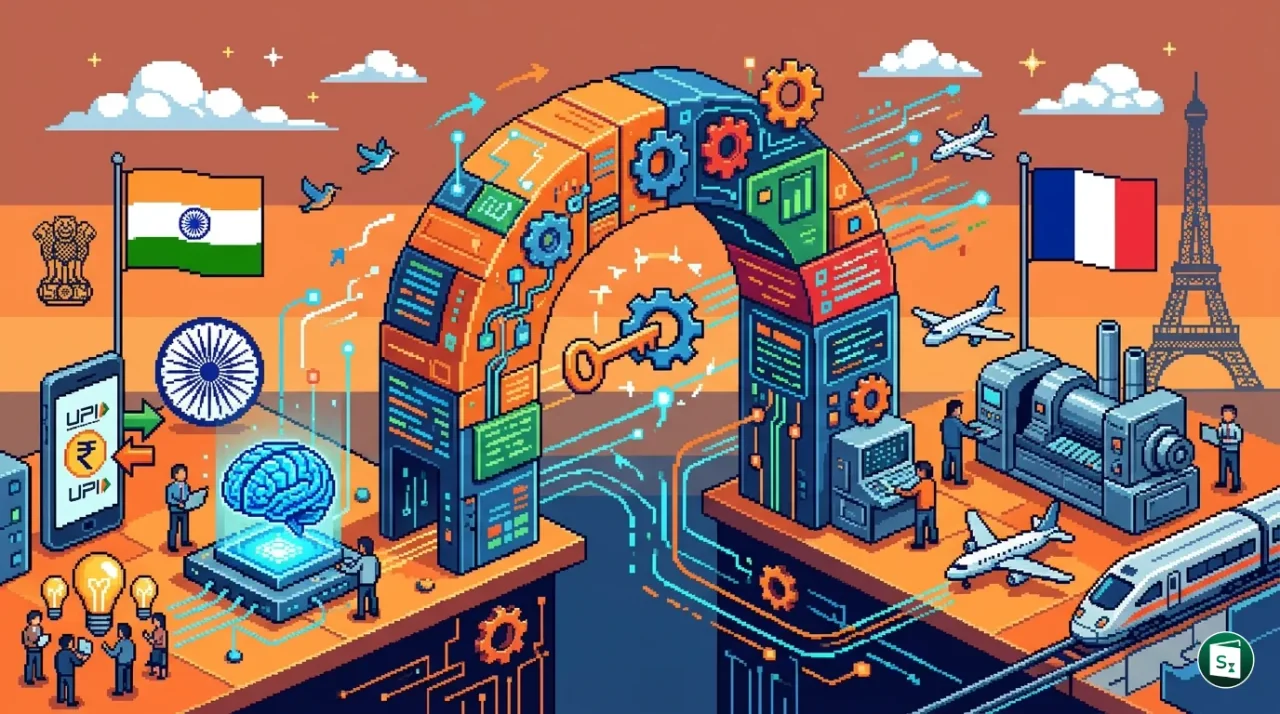
The Innovation Roadmap 2030 is a comprehensive framework that covers cooperation in critical and emerging technologies, artificial intelligence, startup and incubator ecosystems, academic mobility, and industry-academia linkages. It aims to accelerate the development of joint solutions for global challenges. The Joint India-France AI Working Group will provide a structured platform for collaboration on research and development, capacity building, academic exchanges, industry partnerships, and startup linkages in the rapidly evolving AI sector.
On the trade front, the two countries agreed to set up a high-level mechanism to monitor and accelerate bilateral trade growth, addressing sectoral challenges and identifying new areas of economic cooperation. The current bilateral trade stands at approximately USD 16 billion, and the target is to double it within five years. The leaders also called for early implementation of the India-EU Free Trade Agreement.
In the defence sector, the two sides agreed to strengthen collaboration in co-design, co-development, and co-production of advanced defence platforms and technologies, consistent with India’s Make in India initiative. India’s plan to procure 114 Rafale fighter jets from Dassault Aviation was also discussed, with the underlying focus on maximising local content.
Bharat Innovates 2026: India’s Deep-Tech Showcase
PM Modi and President Macron jointly inaugurated Bharat Innovates 2026 on 14 June 2026 at the Palais des Expositions de Nice. This was the first edition of what the Indian government positioned as a flagship platform to connect India’s deep-tech startups and innovators with global investors and institutions. The event was an initiative of India’s Ministry of Education and was held under the framework of the India-France Year of Innovation 2026, which was jointly launched by the two leaders in Mumbai in February 2026.
The three-day event brought together 120 Indian deep-tech startups, nearly 15 premier Higher Education Institutions (including IITs and IISc), and over 500 investors, including leading venture capital firms, global CEOs, and industry leaders from more than 29 countries. The startups covered 13 key sectors: semiconductors, space technology, advanced computing, biotechnology, energy, healthcare, manufacturing, artificial intelligence, defence, agritech, medtech, renewable energy, and climate technologies.
Key achievements from Bharat Innovates 2026 included:
- Approximately USD 254.5 million in funding commitments and investment deals, with the opening day alone accounting for nearly USD 30 million
- Over 50 collaboration agreements signed, including 12 agreements between Indian higher education institutions and incubators and their French and global counterparts, 16 agreements with leading global corporations, and partnership agreements between 13 French universities and 11 IITs and IISc
- More than 80 startups pitched to over 50 global investors from more than 10 countries
- Over 40 startups secured confirmed investor follow-up commitments
- Launch of the India-France ATL Bridge, a collaboration between NITI Aayog’s Atal Innovation Mission and La Foundation Dassault Systemes, establishing France’s first School Innovation Lab based on India’s Atal Tinkering Lab model
Speaking at the event, PM Modi said that India-France ties go beyond conventional trade and strategic partnerships, driven not only by shared interests but also by a shared vision. President Macron described it as an honour to host the first Bharat Innovates event outside India and highlighted India’s achievements including the Chandrayaan-3 mission as evidence of its innovation capabilities.
India at the G7 Outreach Summit
PM Modi travelled to Evian-les-Bains in the French Alps to attend the 52nd G7 Summit from 15 to 17 June 2026 as a guest partner. France, which held the rotating presidency of the G7 in 2026, invited India as one of five partner countries alongside Brazil, Kenya, South Korea, and Ukraine. Other invited countries included Egypt, Qatar, and the United Arab Emirates.
The G7 members are Canada, France, Germany, Italy, Japan, the United Kingdom, and the United States, with the European Union also represented. The summit took place at the Hotel Royal in Evian, which had previously hosted the G8 Summit in 2003. The agenda covered peacebuilding and security for Ukraine, ending crises in the Middle East, forging new partnerships, rebuilding international solidarity, and promoting balanced and sustainable economic growth.
India’s participation in G7 summits has been consistent since the Biarritz Summit in 2019. At Evian, PM Modi held bilateral meetings with several world leaders on the sidelines, including US President Donald Trump and Canadian Prime Minister Mark Carney. He also emphasised India’s commitment to building trust-based international partnerships where the Global South is treated as an equal partner.
VivaTech 2026: India as AI Country of Focus
After the G7 Summit, PM Modi travelled to Paris for VivaTech 2026, Europe’s largest technology and startup convention, held from 17 to 20 June 2026 at the Paris Expo Porte de Versailles. India was designated as the AI Country Partner and AI Country of Focus, a recognition that underscored India’s emergence as a global leader in artificial intelligence, digital public infrastructure, and technology-driven development. India’s participation was led by the India Trade Promotion Organisation (ITPO), with involvement from the Ministry of Commerce, MeitY, DPIIT, and the Ministry of Education.
Addressing a gathering of tech entrepreneurs, startup founders, investors, and business leaders, PM Modi outlined India’s vision for human-centric AI and frontier technologies. He highlighted India’s approach to democratising technology and said that for India, AI stands for “All Inclusive”. He emphasised that AI must improve lives, widen access, drive growth, and help sustain a healthy planet.
Modi noted that India is simplifying regulations and ensuring ease of doing business, supporting private enterprise through targeted incentives of over USD 50 billion. He pointed to India’s affordable data costs and low-cost green energy as key advantages for global technology companies. He invited attendees to visit the India Pavilion, which showcased innovations including a single-piece 3D-printed rocket engine, advanced genetic engineering therapies, AI solutions for cancer detection, cyber security systems, autonomous robots, and smart city solutions.
The India Pavilion, one of the largest national pavilions at the event, brought together over 100 Indian startups, leading technology companies, and government bodies. The pavilion’s theme, “Bharat Humanizing Tech”, reflected India’s positioning of AI as a tool for inclusive development, governance, and public service delivery at population scale. Piyush Goyal and French Minister for AI and Digital Affairs Anne Le Henanff inaugurated the pavilion, with Goyal highlighting India’s vision of MANAV (ethical, accountable, inclusive, and trustworthy AI).
UPI Expands Across France
A significant tangible outcome of the visit was the expansion of India’s Unified Payments Interface (UPI) across France. UPI, developed by the National Payments Corporation of India (NPCI), is a real-time payment system that allows instant money transfers through mobile devices. Nearly half of all real-time digital transactions in the world take place in India through UPI.
UPI was first launched in France on 3 July 2024 at the Eiffel Tower through a partnership between NPCI International Payments Limited (NIPL) and French payments firm Lyra Network. During PM Modi’s visit, Foreign Secretary Vikram Misri confirmed that UPI is now available at multiple locations across France, including:
- Eiffel Tower (operational since 2024)
- Charles de Gaulle Airport, Paris (rollout in June 2026)
- Nice Airport (rollout in June 2026)
- Galeries Lafayette Nice Massena (launched by Piyush Goyal on 16 June 2026)
PM Modi announced during the Bonjour Modi event that the scope of UPI usage in France would expand further to additional cities, making instant India-France connectivity and mutual payments possible. The initiative strengthens India’s digital public infrastructure footprint in Europe and simplifies payments for Indian tourists, students, and business travellers. France became the first European country to accept UPI payments. UPI is now accepted in nine countries: Singapore, the United Arab Emirates, France, Mauritius, Nepal, Bhutan, Qatar, Sri Lanka, and Cambodia.
Bonjour Modi: Engaging the Indian Diaspora
PM Modi concluded his France visit with a vibrant community programme titled “Bonjour Modi” at the Salle Pleyel concert hall in Paris on 18 June 2026. The event saw a large gathering of the Indian diaspora, with people chanting “Modi, Modi” and “Bharat Mata Ki Jai”. The Ministry of External Affairs said the reception reflected the deep affection of the diaspora for the motherland.
Addressing the gathering in Hindi, PM Modi described Paris as “the city of lights, the city of colours” and praised the Indian community for enriching the city through its diversity, noting the presence of Tamils, Punjabis, Gujaratis, Marathis, and Bengalis. He said the diaspora had become a great strength of the India-France strategic partnership.
Modi highlighted that India is emerging as a “trusted partner” for the world at a time when every country is seeking reliable supply chains and stable partnerships. He noted that nearly 25 crore people have been lifted out of poverty in India over the past 12 years and that the country is racing towards the goal of Viksit Bharat. He called on the diaspora to deepen their engagement with India’s growth story.
The Prime Minister also reflected on shared Indo-French heritage, mentioning Noor Inayat Khan, the Indian-origin British spy who sacrificed her life for the French Resistance during World War II, and General Jean-Francois Allard, who served in Maharaja Ranjit Singh’s army.
Key Takeaways
- The India-France Strategic Partnership was launched on 26 January 1998, the first such partnership India entered into with a Western nation. It was elevated to a Special Global Strategic Partnership in February 2026.
- PM Modi’s June 2026 France visit produced 13 key outcomes and 19 signed agreements spanning AI, trade, defence, space, digital payments, education, and health.
- The India-France Innovation Roadmap 2030 was adopted to guide cooperation in critical and emerging technologies, AI, startups, and academic mobility.
- A Joint India-France AI Working Group was established to focus on AI governance, research, capacity building, and industry partnerships.
- Bharat Innovates 2026 in Nice featured 120 Indian deep-tech startups, generated approximately USD 254.5 million in funding commitments, and resulted in over 50 collaboration agreements.
- India was designated as the AI Country Partner at VivaTech 2026 in Paris, where PM Modi outlined India’s vision of human-centric AI and highlighted over USD 50 billion in innovation incentives.
- UPI was expanded across France, becoming available at the Eiffel Tower, Charles de Gaulle Airport, Nice Airport, and Galeries Lafayette. France was the first European country to accept UPI.
- India and France set a target to double bilateral trade from USD 16 billion to USD 32 billion within five years through a new high-level mechanism.