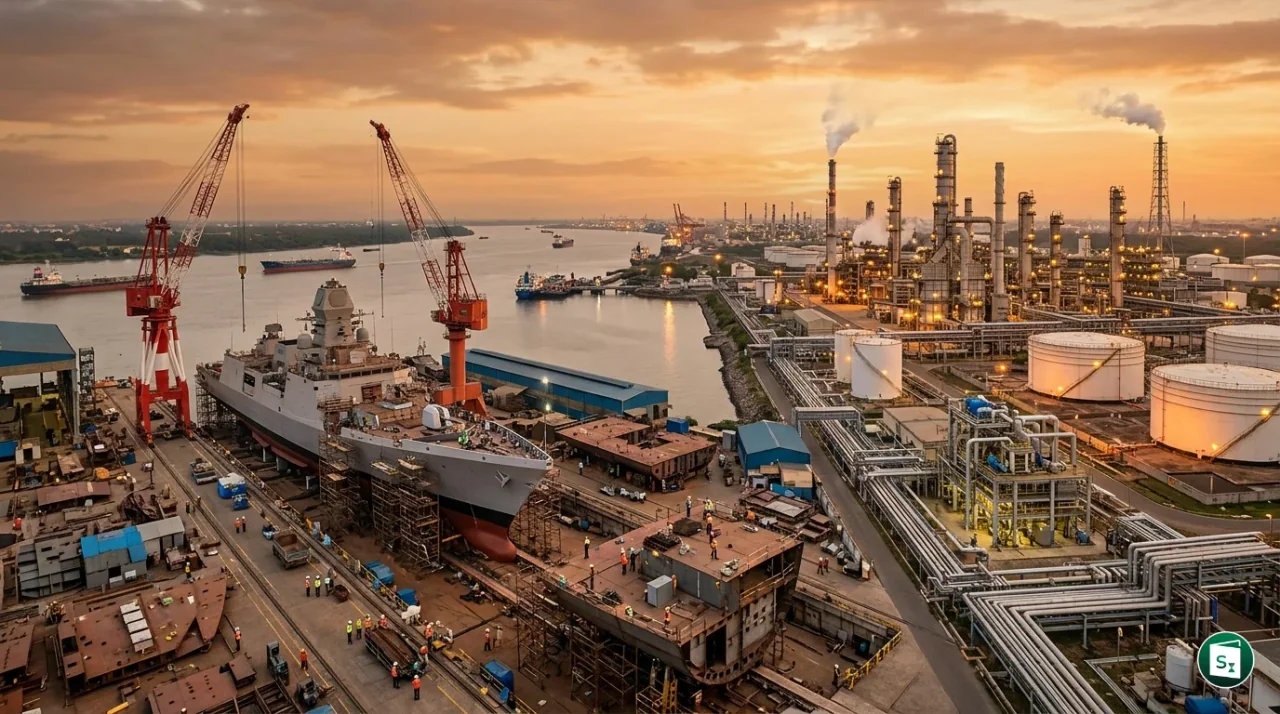
The Department of Public Enterprises (DPE) under the Ministry of Finance has upgraded Chennai Petroleum Corporation Ltd (CPCL) and Garden Reach Shipbuilders & Engineers Ltd (GRSE) as Navratna Central Public Sector Enterprises, making them the 28th and 29th CPSEs respectively to hold this distinction. With this upgrade, both companies can now invest up to Rs 1,000 crore or 15% of their net worth on a single project without seeking prior approval from the central government. The elevation reflects their consistent financial performance, operational efficiency, and growing strategic importance in their respective sectors.
What Is the Navratna Status?
The Navratna classification is a status awarded to select Central Public Sector Enterprises (CPSEs) that have demonstrated strong financial and operational performance over a sustained period. The government introduced the Navratna scheme in 1997 to identify high-performing CPSEs and grant them greater autonomy to compete effectively in the global market.
The Department of Public Enterprises (DPE), which functions under the Ministry of Finance, is the nodal agency responsible for formulating policies related to CPSEs, including the grant of Navratna status. The DPE was originally set up as the Bureau of Public Enterprises (BPE) in 1965 and was converted into a full-fledged department in May 1990. It is headquartered in New Delhi.
To be eligible for Navratna status, a CPSE must first hold Miniratna Category-I status and be classified under Schedule ‘A’. It must have obtained an Excellent or Very Good rating under the Memorandum of Understanding (MoU) system in at least three of the last five years. Additionally, the enterprise must score 60 or above out of a maximum of 100 marks across six performance indicators, which include net profit to net worth, manpower cost to total cost of production, profit before depreciation interest and taxes (PBDIT) to capital employed, profit before interest and taxes (PBIT) to turnover, earnings per share (EPS), and inter-sectoral performance.
CPCL: From Madras Refineries to Navratna
Chennai Petroleum Corporation Limited (CPCL), formerly known as Madras Refineries Limited (MRL) , was incorporated on November 18, 1965, as a joint venture between the Government of India, AMOCO (an American oil company), and the National Iranian Oil Company (NIOC) . The company was set up to establish a refinery at Manali, on the northern outskirts of Chennai, with an initial installed capacity of 2.5 million metric tonnes per annum (MMTPA) .
In 1985, AMOCO disinvested its stake in favour of the Government of India. Subsequently, the government transferred its equity to Indian Oil Corporation Limited (IOCL) , making CPCL a subsidiary of IOCL in 2001. Today, IOCL holds 51.89% of CPCL’s equity, while NIOC (through its affiliate Naftiran Intertrade Company) holds 15.40%, with the remaining held by public shareholders and institutions. The company operates under the administrative control of the Ministry of Petroleum and Natural Gas and is headquartered in Chennai, Tamil Nadu.
CPCL’s Manali Refinery is one of the most complex refineries in India, with a current installed capacity of 10.5 MMTPA. It produces a diverse range of products including LPG, motor spirit, aviation turbine fuel, high-speed diesel, naphtha, bitumen, lube base stocks, paraffin wax, fuel oil, hexane, and petroleum coke. The refinery also houses a wax plant with a capacity of 30,000 metric tonnes per annum, supporting the livelihoods of around 30,000 beneficiaries, mainly from micro, small, and medium enterprises.
CPCL’s Financial Performance
CPCL’s elevation to Navratna status was backed by strong financial performance in FY 2025-26. The company posted a revenue from operations of Rs 78,611 crore, up from Rs 71,050 crore in the previous year. Its net profit surged to Rs 3,062 crore, a dramatic increase from Rs 174 crore in FY 2024-25, driven by record throughput, improved operating efficiencies, and stronger refining margins. Prior to this upgrade, CPCL held Miniratna Category-I status.
GRSE: From a Small Workshop to a Warship Powerhouse
Garden Reach Shipbuilders & Engineers Ltd (GRSE) , headquartered in Kolkata, West Bengal, has one of the longest histories among Indian CPSEs. It traces its origins to 1884, when it started as a small workshop on the eastern bank of the Hooghly River repairing vessels for the River Steam Navigation Company. The company was nationalised by the Government of India in 1960 and was awarded Miniratna status in September 2006.
GRSE functions under the administrative control of the Ministry of Defence and is a leading defence shipyard catering primarily to the Indian Navy and the Indian Coast Guard. It holds the distinction of being the first Indian shipyard to build and deliver 100 warships, a milestone achieved in March 2019. As of 2026, GRSE has designed and built 118 warships, including 80 for the Indian Navy.
The shipyard has facilities in Kolkata and a diesel engine plant in Ranchi. It operates a dry dock capable of handling ships up to 26,000 tonnes deadweight (DWT) and has a covered all-weather non-tidal wet basin for fitting-out operations. GRSE also manufactures modular bridges, with over 5,800 modular bridges supplied to the Border Roads Organisation (BRO) and other agencies. In 2023, GRSE signed an MoU with Rolls-Royce to manufacture marine engines in India.
GRSE’s Journey in Numbers
GRSE’s financial performance over the last five years has been remarkable. Its revenue from operations grew from Rs 1,754 crore in FY 2021-22 to Rs 7,002 crore in FY 2025-26, an increase of nearly 300%. Its profit after tax rose from Rs 190 crore to Rs 748 crore during the same period, reflecting a growth of nearly 294%. The company delivered eight warships during FY 2025-26, including a historic triple delivery on March 30, 2026, when it handed over INS Dunagiri (a Project 17A advanced guided-missile frigate), INS Sanshodhak (a survey vessel), and INS Agray (an anti-submarine warfare shallow water craft) to the Indian Navy on the same day. The company is currently pursuing both brownfield and greenfield expansion projects to increase its shipbuilding capacity.
What Changes With Navratna Status?
The Navratna status significantly enhances the financial and operational autonomy of CPCL and GRSE. The key powers that come with this status include:
| Power Conferred | Details |
|---|---|
| Investment ceiling | Up to Rs 1,000 crore or 15% of net worth on a single project, whichever is lower, without prior government approval |
| Annual investment limit | Up to 30% of net worth in a given year, subject to the cap of Rs 1,000 crore per project |
| Capital expenditure | No monetary ceiling on capital expenditure for purchase of new items or replacement |
| Joint ventures | Freedom to enter into technology joint ventures, strategic alliances, and form subsidiary companies overseas |
| Mergers and acquisitions | Empowered to pursue mergers and acquisitions to expand operations |
| Human resources | Greater authority in decisions related to organisational structure and human resources management |
This autonomy allows both companies to respond quickly to market opportunities without waiting for multi-layered government clearances. For CPCL, this means faster execution of its planned 9 MMTPA refinery complex at the Nagapattinam location, including a petrochemical facility. For GRSE, the enhanced powers come at a time when the shipyard is pursuing capacity expansion and targeting a larger share of the export market for warships and naval platforms.
CPSE Classification Framework in India
The Government of India classifies Central Public Sector Enterprises into three tiers based on their performance, size, and strategic importance. With the addition of CPCL and GRSE, the total number of Navratna CPSEs now stands at 29, while the higher Maharatna category has 13 CPSEs.
| Category | Year Introduced | Key Criteria | Investment Autonomy | Number |
|---|---|---|---|---|
| Maharatna | 2010 | Navratna status, listed on stock exchange, average turnover over Rs 25,000 crore, average net worth over Rs 15,000 crore, average net profit over Rs 5,000 crore in last 3 years | Up to Rs 5,000 crore or 15% of net worth per project | 13 |
| Navratna | 1997 | Miniratna-I status, Schedule ‘A’, Excellent/Very Good MoU rating in 3 of last 5 years, composite score of 60+ | Up to Rs 1,000 crore or 15% of net worth per project | 29 |
| Miniratna Category-I | 1997 | Profit in last 3 continuous years, pre-tax profit of Rs 30 crore or more in at least one of three years, positive net worth | Up to Rs 500 crore or equity/net worth, whichever is lower | 57+ |
| Miniratna Category-II | 1997 | Profit for last 3 continuous years, positive net worth | Up to Rs 300 crore or 50% of net worth, whichever is lower | 14+ |
The classification helps efficient CPSEs operate with greater commercial freedom while maintaining government oversight proportionate to their performance. The Maharatna status, introduced in 2010, is the highest tier and currently includes major CPSEs such as Indian Oil Corporation, NTPC, ONGC, Coal India, SAIL, BPCL, HPCL, GAIL, Power Grid Corporation, BHEL, Power Finance Corporation, REC, and Oil India Limited.
Key Takeaways
- The Department of Public Enterprises (DPE) under the Ministry of Finance upgraded CPCL as the 28th and GRSE as the 29th Navratna CPSE in June 2026.
- CPCL, formerly Madras Refineries Limited, was incorporated in 1965 and is a subsidiary of Indian Oil Corporation (IOCL) with its refinery at Manali, Chennai having a capacity of 10.5 MMTPA.
- GRSE, established in 1884 and nationalised in 1960, is the first Indian shipyard to build 100 warships and operates under the Ministry of Defence.
- Navratna CPSEs can invest up to Rs 1,000 crore or 15% of net worth per project without prior government approval.
- The Navratna scheme was introduced in 1997, and eligibility requires Miniratna Category-I status, Schedule ‘A’ classification, and a composite score of 60 or above on six performance indicators.
- The Maharatna category, introduced in 2010, is the highest CPSE tier with 13 companies and an investment ceiling of up to Rs 5,000 crore per project.