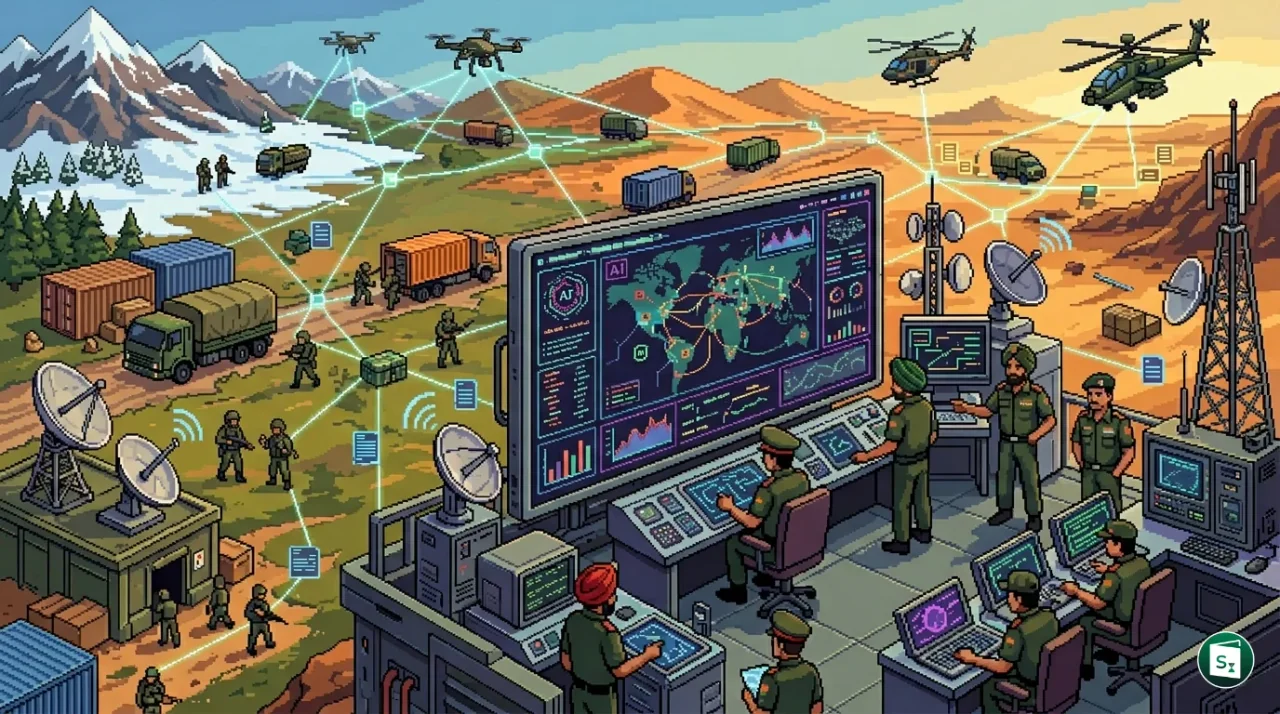
The Indian Army reached a significant milestone in its digital transformation journey on June 2, 2026, with the launch of two cutting-edge platforms, Q-FORCE and Kautilya. These systems are designed to revolutionize how the force manages its vast supply chains and processes field intelligence across diverse operational environments. By integrating logistics and artificial intelligence, the Army aims to enhance its combat readiness and decision-making speed in modern high-tech warfare.
Q-FORCE: Streamlining the Army’s Supply Chain
The Q-FORCE platform is a comprehensive digital application developed to unify the Indian Army’s complex logistics and supply chain networks. It integrates several existing inventory systems and legacy platforms into a single, coordinated framework. This integration is crucial for maintaining real-time visibility of stocks, ranging from critical ammunition and fuel to food supplies and medical equipment.
One of the standout features of Q-FORCE is its ability to function seamlessly across India’s diverse operational terrains. Whether in the high-altitude regions of the Himalayas, where extreme cold and low oxygen levels pose unique challenges, or in the arid Western deserts, the platform optimizes supply allocation and transport planning. By automating reorder thresholds and tracking shipments in real-time, the system significantly reduces the “logistics tail”—the administrative and physical effort required to sustain combat units in the field.
| Feature | Description |
|---|---|
| Asset Visibility | Provides near real-time tracking of inventory from depots to forward units. |
| Terrain Optimization | Customizes logistics planning for mountains, deserts, and jungles. |
| System Integration | Consolidates legacy platforms like the Computerised Inventory Control Project (CICP). |
| Efficiency | Aims to compress the logistics cycle by one-third and reduce manual paperwork. |
Kautilya: The AI ‘Co-Pilot’ for Command Intelligence
Named after the legendary ancient strategist and author of the Arthashastra, the Kautilya platform serves as an AI-powered command intelligence tool. It is designed to act as a “co-pilot” for military commanders, helping them process and analyze the massive volumes of unstructured data generated by unit reports, sensors, and surveillance systems.
The platform utilizes Natural Language Processing (NLP), allowing officers to interact with the system through intuitive interfaces and generate structured analytics. By providing real-time dashboards on personnel readiness, equipment status, and operational training, Kautilya ensures that commanders have a clear and updated “battlefield picture.” This capability is vital for shortening the OODA loop (Observe-Orient-Decide-Act), which represents the cycle of decision-making. In modern warfare, the speed at which a commander can process information and act determines the strategic advantage.
Analogy · The Digital Strategist Expand analogy
Imagine a grandmaster playing multiple chess games at once. While the grandmaster is an expert, having a supercomputer analyze every move of every opponent in real-time and suggesting the most efficient path to victory would be a game-changer. Kautilya acts as that supercomputer for Army commanders, filtering through the “noise” of information to highlight the most critical threats and opportunities.
The Strategic Context: ‘Year of Networking and Data Centricity’
The launch of Q-FORCE and Kautilya is a key milestone in the Indian Army’s multi-year roadmap for digital modernization. The Army has designated 2026 as the “Year of Networking and Data Centricity,” focusing on building the infrastructure and networking capabilities required for data-driven warfare. This follows the “Year of Technology Absorption” (2024) and the “Year of Technology Implementation” (2025), reflecting a structured approach to integrating advanced tech into the force.
These initiatives are part of broader defense projects such as Project SANJAY, which focuses on battlefield surveillance and digital integration. By developing these platforms indigenously, the Army is aligning with the Atmanirbhar Bharat (Self-Reliant India) initiative, ensuring that sensitive operational data remains secure within national networks. The goal is to achieve full AI integration across all operational systems by 2027, transforming the Army into a technology-intensive force.
Timeline of Digital Transformation
| Year | Designation | Core Focus |
|---|---|---|
| 2024 | Year of Technology Absorption | Researching and testing emerging technologies. |
| 2025 | Year of Technology Implementation | Rolling out initial digital platforms and hardware. |
| 2026 | Year of Networking and Data Centricity | Integrating systems into a unified, data-driven network. |
| 2027 | Target for Full AI Integration | Achieving comprehensive AI-enabled operational capability. |
Modernizing the Last-Mile: Logistics in Diverse Terrains
A critical aspect of the Q-FORCE implementation is its focus on the “last-mile” delivery in difficult geographical zones. In the high-altitude regions of Ladakh and Arunachal Pradesh, traditional supply routes are often hampered by heavy snowfall and rugged mountains. The platform works in tandem with specialized hardware, such as high-altitude logistics drones and autonomous robotic mules, which are being inducted to replace animal transport.
By utilizing predictive analytics, Q-FORCE can forecast the requirement for essential items like oxygen cylinders, kerosene for heating, and specialized high-altitude rations before a shortage occurs. In the Western sector, where sandstorms and extreme heat affect equipment health, the system integrates with workshop automation tools like Project Beehive to monitor the maintenance status of tanks and infantry combat vehicles. This dual approach of digital tracking and physical automation ensures that troops stationed in the most remote outposts are always mission-ready.
Key Integrated Systems
| System | Role |
|---|---|
| Project Beehive | Automates over 2,000 workshops for real-time equipment health monitoring. |
| DIME | Provides pan-Army asset visibility and reduces administrative delays. |
| Project SANJAY | Integrates sensor data to provide a common operational picture. |
| SAMBHAV | Indigenous 5G ecosystem for secure mobile communication. |
Key Takeaways
- The Indian Army launched Q-FORCE and Kautilya on June 2, 2026, as part of its digital transformation strategy.
- Q-FORCE is an integrated application for logistics and sustainment management across diverse operational terrains like the Himalayas and deserts.
- Kautilya is an AI-powered command intelligence platform that acts as a decision-support co-pilot using Natural Language Processing (NLP).
- The year 2026 has been designated by the Army as the “Year of Networking and Data Centricity.”
- These platforms are part of broader indigenous initiatives like Project SANJAY and align with the Atmanirbhar Bharat goal in defense technology.
- The Army aims to achieve full AI integration across all its operational systems by 2027.