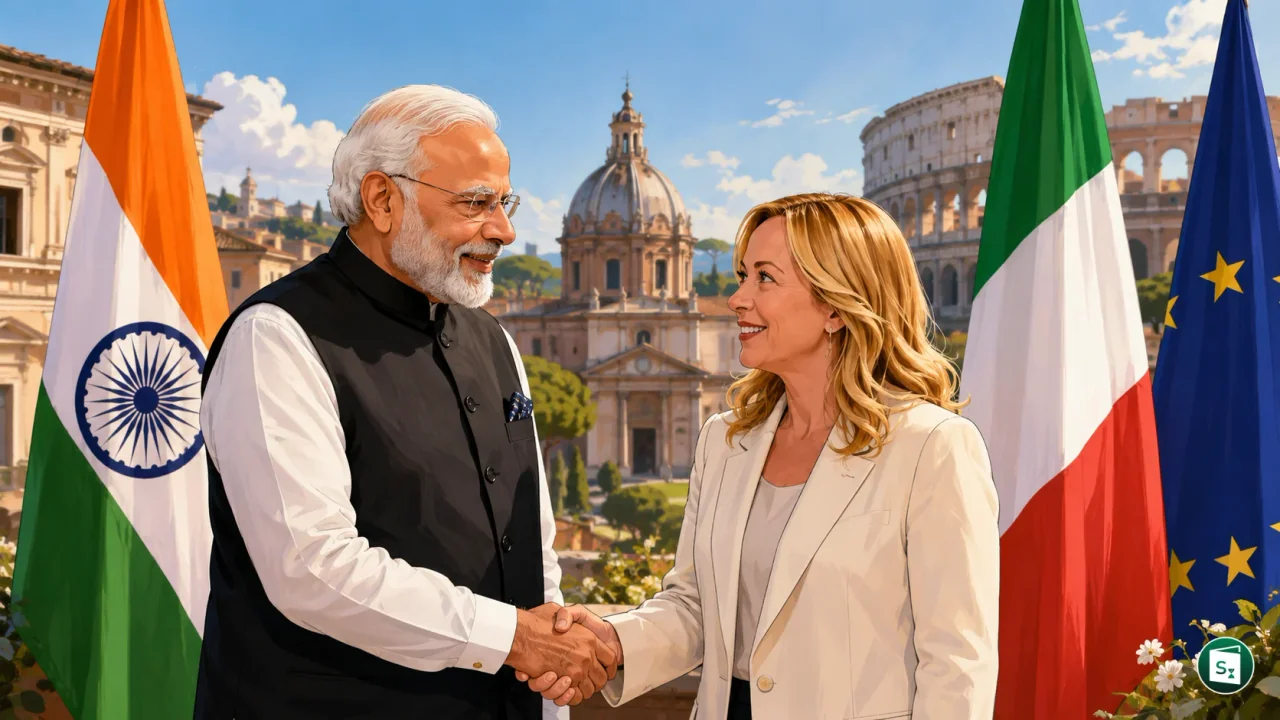
Prime Minister Narendra Modi and Italian Prime Minister Giorgia Meloni elevated bilateral ties to a Special Strategic Partnership during a high-profile meeting in Rome on June 2, 2026. The visit focused on the implementation of the Joint Strategic Action Plan (2025-2029) and resulted in the adoption of a transformative Defence Industrial Roadmap. By signing 10 Memorandums of Understanding (MoUs), the two nations have charted a course for deeper cooperation in the Indo-Mediterranean strategic space.
Elevation to a Special Strategic Partnership
The decision to elevate the relationship to a Special Strategic Partnership marks the highest level of diplomatic engagement between India and Italy. This transition builds upon the Strategic Partnership established in March 2023 and underscores the growing alignment between the two nations on global issues. By upgrading the status, both countries have committed to a more robust framework for security, trade, and technology cooperation.
During the visit, Prime Minister Modi also held discussions with the Italian President, Sergio Mattarella. A key highlight of the bilateral talks was the recognition of the 1.87 lakh-strong Indian diaspora in Italy, which is the largest in the European Union. This community serves as a vital link, fostering cultural and economic ties between the two ancient civilizations. The leaders emphasized that this special status will allow for more frequent high-level consultations and a stronger voice in international forums like the G20 and the G7.
Joint Strategic Action Plan 2025–2029: A Five-Year Roadmap
The Joint Strategic Action Plan (2025–2029) serves as a comprehensive blueprint for the next five years of bilateral engagement. Initially adopted during the G20 Summit in Rio de Janeiro in November 2024, the plan identifies 10 specific pillars for cooperation. During the Rome meeting, the leaders reviewed the progress of these initiatives and emphasized the goal of increasing bilateral trade to €20 billion by 2029.
| Pillar | Focus Areas |
|---|---|
| Political Dialogue | Regular high-level meetings and annual consultations at the senior official level. |
| Economic Cooperation | Investments in semiconductors, advanced manufacturing, and pharmaceuticals. |
| Connectivity | Implementation of the India-Middle East-Europe Economic Corridor (IMEC). |
| Defence Cooperation | Co-design and co-production of military equipment under the new Roadmap. |
| Space Sector | Collaborative missions between ISRO and the Italian Space Agency (ASI). |
| Science and Technology | Focus on Artificial Intelligence (AI), quantum computing, and semiconductors. |
| Energy Transition | Joint projects in green hydrogen, biofuels, and renewable energy. |
| Security | Cooperation in cybersecurity and counter-terrorism initiatives. |
| Migration and Mobility | Structured legal channels for the mobility of students and professionals. |
| Cultural Ties | Strengthening people-to-people connections through tourism and heritage. |
This roadmap ensures that the partnership remains time-bound and outcome-oriented. It specifically targets the development of sustainable supply chains and the integration of small and medium enterprises (SMEs) from both nations into the global value chain.
Strengthening Defence and Security Cooperation
A pivotal outcome of the visit was the adoption of the Defence Industrial Roadmap, which transforms the bilateral relationship from a buyer-seller model into a partnership based on co-design, co-development, and co-production. This roadmap focuses on advanced military technologies, including naval platforms, helicopters, and electronic warfare systems. By leveraging each other’s industrial strengths, both nations aim to achieve greater self-reliance in defence manufacturing.
Security cooperation has also been bolstered through a significant Memorandum of Understanding signed between India’s Directorate of Enforcement (ED) and Italy’s Guardia di Finanza. This agreement establishes a framework for collaboration in combating financial crimes, money laundering, and terror financing. The two nations have also launched a formal Maritime Security Dialogue to ensure the safety of sea lanes in the Indo-Mediterranean region, which is critical for global trade and energy security.
Expanding the Economic and Technology Frontier
The economic dimension of the partnership was reinforced by the signing of 10 Memorandums of Understanding (MoUs). These agreements target future-ready sectors and aim to integrate the innovation ecosystems of both countries. A major highlight was the launch of INNOVIT India, a dedicated innovation hub that will link startups, universities, and research centres in fields like Artificial Intelligence (AI), quantum computing, and semiconductors.
| Sector | Key Provisions and Objectives |
|---|---|
| Critical Minerals | Framework for cooperation in the exploration and supply chain of lithium and cobalt. |
| Healthcare | Joint Declaration of Intent to facilitate the mobility of Indian nurses to Italy. |
| Innovation Hub | Establishment of INNOVIT India to support startups in deep-tech and fintech. |
| Agriculture | Cooperation in digital farming and climate-resilient crops for the period 2026-2031. |
| Financial Intelligence | Collaboration between the ED and Guardia di Finanza to fight economic crimes. |
| Maritime Heritage | Italian technical support for the National Maritime Heritage Complex (NMHC) in Lothal. |
| Marine Products | Agreement between MPEDA and Italian seafood agencies to boost bilateral trade. |
| Traditional Medicine | Promotion of Ayurveda and joint research in Indian traditional medicinal systems. |
| Higher Education | Roadmap to enhance academic collaboration and student mobility between universities. |
| Climate Change | Joint research on sustainability between IITM Pune and Italian climate agencies. |
Furthermore, the MoU on critical minerals is essential for India’s clean energy goals, as it focuses on securing the sustainable supply of minerals required for electric vehicle batteries. The healthcare mobility agreement addresses the labour shortage in Italy while providing high-quality professional opportunities for Indian medical staff.
Connectivity and the IMEC Corridor
A central focus of the bilateral discussions was the progress of the India-Middle East-Europe Economic Corridor (IMEC). Italy serves as the western anchor of this ambitious connectivity project, which seeks to integrate the economies of India, the Middle East, and Europe. Both Prime Ministers noted that the corridor will act as a “green and digital bridge,” significantly reducing transit times and lowering logistics costs for international trade.
The partnership also emphasizes maritime infrastructure, as demonstrated by the MoU on maritime transport and ports. This agreement facilitates cooperation in port management and sustainable shipping, directly supporting the operationalization of the IMEC. By strengthening these links, India and Italy are creating a more resilient supply chain that bypasses traditional chokepoints and enhances energy security for the entire Mediterranean and Indian Ocean regions.
Cultural Ties: Year of Culture and Tourism 2027
To further deepen the bonds between the two societies, India and Italy have officially declared 2027 as the Year of Culture and Tourism. This initiative will involve a series of high-profile events, heritage exhibitions, and artist exchanges aimed at celebrating the shared history of these two ancient civilizations. A significant component of this collaboration is Italy’s technical participation in the development of the National Maritime Heritage Complex (NMHC) at Lothal, Gujarat, where Italian experts will share their experience in maritime archaeology and museum conservation.
During the visit, Prime Minister Modi was also awarded the Agricola Medal 2026 by the Food and Agriculture Organization (FAO), which is headquartered in Rome. This prestigious recognition was given in honor of India’s significant contributions to global food security and its leadership in promoting sustainable agricultural practices. The award underscores the multidimensional nature of the partnership, which extends from strategic defence to global humanitarian goals.
Key Takeaways
- India and Italy elevated their bilateral relationship to a Special Strategic Partnership on June 2, 2026.
- The Joint Strategic Action Plan (2025-2029) has set a bilateral trade target of €20 billion by 2029.
- A transformative Defence Industrial Roadmap was adopted to focus on the co-production of helicopters and naval platforms.
- Both nations have declared 2027 as the Year of Culture and Tourism to strengthen people-to-people ties.
- Italy will provide technical expertise for the development of the National Maritime Heritage Complex (NMHC) in Lothal, Gujarat.
- Prime Minister Narendra Modi was awarded the Agricola Medal 2026 by the FAO in recognition of India’s food security efforts.
- Italy is officially recognized as the western anchor of the India-Middle East-Europe Economic Corridor (IMEC).
- The launch of INNOVIT India will serve as a dedicated hub for startups and innovation in Artificial Intelligence and semiconductors.