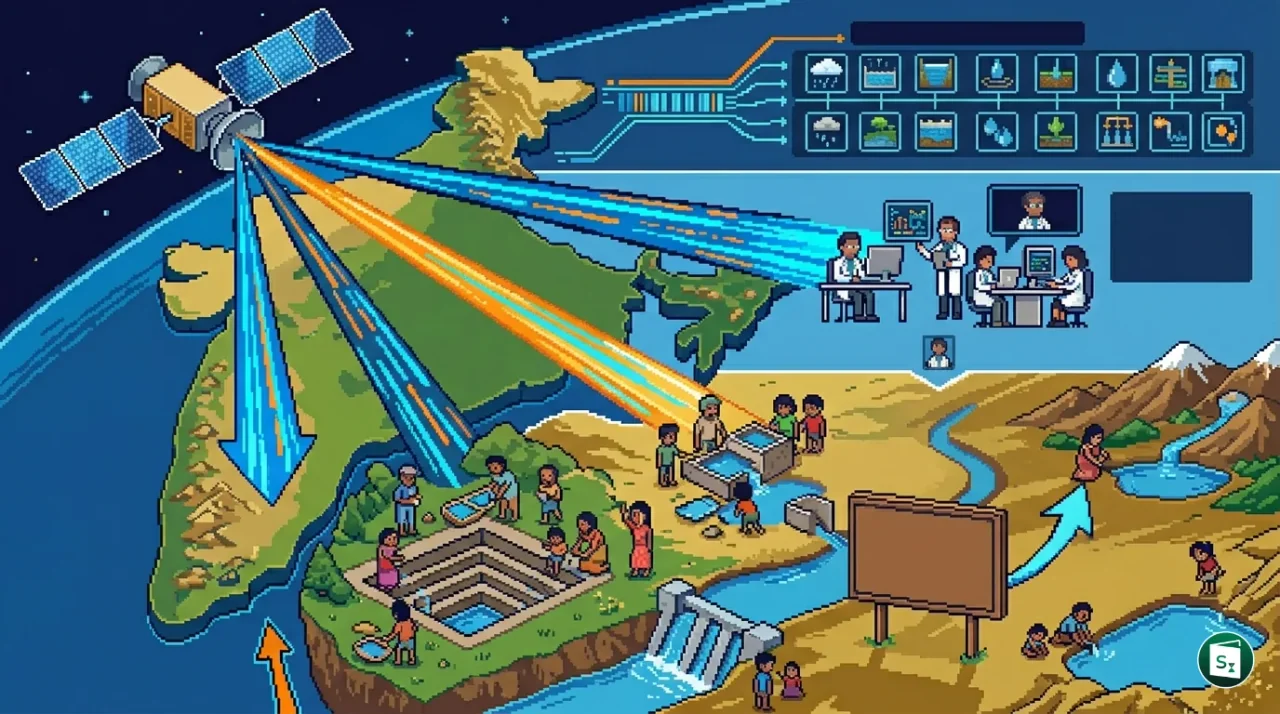
The Ministry of Jal Shakti has entered into a strategic partnership with the Indian Space Research Organisation (ISRO) to enhance India’s water resource management through advanced satellite technology. This collaboration, formalised during a national workshop in New Delhi, involves joint research across 24 priority areas to address critical water governance challenges using space-based data. Alongside this partnership, the government has launched the third phase of the Jal Sanchay Jan Bhagidari campaign, targeting the creation of 2 crore water conservation structures by May 2027.
Strategic Partnership: Jal Shakti Ministry and ISRO
The Memorandum of Understanding (MoU) was signed by the Department of Water Resources, River Development and Ganga Rejuvenation (DoWR, RD & GR) under the Ministry of Jal Shakti and ISRO during the National Workshop on Research and Development in the Water Sector. The Union Jal Shakti Minister, C.R. Patil, highlighted that this collaboration is a vital step toward achieving Viksit Bharat by 2047 by integrating cutting-edge space technology into water governance.
The partnership aims to leverage ISRO’s expertise in remote sensing and geospatial analytics to provide real-time insights into India’s water assets. This initiative builds on the Ministry’s long-standing commitment to scientific research, having supported 113 directly sponsored research projects in the water sector over the last ten years as part of a larger portfolio of over 315 R&D initiatives.
24 Key Areas of Space-Based Water Research
The collaboration identifies 24 priority research areas where ISRO’s satellite capabilities will be deployed to improve hydrological modelling and resource assessment. Key focus areas include reservoir monitoring, water-spread assessment, and river-flow analysis. The research will also extend to modern environmental challenges, such as tracking macroplastic distribution in river systems and conducting satellite-based water quality assessments.
The use of space technology is particularly crucial for groundwater evaluation and flood forecasting. By utilising platforms like the National Remote Sensing Centre (NRSC) and the Bhuvan Geoportal, the Ministry can now monitor urban aquifers and map floodplain inundation with higher precision. These technical studies help in planning for climate resilience and ensuring the structural safety of large dams through continuous monitoring.
| Research Domain | Key Focus Applications |
|---|---|
| Surface Water | Reservoir monitoring, river morphology, and flood mapping |
| Groundwater | Aquifer mapping, urban groundwater evaluation, and recharge planning |
| Environment | Water quality assessment and macroplastic distribution studies |
| Disaster Management | Flood forecasting and dam safety monitoring |
Launch of Jal Sanchay Jan Bhagidari Phase III
In a parallel development, the government launched the third phase of the Jal Sanchay Jan Bhagidari (JSJB) campaign. This flagship initiative, which translates to ‘Water Conservation through People’s Participation’, aims to create 2 crore water conservation structures across the country between June 2026 and May 2027. The campaign operates on the principle of community-led water management, encouraging local bodies and citizens to build rainwater harvesting systems and desilt local ponds.
The launch follows the substantial impact of the previous phases, which successfully created over 1.5 crore water conservation structures. To support this massive scaling effort, the Ministry also introduced the JSJB-Catch the Rain Portal, a digital platform designed for participatory documentation of conservation efforts. This phase will work in tandem with the MAHA on Water (Mission for Advancement in High-Impact Areas for Water) initiative, which provides funding support for high-impact research in water-use efficiency and climate resilience.
Strengthening India’s Water Research Ecosystem
The national workshop also witnessed the unveiling of the Bharat Water Innovation Network (Bharat WIN). This digital platform is dedicated to supporting startups and MSMEs in developing prototypes and products for the water sector. By fostering an innovation-driven ecosystem, Bharat WIN aims to bridge the gap between academic research and commercial application.
The Ministry’s collaboration with the Anusandhan National Research Foundation (ANRF) under the MAHA mission further strengthens this ecosystem. With a projected outlay of ₹200 crore, the mission will support multidisciplinary consortia to develop technology-driven solutions for drinking water and sustainable irrigation. These integrated efforts reflect a holistic approach to water management, combining space technology, community action, and industrial innovation.
Key Takeaways
- The Ministry of Jal Shakti and ISRO signed an MoU on June 1, 2026, to collaborate on satellite-based water resource management.
- The partnership identifies 24 priority research areas, including reservoir monitoring, macroplastic distribution, and satellite-based water quality assessment.
- Phase III of the Jal Sanchay Jan Bhagidari (JSJB) campaign targets the creation of 2 crore water conservation structures by May 2027.
- Previous phases of the JSJB campaign have successfully established over 1.5 crore water conservation structures across India.
- The MAHA on Water mission, a joint initiative with the Anusandhan National Research Foundation, has a projected outlay of ₹200 crore for high-impact water research.
- Bharat Water Innovation Network (Bharat WIN) was launched to support startups and MSMEs in developing technological solutions for the water sector.