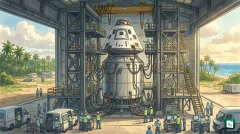
ISRO has successfully completed three major qualification tests of the Gaganyaan crew module systems, validating critical safety mechanisms that will protect astronauts during the most dangerous phases of India’s first human spaceflight mission. The tests focused on three moments that the crew cannot control themselves: keeping the capsule upright after splashdown in the sea, ensuring a clean break from the service module before re-entry, and confirming that the module can withstand the forces generated when the parachute cover is blasted away. Together, these trials bring Gaganyaan another step closer to its first crewed launch by proving that systems central to crew safety are ready for flight.
What Is the Gaganyaan Mission?
Gaganyaan is India’s first indigenous human spaceflight programme, overseen by the Indian Space Research Organisation (ISRO) through its dedicated Human Space Flight Centre (HSFC). HSFC was established on 30 January 2019 in Bengaluru to lead the country’s human spaceflight efforts. The project aims to send a crew of two to three astronauts, called Gaganyatris, to a Low Earth Orbit of 400 km for a three-day mission and bring them back safely with a splashdown in Indian sea waters.
The spacecraft consists of two main parts. The Crew Module (CM) is the habitable space where the astronauts live during the mission. It has a sphere-cone configuration with a diameter of 3.5 metres and a height of 3.58 metres, and is built with a double-walled construction consisting of a pressurised metallic inner structure and an unpressurised outer structure with a Thermal Protection System. The Service Module (SM) provides power, propulsion, and life support to the crew module during orbit. Together, the CM and SM form the Orbital Module with a combined launch mass of 8,200 kg.
The mission will be launched aboard the Human Rated LVM3 (HLVM3) rocket, a reconfigured version of ISRO’s workhorse LVM3 launcher. The HLVM3 is equipped with a Crew Escape System (CES) that uses quick-acting solid motors to pull the crew module to safety in case of an emergency during launch or ascent. India aims to become the fourth country in the world to independently send humans to space, after the United States, Russia, and China.
The Three Tests Explained
ISRO announced on 12 July 2026 that it had successfully completed three qualification tests of the crew module systems. Each test addressed a different phase of the mission’s return sequence: splashdown recovery, module separation, and parachute deployment.
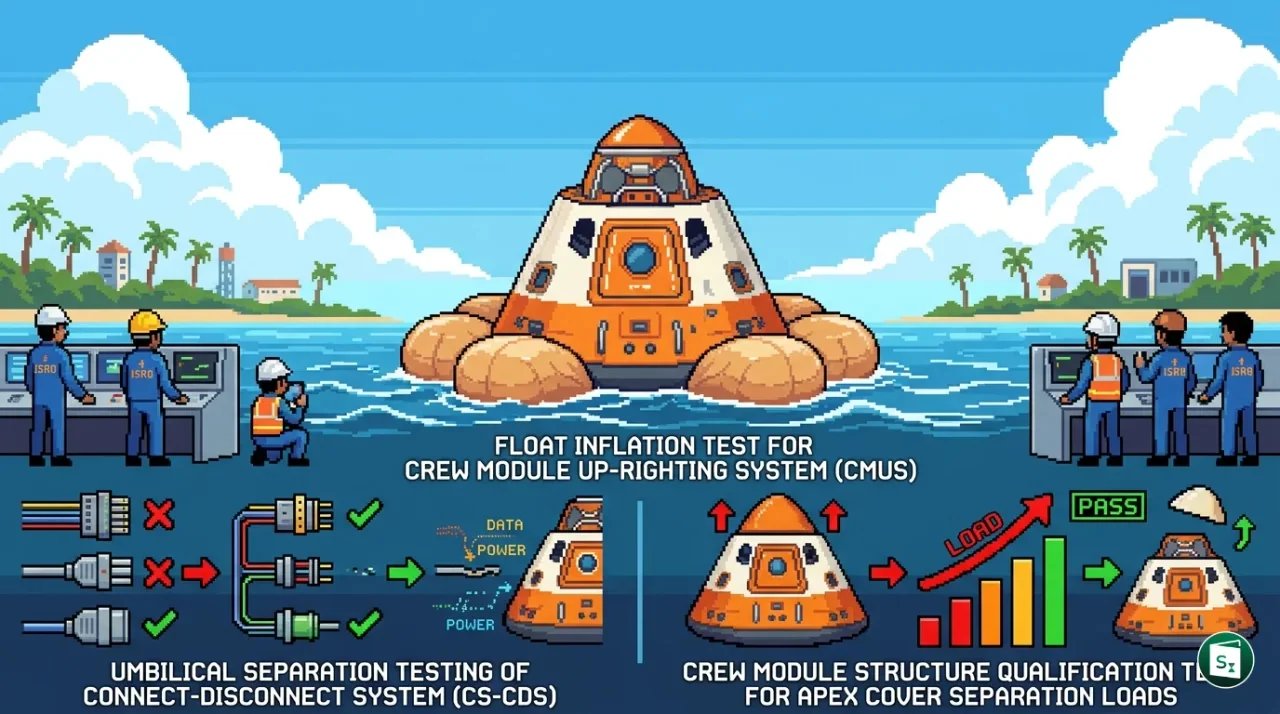
Float Inflation Test of the Crew Module Up-righting System (CMUS)
After the crew module re-enters the atmosphere and descends under parachutes, it splashes down in the sea. This is the final stage of the mission, and one of the most critical for crew safety. If the capsule lands upside down or at an awkward angle, it can endanger the astronauts inside and make recovery difficult.
ISRO has developed a stored cold gas-based uprighting system to address this. The system uses high-pressure gas bottles connected to control valves and flotation bags. When activated after splashdown, the valves release the compressed gas into the flotation bags, which inflate and push the capsule back to an upright position.
During the qualification test, engineers built a system-level setup containing all elements of the Crew Module Up-righting System (CMUS). They successfully conducted inflation tests of the primary inflation module, releasing stored gas from high-pressure bottles to inflate the flotation devices by operating the control valves. The test demonstrated that the inflation module meets all functional and performance requirements and works across the complete range of gas bottle pressures. This confirms that the system can reliably right the crew module no matter how it lands in the water.
Umbilical Separation Test of the Connect-Disconnect System (CS-CDS)
The Crew Module and Service Module remain connected throughout the mission through an umbilical link called the Crew Module Service Module Connect and Disconnect System (CS-CDS). This system carries all electrical communication between the two modules as well as fluid lines for the Environment Control and Life Support System (ECLSS), which maintains breathable air, temperature, and pressure inside the crew module.
The system consists of two umbilical units. CSU-1 is located on the crew module side, while CSU-2 is on the service module side. The separation sequence works in two steps. First, after the de-orbit manoeuvre, the service module separates from the crew module when CSU-1 disconnects. Then, shortly before the crew module enters the atmosphere, CSU-2 must also detach cleanly.
ISRO carried out a separation test of CSU-2 from a simulated crew module. The test demonstrated a clean separation of the umbilical unit without any damage or sticking. It also confirmed the structural stability of the crew module panel and its interfaces under the stress of separation, validating that the design has the required safety margins.
Structural Qualification Test for Apex Cover Separation Loads
The apex cover is a protective shield that sits on top of the crew module and guards the parachutes and their associated subsystems throughout the launch, orbital phase, and re-entry. Before the parachutes can deploy to slow the module for a safe landing, this cover must be jettisoned at a predetermined altitude using pyrotechnically actuated thrusters.
The separation event generates powerful shock and reaction loads. If the crew module structure cannot withstand these forces, it could be damaged and the parachute deployment sequence could fail. To validate the structural integrity of the crew module for this event, ISRO built an instrumented test rig with a simulated crew module and applied loads approximately 1.75 times higher than the estimated reaction loads expected during an actual mission.
All measured strain and deformation during the test remained within design limits. This confirmed that the crew module structure has adequate strength and design margins to handle the apex cover separation event safely during flight.
Significance of These Tests
These three qualification tests are not about launching a rocket or flying in space. They are about the engineering rigour that goes into making a human-rated spacecraft safe. Unlike satellites, where a single point of failure can be tolerated, human spaceflight demands that every system function perfectly because crew safety is non-negotiable.
The tests validate systems that operate at the three most vulnerable moments of the return journey. The CMUS ensures that after a high-speed ocean impact, the crew module rights itself and keeps the astronauts stable until recovery teams arrive. The CS-CDS guarantees that the crew module separates cleanly from the service module before the fiery re-entry, so no loose connections or snagged cables compromise the descent. The apex cover test confirms that the parachutes, the final line of defence for a soft landing, can deploy without interference because the structure around them can survive the jettisoning shock.
These tests add to a growing list of successful qualification milestones for Gaganyaan. Earlier in 2026, ISRO completed the Integrated Main Parachute Air Drop Test (IMAT), where a full-scale dummy crew module was dropped from an Indian Air Force helicopter to validate the parachute deployment sequence. The second Integrated Air Drop Test (IADT) was also conducted, in which a dummy module was dropped from a Chinook helicopter and recovered by the Indian Navy, refining the spacecraft’s recovery mechanisms.
The Road Ahead for Gaganyaan
Before any Indian astronaut flies to space, ISRO plans to conduct a series of uncrewed test flights to prove the safety and reliability of all systems. The first uncrewed mission, designated G1, is expected later in 2026 and will carry Vyommitra, a half-humanoid robot that will test the life support and safety systems from inside the crew module. Two more uncrewed missions, G2 and G3, are planned after that.
Only after these precursor missions are successfully completed will ISRO proceed with the first crewed mission, designated H1, which is currently targeted for 2027. Four astronauts have already been selected and are undergoing training at the Astronaut Training Facility in Bengaluru, which includes classroom instruction, simulator training, parabolic flight for microgravity familiarisation, and survival training for recovery at sea.
Key Takeaways
- ISRO successfully completed three qualification tests of the Gaganyaan crew module systems on 12 July 2026, validating splashdown recovery, module separation, and parachute deployment systems.
- The Crew Module Up-righting System (CMUS) uses a stored cold gas-based flotation system to return the capsule to an upright position after splashdown in the sea.
- The Crew Module Service Module Connect and Disconnect System (CS-CDS) provides the electrical and fluid umbilical link between the two modules, and its clean separation before re-entry was successfully demonstrated.
- The apex cover structural qualification test subjected the crew module to loads 1.75 times higher than expected, confirming the structure can withstand the pyrotechnic shock of cover jettisoning.
- Gaganyaan aims to send a crew of two to three astronauts to a 400 km Low Earth Orbit for a three-day mission, making India the fourth country to independently achieve human spaceflight.
- The first uncrewed test flight G1, carrying the half-humanoid robot Vyommitra, is expected in 2026, with the first crewed mission H1 targeted for 2027.