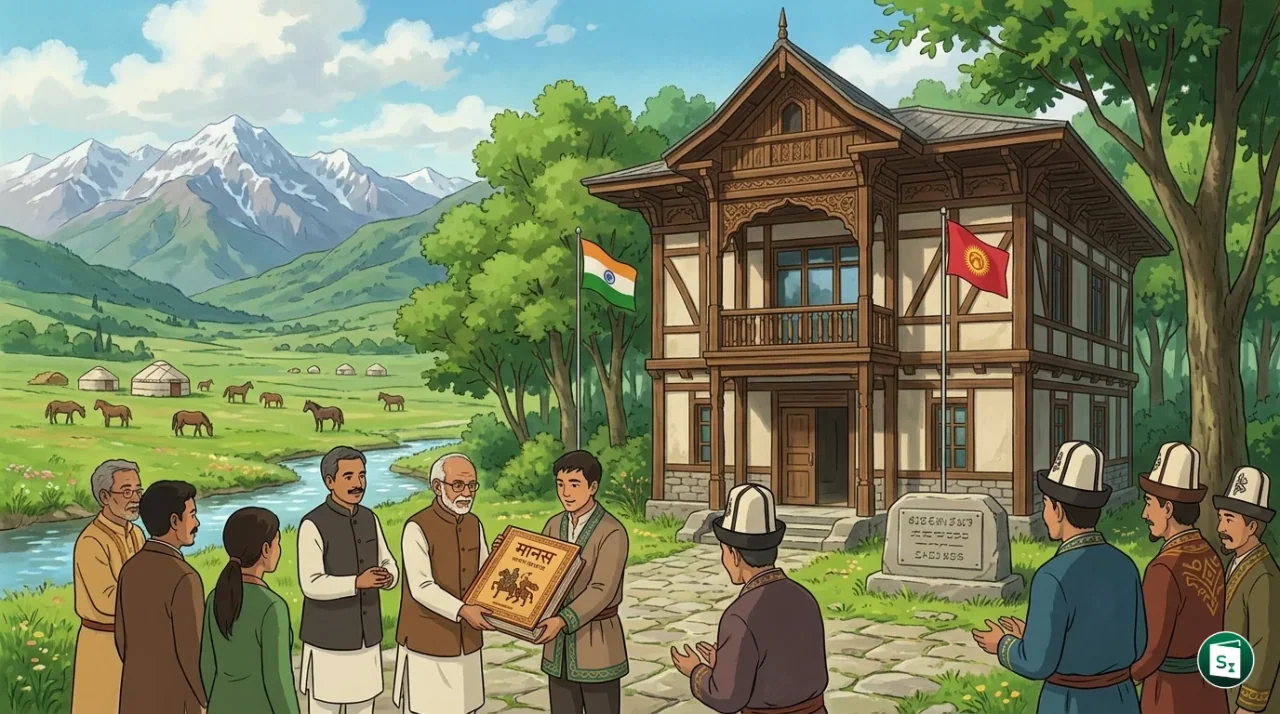
India and Kyrgyzstan have launched the International Centre for Civilizational Studies Manas and Mahabharata in Bishkek, the capital of Kyrgyzstan, to promote comparative research on the two countries’ epic traditions and cultural heritage. The centre was established by the Manas National Academy in collaboration with the Centre for Studies of International Relations (CSIR), New Delhi, during an Indian delegation’s visit from July 4 to 7, 2026. The inauguration also witnessed the release of the first Hindi translation of the Kyrgyz national epic Manas, marking a significant milestone in India Kyrgyzstan cultural ties.
A New Hub for Civilisational Studies
The International Centre for Civilizational Studies Manas and Mahabharata is a dedicated platform for advancing scientific, educational, and cultural cooperation between India and Kyrgyzstan. It will focus on comparative civilisational studies, exploring the epic traditions of the Mahabharata and Manas, the cultural heritage of both countries, and the development of humanitarian diplomacy. The centre will also promote international scientific cooperation and train emerging researchers in these fields.
The Indian delegation was led by Sunil Ambekar, a member of the National Executive Committee and Head of Media and Communications at the Rashtriya Swayamsevak Sangh (RSS), who served as the Chief Guest. The delegation included Dr. Punit Gaur, Honorary Director of CSIR; Professor Hem Chandra Pande, a distinguished linguist and former Director of the Centre for Russian Language and Literature at Jawaharlal Nehru University (JNU); and Professor Ramakant Dwivedi, Chairman of the India Central Asia Foundation and Director of the MERI Centre for International Studies.
Speaking at the event, Dr. Punit Gaur noted that the centre aligns with Prime Minister Narendra Modi’s proposal, made at the 25th SCO Summit in Tianjin in September 2025, to establish a Civilizational Dialogue Forum to foster connections across Eurasian cultures. The centre will prioritise the study of epic heritage, civilizational processes, history, culture, intercultural dialogue, and humanitarian diplomacy.
The Epic of Manas: A Kyrgyz National Treasure
The Epic of Manas is the defining cultural symbol of the Kyrgyz people and one of the longest oral epics in the world, with the full version running to over 500,000 lines. It is roughly 20 times longer than Homer’s Iliad and Odyssey combined. The epic is a trilogy that tells the story of three generations of heroes: Manas, the legendary warrior who united the Kyrgyz tribes; his son Semetey; and his grandson Seitek. It narrates the struggle of the Kyrgyz people to reunite scattered tribes, reclaim their homeland, and defend it across generations.
The epic has been passed down orally for more than 1,000 years by hereditary storytellers called manaschis, who recite it in a melodic chant without musical accompaniment. The tradition of Manas recitation was inscribed by UNESCO on the Representative List of the Intangible Cultural Heritage of Humanity in 2009, and the full Kyrgyz epic trilogy Manas, Semetey, Seytek was added in 2013.
For the Kyrgyz people, Manas is far more than a literary work. It is a living cultural archive that preserves the values, history, and worldview of a nomadic civilisation. The epic teaches values of loyalty, unity, courage, and love for the homeland. Its influence permeates everyday Kyrgyz life, from the national flag’s 40 sun rays (representing the 40 tribes united by Manas) to the naming of the country’s main international airport after the epic hero.
First Hindi Translation: A Cultural Milestone
A highlight of the inauguration was the release of the first Hindi translation of the Kyrgyz epic Manas. The translation was prepared by two distinguished Indian scholars: Professor Hem Chandra Pande, former Director of the Centre for Russian Language and Literature at JNU, and Professor Ramakant Dwivedi, Chairman of the India Central Asia Foundation. The translation is based on the Russian poetic retelling by Mar Baizhiev, who was honoured as the People’s Writer of the Kyrgyz Republic.
The translated work covers all three parts of the epic: Manas, Semetey, and Seitek. Professor Ramakant Dwivedi explained at the ceremony that the publication aims to introduce Indian readers to Kyrgyz epic heritage and promote academic cooperation between the two countries in epic studies, civilizational studies, and humanitarian diplomacy. The release had earlier been previewed during the international academic conference India Central Asia held in New Delhi on March 25-26, 2026, supported by Kyrgyzstan’s Ambassador to India.
This translation is significant because it makes the Manas epic accessible to over 500 million Hindi speakers in India. It opens up new avenues for academic research and comparative literary studies between the Indian and Central Asian epic traditions. The Mahabharata and Manas, though separated by geography and language, share deep structural similarities as foundational epics that encode the moral and social values of their respective civilisations.
Strengthening Academic Partnerships
As part of the inauguration ceremony, trilateral cooperation agreements were signed between the Manas National Academy, CSIR, and seven leading universities of Kyrgyzstan. These include the Kyrgyz National University (KNU), Bishkek State University (BSU), the American University of Central Asia (AUCA), and Ala Too International University, among others. The agreements aim to facilitate joint research, faculty exchanges, and collaborative educational programmes in civilizational studies.
The Manas National Academy, headquartered in Bishkek, is the premier Kyrgyz institution dedicated to researching, preserving, and promoting the Epic of Manas. It also supports studies on Kyrgyz history, language, literature, and cultural heritage. On the Indian side, the Centre for Studies of International Relations (CSIR), based in New Delhi, is a research institute that focuses on Indian cultural and civilizational linkages with the world. It is distinct from the more widely known Council of Scientific and Industrial Research which shares the same acronym.
The event was supported by the Kyrgyz Embassy in India and the Indian Embassy in Kyrgyzstan, represented by Ambassador Birender Singh Yadav. The Indian delegation also held a bilateral meeting with Oktyabr Kapalbayev, Deputy Head of the Department of Political and Economic Studies at the Administration of the President of the Kyrgyz Republic, alongside senior Kyrgyz officials including Deputy Ministers of Science, Higher Education, and Culture.
Significance for India’s Central Asia Outreach
The establishment of this centre is an important step in India’s broader strategy to deepen its engagement with Central Asia, a region of growing geopolitical and economic significance. India and Kyrgyzstan established diplomatic relations in March 1992 and elevated their relationship to a Strategic Partnership in 2019 during Prime Minister Modi’s visit to Bishkek. Kyrgyzstan has supported India’s full membership in the Shanghai Cooperation Organisation (SCO) and India’s bid for a permanent seat in the UN Security Council.
The centre reflects India’s shift towards civilisational diplomacy as a tool of foreign policy. Instead of focusing solely on trade or security, this approach uses shared cultural heritage and historical links as the foundation for stronger bilateral ties. PM Modi’s call at the 2025 SCO Summit for a Civilizational Dialogue Forum provided the conceptual framework for such initiatives. The Manas Mahabharata centre is the first concrete institutional outcome of that vision in Central Asia.
The initiative also strengthens India’s Connect Central Asia policy, announced in 2012, which aims to enhance political, economic, and cultural ties with the five Central Asian republics. Cultural diplomacy has become a key pillar of this policy, with India leveraging its historical civilizational links with the region, including the shared Buddhist heritage, the influence of Indian philosophy and literature, and the long history of trade along the Silk Route. The centre in Bishkek institutionalises this civilizational connect, providing a permanent platform for academic and cultural exchange between India and Kyrgyzstan.
Key Takeaways
- The International Centre for Civilizational Studies Manas and Mahabharata was inaugurated in Bishkek, Kyrgyzstan, established by the Manas National Academy and CSIR (Centre for Studies of International Relations), New Delhi.
- The centre will focus on comparative civilisational studies, epic traditions, cultural heritage, humanitarian diplomacy, and academic research cooperation between India and Kyrgyzstan.
- The first Hindi translation of the Kyrgyz epic Manas, translated by Hem Chandra Pande and Ramakant Dwivedi from the Russian poetic retelling by Mar Baizhiev, was released during the ceremony.
- The Epic of Manas, with over 500,000 lines, is one of the longest oral epics in the world and was inscribed by UNESCO on the Representative List of Intangible Cultural Heritage in 2009 (trilogy in 2013).
- Trilateral cooperation agreements were signed between the Manas National Academy, CSIR, and seven Kyrgyz universities including KNU, BSU, AUCA, and Ala Too.
- The initiative aligns with PM Narendra Modi’s proposal for a Civilizational Dialogue Forum under the SCO, announced at the 25th SCO Summit in Tianjin in September 2025.