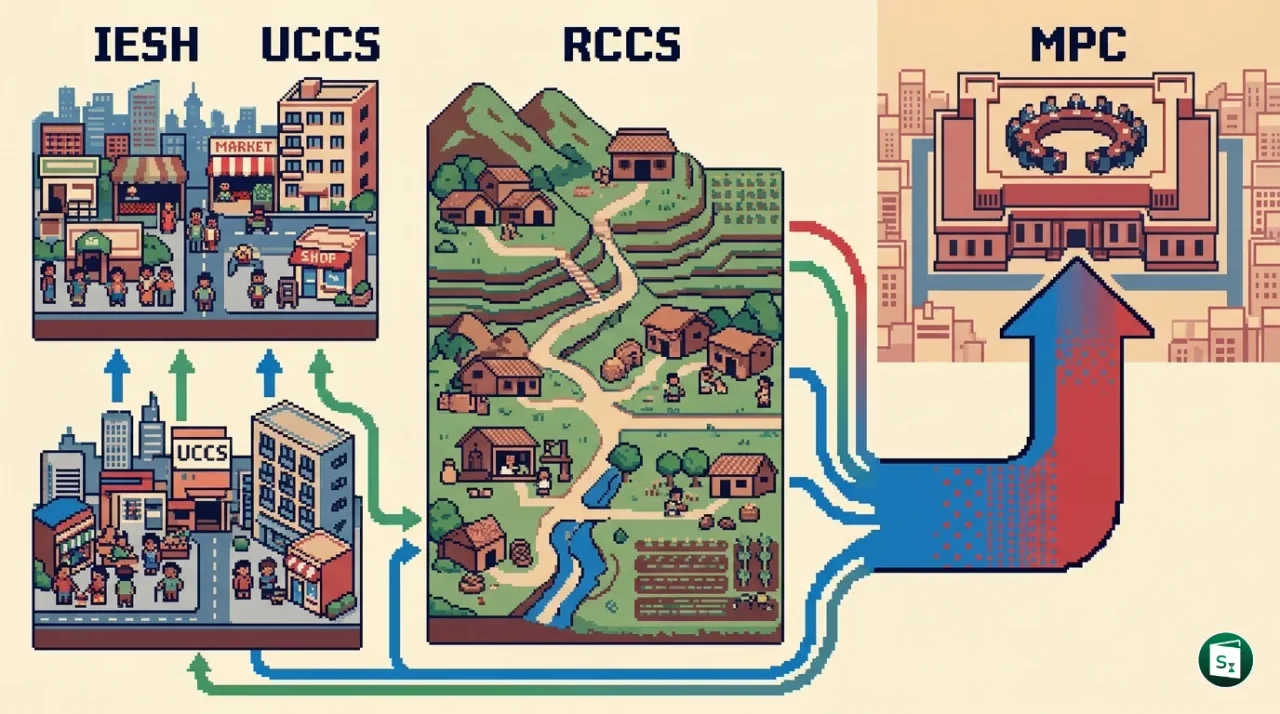
The Reserve Bank of India has launched the July 2026 round of three household surveys designed to capture the economic pulse of the nation ahead of the Monetary Policy Committee meeting scheduled for August 3 to 5, 2026. The Inflation Expectations Survey of Households (IESH) , the Urban Consumer Confidence Survey (UCCS) , and the Rural Consumer Confidence Survey (RCCS) together provide the central bank with critical ground-level data on how households perceive inflation, employment, income, and overall economic conditions. These surveys form a key pillar of the RBI’s pre-policy data gathering exercise, helping the MPC assess whether its past rate decisions are transmitting through the economy as intended.
Why the RBI Conducts Household Surveys
Monetary policy does not operate in a vacuum. The RBI’s rate decisions affect millions of households and businesses, but the transmission of policy takes time. To bridge this gap, the central bank relies on forward-looking indicators that reveal how people actually feel about the economy, rather than relying solely on hard data such as GDP or CPI inflation, which arrive with a lag.
Inflation expectations are particularly important. If households expect prices to rise sharply in the future, they may demand higher wages or accelerate purchases, behaviours that can become self-fulfilling and drive actual inflation higher. Similarly, consumer confidence data tells the RBI whether people are optimistic enough to spend and invest, or whether they are tightening their belts in ways that could slow growth. The household surveys give the MPC a direct window into these subjective expectations, allowing it to calibrate its policy stance before problems materialise in official statistics.
The RBI conducts these surveys on a bi-monthly basis, aligning their frequency with the six MPC meetings held each financial year. This ensures that every policy review is backed by fresh, timely data on household sentiment.
The Three Surveys at a Glance
Each of the three surveys serves a distinct purpose and covers a different segment of the population. Together, they give the RBI a 360-degree view of economic sentiment across urban and rural India.
Inflation Expectations Survey of Households (IESH)
The IESH is designed to capture how households perceive and expect price movements based on their own consumption baskets. The survey is conducted across 19 major cities: Ahmedabad, Bengaluru, Bhopal, Bhubaneswar, Chandigarh, Chennai, Delhi, Guwahati, Hyderabad, Jaipur, Jammu, Kolkata, Lucknow, Mumbai, Nagpur, Patna, Raipur, Ranchi and Thiruvananthapuram.
The survey collects two types of data. Qualitatively, it asks households whether prices of general goods, food products, non-food items, household durables, housing, and services have risen, fallen, or stayed the same over the past three months, and what they expect over the next three months and one year. Quantitatively, it asks respondents to estimate the exact inflation rate they are experiencing currently, and what they expect it to be three months and one year ahead.
Each round of the IESH typically gathers around 6,000 responses, covering households from different income groups, occupations, and educational backgrounds. The survey is conducted by Hansa Research Group Pvt. Ltd., Mumbai, on behalf of the RBI.
Urban Consumer Confidence Survey (UCCS)
The UCCS tracks the economic mood of urban India. It collects qualitative responses from households across the same 19 cities on five key parameters: the general economic situation, the employment scenario, the overall price level, household income, and household spending.
Respondents are asked to compare current conditions with what they were a year ago, and to state their expectations for one year ahead. From these responses, the RBI constructs two composite indices. The Current Situation Index (CSI) reflects how people feel about the present, while the Future Expectations Index (FEI) captures their outlook. Both indices are set at a base of 100, with scores above 100 indicating optimism and below 100 indicating pessimism.
The UCCS also covers around 6,000 respondents per round and is administered by Hansa Research Group.
Rural Consumer Confidence Survey (RCCS)
The RCCS extends the same consumer confidence framework to rural and semi-urban India. It covers households across 31 States and Union Territories, making it the widest in geographic coverage among the three surveys.
The parameters are identical to those of the UCCS: general economic situation, employment, price levels, income, and spending. In addition, the RCCS also collects households’ current perception of inflation and their one-year-ahead inflation expectation, providing a rural counterpart to the urban-focused IESH.
Each round of the RCCS draws approximately 8,900 responses, reflecting its broader geographic reach. The survey is administered by Ipsos Research Private Ltd., Gurugram.
How Survey Results Influence Monetary Policy
The data from these three surveys feeds directly into the MPC’s deliberations. The IESH results, for instance, help the committee gauge whether inflation expectations remain anchored around the target of 4% or are drifting higher. If households expect inflation to stay above the upper tolerance band of 6% for an extended period, the MPC may need to keep interest rates elevated to prevent expectations from becoming entrenched.
The consumer confidence surveys, on the other hand, reveal the real economy impact of past policy decisions. A sustained drop in the CSI or FEI signals that households are feeling the pinch of higher borrowing costs, which could translate into weaker demand and slower growth. The MPC considers this alongside inflation data to strike a balance between its dual objectives: price stability and growth.
The May 2026 rounds of these surveys, released in June, showed that urban household inflation perception had risen to 7.8%, while one-year-ahead expectations climbed to 9.3%. Rural households reported more moderate but still elevated numbers, with current perception at 5.9% and one-year-ahead expectations at 7.2%. Consumer confidence in both urban and rural areas had weakened, with the urban CSI falling to 90.7 and the rural CSI dropping to 95.2. These findings provide the baseline against which the July 2026 round results will be compared.
The Monetary Policy Committee and Its Mandate
The Monetary Policy Committee (MPC) was constituted under Section 45ZB of the Reserve Bank of India Act, 1934, following amendments made in 2016. It is a six-member committee responsible for determining the policy repo rate required to achieve the inflation target set by the government.
The committee comprises three ex-officio members from the RBI: the Governor (who serves as the Chairperson), the Deputy Governor in charge of monetary policy, and one RBI officer nominated by the Central Board. The remaining three members are external experts appointed by the central government from the fields of economics, banking, finance, or monetary policy. These external members serve four-year terms.
The government, in consultation with the RBI, sets the inflation target once every five years. The current target is 4% with a +/- 2% tolerance band, meaning the MPC must aim to keep CPI inflation between 2% and 6%. The committee is required to meet at least four times a year, though it currently meets six times on a bi-monthly schedule.
The next MPC meeting is scheduled for August 3 to 5, 2026, with the policy decision to be announced on August 5, 2026. The July 2026 rounds of the three household surveys will be among the key inputs the committee reviews before arriving at its rate decision.
Key Takeaways
- The RBI launched the July 2026 round of three household surveys to gather inputs for the August 3-5, 2026 MPC meeting.
- The Inflation Expectations Survey of Households (IESH) collects inflation perception and expectation data across 19 cities with around 6,000 respondents per round.
- The Urban Consumer Confidence Survey (UCCS) tracks economic sentiment across the same 19 cities using the Current Situation Index (CSI) and Future Expectations Index (FEI) , with scores above 100 indicating optimism.
- The Rural Consumer Confidence Survey (RCCS) covers rural and semi-urban households across 31 States and UTs with approximately 8,900 respondents per round.
- The MPC was constituted under Section 45ZB of the RBI Act, 1934, and consists of six members, three from the RBI and three external appointees.
- The current inflation target is 4% with a +/- 2% tolerance band, and the MPC meets six times per financial year on a bi-monthly basis.