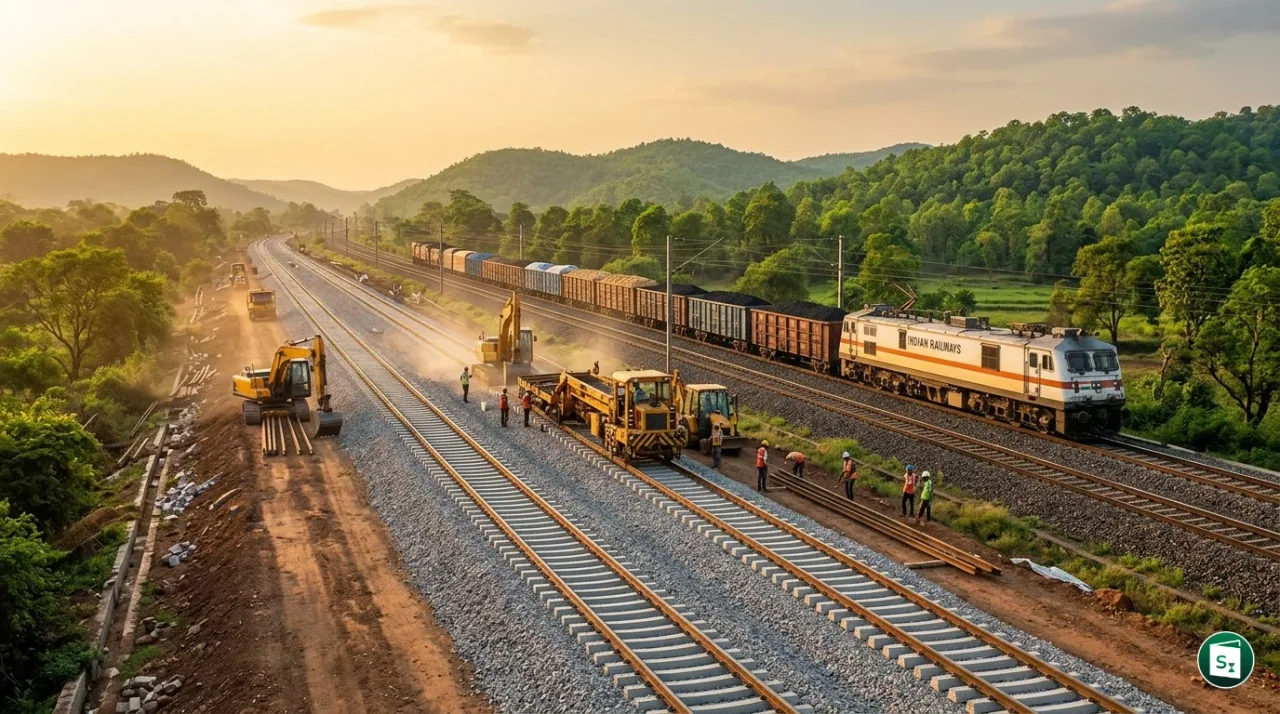
The Cabinet Committee on Economic Affairs, chaired by Prime Minister Narendra Modi, approved two railway multi-tracking projects in Odisha and Jharkhand on July 15, 2026, with a total investment of ₹3,907 crore. The projects involve doubling the Paradeep-Haridaspur line and constructing a fourth line between Rajkharsawan and Dangoaposi, adding 145 km to the rail network across four districts. These capacity enhancement works aim to ease congestion on critical freight corridors and strengthen port connectivity in the mineral-rich eastern region.
The Two Approved Projects
The two projects, cleared under the PM Gati Shakti National Master Plan, cover four districts across Odisha and Jharkhand and are expected to be completed by FY 2030-31. Together, they will enhance connectivity to approximately 1,526 villages with a combined population of about 14 lakh people.
Doubling of Paradeep-Haridaspur Line
The ₹2,542 crore project involves doubling the existing single line between Paradeep and Haridaspur in Odisha, spanning about 74 km across the districts of Jagatsinghpur, Kendrapada, and Jajpur. The corridor connects Paradeep Port, one of India’s busiest major ports, to the Howrah-Chennai main line at Haridaspur and further to the Talcher coalfields and iron ore mines.
The original single-line section, commissioned in July 2020 after decades of delays, was already nearing saturation. The line was first sanctioned in 1997 and executed by Rail Vikas Nigam Limited (RVNL) through a Special Purpose Vehicle called Haridaspur Paradip Railway Company Limited (HPRCL), incorporated in 2006 under the National Rail Vikas Yojana. The doubling will remove existing bottlenecks and support the growing logistics needs of steel plants and industries near Paradeep.
Rajkharsawan-Dangoaposi Fourth Line
The ₹1,365 crore project involves constructing a fourth railway line between Rajkharsawan in Seraikela-Kharsawan district and Dangoaposi in West Singhbhum district of Jharkhand, covering approximately 75 km. This route is located in the mineral-rich Kolhan division, a region known for its iron ore, coal, dolomite, and limestone reserves.
The existing tracks on this section are heavily congested due to continuous freight movement serving major steel plants and industrial units across the region. The addition of a fourth line will significantly reduce bottlenecks and improve the reliability of both passenger and goods trains on this crucial corridor.
Strategic Importance for Eastern India
The approved projects are aligned with the government’s Purvodaya vision, which aims for the all-round development of eastern India covering Bihar, Jharkhand, West Bengal, Odisha, and Andhra Pradesh. Announced in the Union Budget 2024-25, Purvodaya focuses on human resource development, infrastructure creation, and economic opportunities to make the eastern region an engine for Viksit Bharat.
Odisha and Jharkhand together hold about 80% of India’s iron ore reserves and significant deposits of coal, chromite, bauxite, and dolomite. The Paradeep Port, located in Jagatsinghpur district, handled a record 156.45 million metric tonnes (MMT) of cargo in FY 2025-26, the highest among all major ports in India. It has a rated capacity of 289 MTPA and is the top performing major port on the eastern coast.
The capacity augmentation from these two projects is expected to facilitate an additional 44 million tonnes per annum (MTPA) of freight movement. This will significantly improve the evacuation of coal, iron ore, dolomite, limestone, and gypsum from the mining belts to ports and industrial consumers.
Beyond freight, the enhanced connectivity will also improve access to tourist destinations such as the Lalitgiri Buddhist Complex in Odisha, a prominent Buddhist site from the early centuries of the Common Era, the Shree Baladevjew Temple in Kendrapada, and the scenic Meghahatuburu Hills in Jharkhand.
Economic and Environmental Benefits
The multi-tracking projects are expected to bring significant economic and environmental gains. By shifting freight from roads to railways, the projects will reduce logistics costs for industries. The doubling of the Paradeep-Haridaspur line alone is projected to cut logistics costs by ₹413 crore annually.
Rail transport is more fuel-efficient than road transport for bulk commodities. The projects are expected to reduce diesel consumption by approximately 6 crore litres and lower carbon dioxide emissions by nearly 29 crore kg annually. This environmental benefit is equivalent to planting about 1 crore trees.
The government has stated that these capacity enhancement works will generate substantial direct and indirect employment during the construction phase, contributing to the broader goal of Atmanirbhar Bharat through improved economic activity in the region.
What is the Cabinet Committee on Economic Affairs?
The Cabinet Committee on Economic Affairs (CCEA) is a high-level standing committee of the Union Cabinet responsible for taking decisions on economic policy, investments, and financial matters. It is an extra-constitutional body constituted under the Government of India (Transaction of Business) Rules, 1961, framed under Article 77 of the Constitution.
The CCEA is chaired by the Prime Minister and includes other key Cabinet ministers such as the Ministers of Defence, Home Affairs, Finance, External Affairs, Road Transport and Highways, Agriculture, Commerce and Industry, and Education. It acts as the central authority for economic decision-making and approves all major investment proposals exceeding ₹1,000 crore that come through the Public Investment Board, Expenditure Finance Committee, or the Railways Expanded Board.
The committee’s functions include reviewing economic trends, coordinating economic policies, deciding on pricing matters for essential commodities, laying down priorities for public sector investment, and reviewing the performance of Central Public Sector Enterprises. Over the years, several other cabinet committees such as the Cabinet Committee on Infrastructure (2013) and the Cabinet Committee on Prices (2014) have been merged into the CCEA to streamline economic governance.
Key Takeaways
- The CCEA approved two railway multi-tracking projects in Odisha and Jharkhand on July 15, 2026, with a total investment of ₹3,907 crore.
- The approved projects are the doubling of the Paradeep-Haridaspur line (₹2,542 crore) and the fourth line between Rajkharsawan and Dangoaposi (₹1,365 crore).
- The two projects will add 145 km to the Indian Railways network across four districts and are scheduled for completion by FY 2030-31.
- The capacity augmentation will facilitate an additional 44 MTPA of freight movement, benefiting about 1,526 villages with a population of around 14 lakh.
- The projects are expected to save 6 crore litres of diesel and reduce CO2 emissions by 29 crore kg annually, equivalent to planting about 1 crore trees.
- The CCEA is an extra-constitutional body chaired by the Prime Minister, constituted under the Government of India (Transaction of Business) Rules, 1961 (Article 77 of the Constitution).