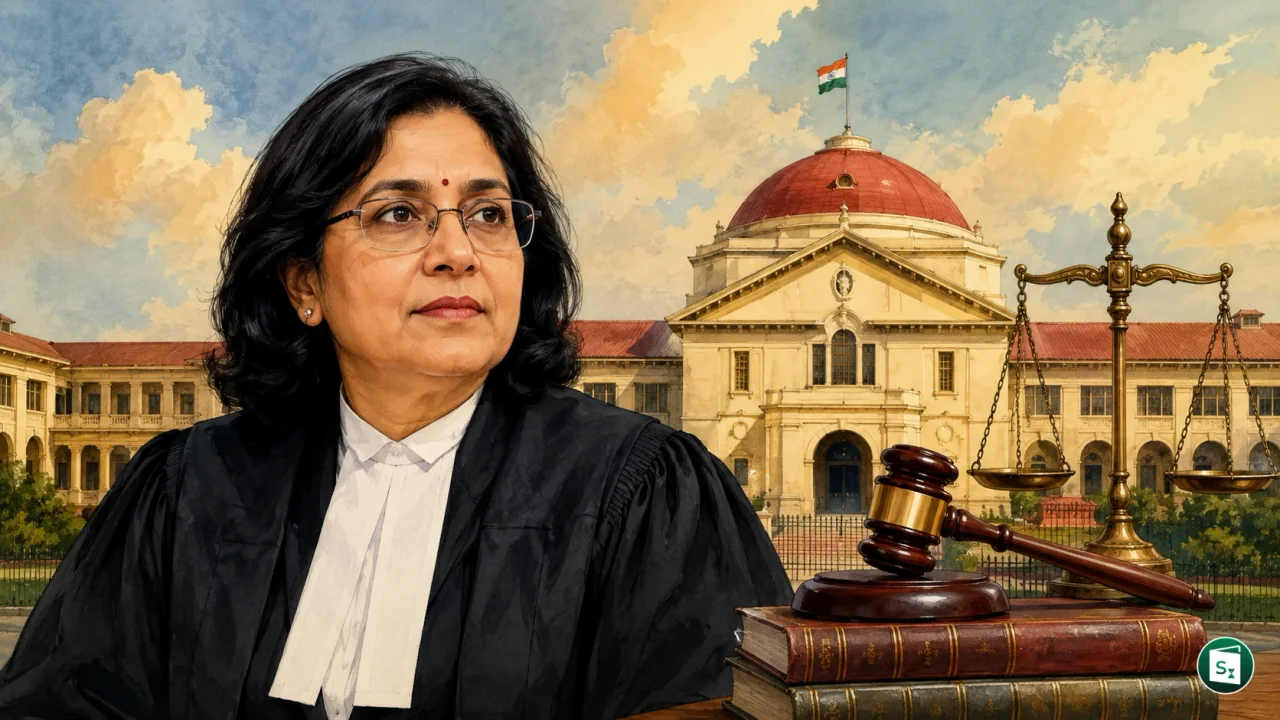
Justice Meenakshi Madan Rai has been appointed as the Chief Justice of the Patna High Court by the President of India, following a recommendation by the Supreme Court Collegium. Her appointment is scheduled to take effect from June 5, 2026, succeeding the retiring Chief Justice, Justice Sangam Kumar Sahoo. Prior to this elevation, Justice Rai served as a senior judge of the Sikkim High Court, where she held the distinction of being the first female judge from the state.
Profile and Career of Justice Meenakshi Madan Rai
Justice Meenakshi Madan Rai has a distinguished career in the Indian judiciary, marked by several pioneering achievements. Born on July 12, 1964, she completed her education in Delhi, graduating in Political Science from Lady Shri Ram College in 1986 and completing her Bachelor of Laws from the Campus Law Centre, Delhi University, in 1989. She began her legal practice in 1990, enrolling with the Bar Association of Delhi and appearing before the Delhi High Court and the Supreme Court of India.
In December 1990, she joined the Sikkim Judicial Service as a Judicial Magistrate 1st Class-cum-Civil Judge, becoming the first woman from Sikkim to hold the post. Over the next two decades, she progressed through the ranks, serving as a Chief Judicial Magistrate in 2000 and later being promoted to the Sikkim Superior Judicial Service as a District and Sessions Judge in 2004. She also served as the Registrar and subsequently the Registrar General of the Sikkim High Court.
Justice Rai achieved a historic milestone on April 15, 2015, when she was elevated as a Judge of the Sikkim High Court, making her the first woman from the state to serve as a High Court judge. During her tenure on the bench, she presided over a wide range of civil, criminal, and constitutional matters. She also took charge as the Acting Chief Justice of the Sikkim High Court on multiple occasions, demonstrating extensive administrative and judicial leadership.
Constitutional Framework for High Court Appointments
The appointment of the Chief Justice and judges of a High Court in India is governed by Article 217 of the Constitution of India. Under this constitutional provision, every judge of a High Court is appointed by the President of India by warrant under their hand and seal. The appointment process requires consultation with the Chief Justice of India and the Governor of the State where the High Court is located.
In practice, the recommendation process is led by the Supreme Court Collegium, which consists of the Chief Justice of India and the four senior-most judges of the Supreme Court. Once the Collegium recommends a candidate for the post of Chief Justice, the proposal is routed through the Union Ministry of Law and Justice to the President for formal approval and notification.
A key judicial policy in India dictates that the Chief Justice of a High Court must be appointed from outside their parent state. This convention of appointing outside Chief Justices is designed to promote national integration, ensure administrative impartiality, and minimize local influences within the state-level judiciary.
Historical Overview of the Patna and Sikkim High Courts
To understand the institutional context of this appointment, a comparison of the history and structure of the Patna and Sikkim High Courts is detailed below:
| Feature | Patna High Court | Sikkim High Court |
|---|---|---|
| Establishment Year | 1916 (Formal operations began on February 3) | 1955 (Integrated into the Indian system in 1975) |
| Viceroy/Authority at Inception | Lord Hardinge (laid foundation in 1913) | Chogyal of Sikkim (pre-merger) |
| Seat / Location | Patna, Bihar | Gangtok, Sikkim |
| First Chief Justice | Sir Edward Maynard Des Champs Chamier | Justice Man Mohan Singh Gujral (first post-merger) |
| Sanctioned Judge Strength | 53 judges | 3 judges (Smallest in India) |
| Constitutional Provision | Governed under general High Court rules | Covered under Article 371F (special provisions for Sikkim) |
The Patna High Court originally held jurisdiction over both Bihar and Orissa provinces until a separate High Court for Orissa was created in 1948. In 2000, its Ranchi bench was separated to form the Jharkhand High Court. In contrast, the Sikkim High Court was established in the Forest Colony of Gangtok following the formal merger of Sikkim as the 22nd state of India.
Key Takeaways
- Justice Meenakshi Madan Rai has been appointed as the Chief Justice of the Patna High Court with effect from June 5, 2026.
- She succeeds the retiring Chief Justice of the Patna High Court, Justice Sangam Kumar Sahoo.
- Justice Rai was the first woman from Sikkim to be appointed to the Sikkim Judicial Service in 1990 and elevated to the Sikkim High Court bench in 2015.
- High Court judge and Chief Justice appointments are governed under Article 217 of the Constitution of India.
- The Sikkim High Court, located in Gangtok, has a sanctioned strength of 3 judges, making it the smallest High Court in India.
- The Patna High Court was formally established on February 3, 1916, with Sir Edward Maynard Des Champs Chamier serving as its first Chief Justice.