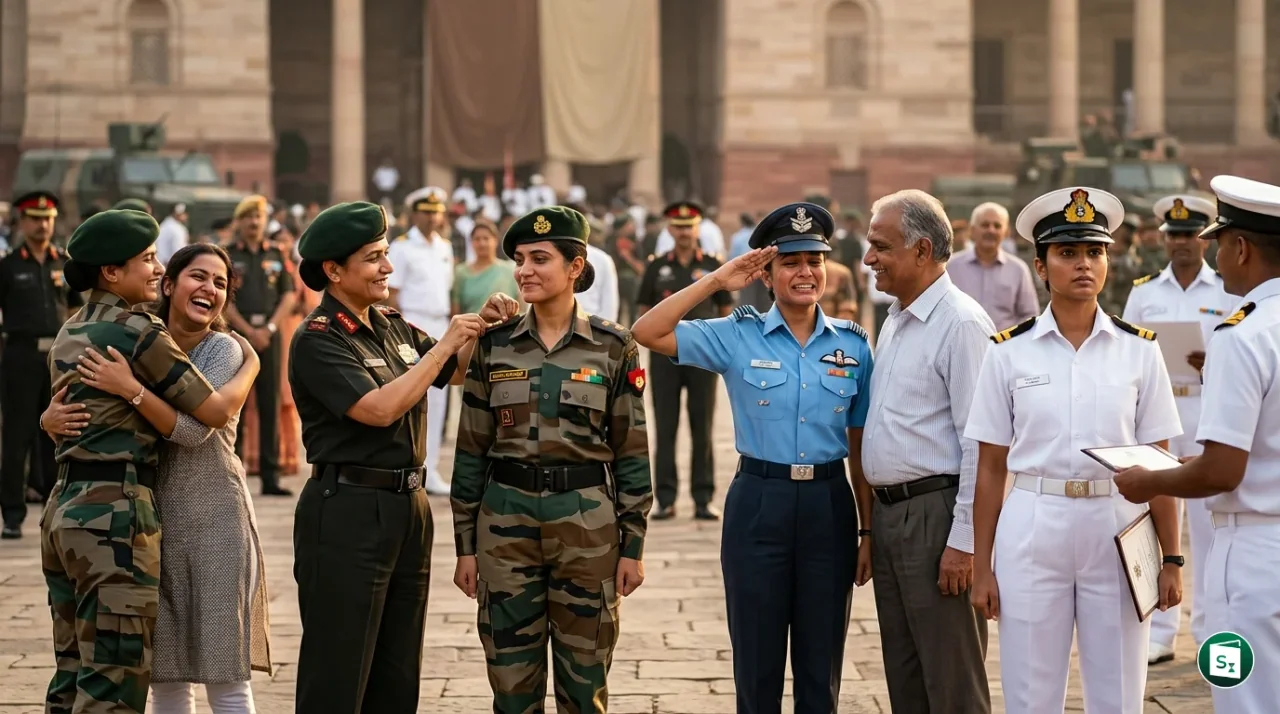
The Indian Armed Forces reached a historic milestone on June 13, 2026, with the commissioning of the first batch of 17 women cadets trained at the National Defence Academy (NDA). These officers, who joined the premier tri-services institution in August 2022, have now been inducted into the Indian Army, Indian Navy, and Indian Air Force. This achievement marks the culmination of a transformative shift in India’s military training, moving toward complete gender parity in the officer cadre.
Historic Commissioning at Service Academies
The commissioning ceremonies took place across the three premier training academies of the Indian military. These officers were part of the 148th Course of the National Defence Academy (NDA), which was the first to admit women following a landmark judicial intervention.
Distribution of Women Officers
The 17 women officers were distributed among the services as follows:
| Service | Number of Officers | Training Academy | Location |
|---|---|---|---|
| Indian Army | 9 | Indian Military Academy (IMA) | Dehradun, Uttarakhand |
| Indian Air Force | 5 | Air Force Academy (AFA) | Dundigal, Telangana |
| Indian Navy | 3 | Indian Naval Academy (INA) | Ezhimala, Kerala |
The Indian Army parade at the IMA was reviewed by President Droupadi Murmu, who serves as the Supreme Commander of the Armed Forces. In her address, she highlighted that the inclusion of women in the NDA is a fundamental step toward building a more representative and stronger military. Meanwhile, the Indian Air Force commissioning at the AFA was attended by Union Defence Minister Rajnath Singh.
The Journey from Khadakwasla to Commissioning
The path to commissioning for these officers began at the National Defence Academy (NDA) in Khadakwasla, near Pune. Established in 1949 as the Inter Services Wing in Dehradun before shifting to its permanent campus in 1954, the NDA is the world’s first tri-service academy. Its motto, “Seva Parmo Dharma” (Service Before Self), guides the training of cadets for all three wings of the armed forces together.
Rigorous Training and Academics
The 17 women cadets underwent three years of intensive physical and academic training at the NDA alongside their male counterparts. This included ground training, drill, swimming, horse riding, and field exercises. Upon completion of their three-year tenure, they were awarded degrees from Jawaharlal Nehru University (JNU).
Following their graduation from the NDA in May 2025, the cadets proceeded to their respective service academies for one year of specialized pre-commissioning training. This phase focused on service-specific skills, such as advanced tactical maneuvers for the Army, naval operations for the Navy, and flight training for the Air Force.
Breaking the Glass Ceiling: The Supreme Court’s Catalyst
The entry of women into the NDA was driven by a landmark intervention by the Supreme Court of India. In the historic case of Kush Kalra vs Union of India (2021), a bench led by Justice Sanjay Kishan Kaul and Justice Hrishikesh Roy identified the exclusion of women from the NDA as gender discriminatory.
The 2021 Landmark Order
In August 2021, the Supreme Court passed an interim order allowing female candidates to appear for the NDA entrance examination. The court noted that denying women the opportunity to join the NDA was a violation of their fundamental rights under Articles 14, 15, and 16 of the Indian Constitution, which guarantee equality and non-discrimination. This decision prompted the government to formally open the academy to women, leading to the first batch joining the 148th Course in 2022.
Prior to this development, women could only join the armed forces as officers after graduating from civilian colleges. They typically entered through the Short Service Commission (SSC) route at institutions such as the Officers Training Academy (OTA) in Chennai. The opening of the NDA now allows women to begin their foundational military training immediately after completing school.
A Paradigm Shift: Permanent Commission from Day One
A crucial distinction of this first batch of women NDA graduates is that they have been granted Permanent Commission (PC) from the very first day of their service. In the past, women were primarily inducted into the armed forces through the Short Service Commission (SSC), which typically restricted their service to a maximum tenure of 14 years. While some branches later allowed for conversion to PC, it was a complex process often requiring legal intervention.
Career Prospects and Leadership
Granting Permanent Commission from day one ensures that these women officers have a clear career path that allows them to serve until retirement age. More importantly, it places them on an equal footing with their male counterparts for command appointments and senior leadership roles. Unlike the SSC route, which historically limited women to staff roles or technical support, the PC through the NDA ensures they are prepared to lead units in various capacities across the three services.
This shift is a direct result of the 2020 Supreme Court judgment in the case of Secretary, Ministry of Defence vs Babita Puniya. The court ordered the Indian Army to grant Permanent Commission to all women officers, observing that physiological factors should not be used to deny them equal opportunities in command postings.
Evolution of Women’s Roles in the Indian Armed Forces
The representation of women in the Indian Armed Forces has seen a steady increase over the last decade. As of 2026, the total number of women officers across the three services has grown to over 11,000, a significant rise from approximately 3,000 in 2014. The Indian Air Force currently leads in terms of representation, with women comprising nearly 14 percent of its officer cadre. The Indian Navy and the Indian Army follow with approximately 7 percent and 5 percent respectively.
Current Representation and New Frontiers
Beyond the landmark NDA entry, women have successfully integrated into several combat and combat-support roles. In the Indian Air Force, women pilots now operate frontline fighter aircraft including the Rafale and Su-30 MKI. The Indian Navy has expanded the deployment of women officers aboard its warships, including destroyers and frigates, ensuring their presence in operational roles at sea.
In the Indian Army, women officers are now commissioned into major combat support arms such as the Regiment of Artillery, Signals, and Engineers. Additionally, the induction of women as Agniveers in the non-officer ranks of the Navy and Air Force has further broadened the scope of gender inclusion. This ongoing transformation is positioning the Indian military as a more inclusive and modern force.
Key Takeaways
- A total of 17 women officers from the first-ever women’s batch of the National Defence Academy (NDA) were commissioned into the Indian Armed Forces in June 2026.
- These officers were part of the 148th Course of the NDA, which initially joined the premier tri-services institution in August 2022.
- The entry of women into the NDA was made possible by the Supreme Court of India’s landmark judgment in the Kush Kalra vs Union of India (2021) case.
- For the first time in military history, these women officers have been granted Permanent Commission (PC) from the very first day of their service.
- The commissioning ceremonies were held at the Indian Military Academy (IMA) in Dehradun, the Air Force Academy (AFA) in Dundigal, and the Indian Naval Academy (INA) in Ezhimala.
- The National Defence Academy, established in 1949 and located in Khadakwasla, Pune, is the world’s first tri-service training academy.