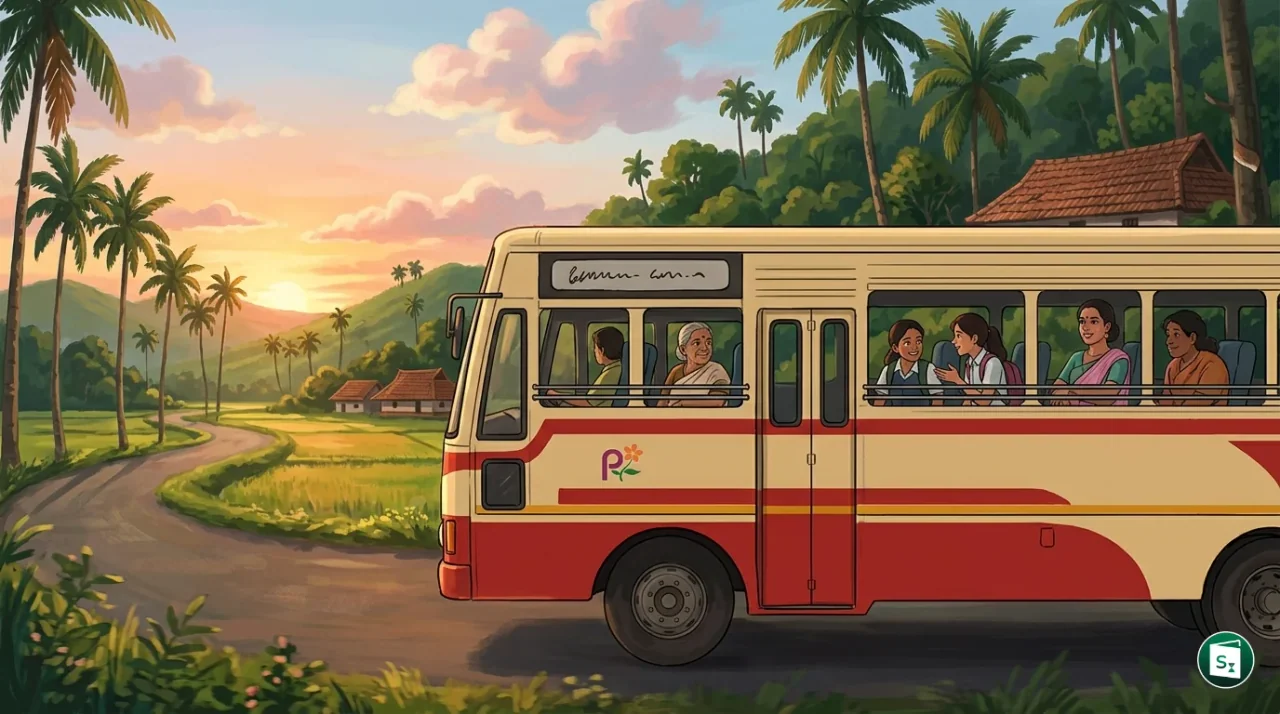
The Kerala government launched the Priyadarshini scheme on June 15, 2026, providing free bus travel for women and transgender persons across the state. This initiative allows eligible passengers to travel without charge on ordinary services operated by the Kerala State Road Transport Corporation (KSRTC). By removing financial barriers to public transport, the government aims to enhance the economic mobility and social inclusion of these communities.
What Is the Priyadarshini Scheme?
The Priyadarshini scheme is a flagship social welfare initiative of the Kerala government. It was first announced as part of the policy guarantees and is now being implemented by the Department of Transport. The primary objective of the scheme is to empower women and transgender persons by making public transportation more accessible.
By providing free rides, the state intends to support students, domestic workers, and daily wage earners who rely heavily on public transport for their commute. The scheme is expected to reduce the monthly expenditure for many families, thereby increasing their disposable income and contributing to the broader economy. This move follows similar successful models implemented in other Indian states like Karnataka and Telangana.
Eligible Services and Identification
The Priyadarshini scheme is currently restricted to the ordinary class of KSRTC buses. These services form the most extensive part of the state’s public transport network, reaching remote villages and busy urban centers alike.
| Service Category | Description |
|---|---|
| Ordinary | Standard non-AC buses that stop at all designated points. |
| City Ordinary | Services that operate within the limits of major cities. |
| Gramavandi | Specialized rural services managed with local panchayats. |
| Limited Stop Ordinary | Faster ordinary services that skip minor intermediate stops. |
| Town-to-Town | Direct transit between two major towns at ordinary rates. |
To ensure easy recognition, all eligible buses display Priyadarshini Scheme stickers on their front and side panels. Passengers are not required to present identity cards or undergo prior registration to avail of the free travel. However, every eligible passenger must collect a zero-fare ticket from the bus conductor. These tickets are generated using Electronic Ticket Machines (ETMs) to record the total number of journeys, which helps the government calculate the reimbursement amount due to KSRTC.
Strategic Impact: Mobility and Gender Equality
The launch of the Priyadarshini scheme is a significant step toward achieving gender equality in Kerala. For women, especially those working in the informal sector, transport costs often consume a large portion of their daily earnings. By making travel free, the government provides an indirect income boost, allowing these individuals to allocate their resources toward health, education, and nutrition.
For the transgender community, the scheme complements existing welfare measures under the Mazhavillu umbrella project. Transgender persons frequently face social marginalization and economic barriers. Access to free public transport not only reduces their cost of living but also encourages their participation in public spaces, which is vital for social integration. This initiative reinforces Kerala’s status as a leader in progressive social policies and inclusive governance.
Financial and Administrative Framework
The financial sustainability of the Priyadarshini scheme depends on a robust reimbursement mechanism between the state government and KSRTC. The estimated monthly expenditure for the initiative is approximately ₹60 crore. To cover this cost, the government has made a dedicated budgetary allocation to compensate the corporation for the revenue lost from issuing zero-fare tickets.
Administratively, KSRTC tracks every free journey through its digital ticketing system. By analyzing the data captured by Electronic Ticket Machines (ETMs), the corporation can provide accurate reports to the Transport Department. This process ensures that the subsidy is disbursed efficiently and that the corporation can maintain its fleet without facing a financial deficit. The government also plans to monitor the scheme’s impact on passenger volume and operational efficiency to make any necessary adjustments in the future.
Static GK: Kerala State Road Transport Corporation
The Kerala State Road Transport Corporation (KSRTC) is one of the oldest state-run public transport providers in India. It traces its origins back to the Travancore State Transport Department, which was established on February 20, 1938. The department was later reorganized as a corporation on April 1, 1965, under the Road Transport Corporation Act, 1950.
Headquartered in Transport Bhavan in Thiruvananthapuram, KSRTC operates under the administrative control of the Department of Transport, Government of Kerala. The corporation plays a vital role in the state’s infrastructure, connecting disparate regions through its various service classes, ranging from basic ordinary buses to premium multi-axle services. The introduction of the Priyadarshini scheme marks a major milestone in the corporation’s history of public service.
Key Takeaways
- The Kerala government launched the Priyadarshini scheme on June 15, 2026, offering free bus travel to women and transgender persons.
- The scheme is applicable to ordinary bus services operated by the Kerala State Road Transport Corporation (KSRTC), including Gramavandi and City Ordinary buses.
- Eligible passengers collect a zero-fare ticket issued through Electronic Ticket Machines (ETMs) to record journeys for government reimbursement.
- The estimated monthly expenditure for the initiative is approximately ₹60 crore, which is funded through state budgetary allocations.
- KSRTC traces its history to the Travancore State Transport Department, established in 1938, and was reorganized as a corporation in 1965.
- The initiative complements the Mazhavillu umbrella project, which focuses on the welfare and social integration of the transgender community in Kerala.