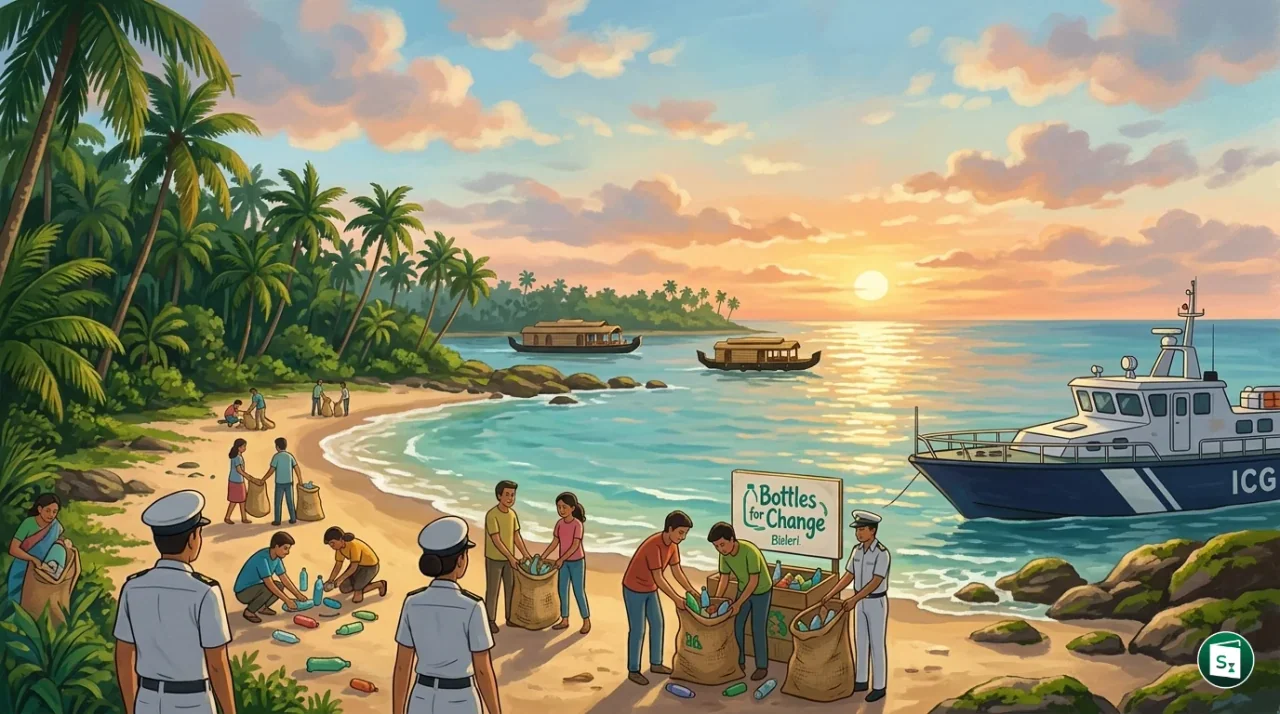
Bisleri International Pvt Ltd has signed a Letter of Association (LoA) with the Indian Coast Guard (Kerala and Mahe) to strengthen plastic waste management along coastal regions. The partnership will be carried out through Bisleri’s flagship sustainability initiative, Bottles for Change (BFC), and aligns with the Indian Coast Guard’s mission of Plastic Free Oceans. This collaboration brings together a corporate sustainability programme and a government agency responsible for protecting India’s marine environment.
What Is the Bottles for Change Initiative?
Bottles for Change was launched on 5 June 2018 (World Environment Day) by Bisleri International Pvt Ltd, a company founded in 1969 by Ramesh Chauhan and headquartered in Mumbai. Bisleri is India’s largest selling packaged drinking water brand with over 128 operational plants and a distribution network of more than 6,000 distributors across the country.
The programme is designed to create awareness among citizens about the importance of recycling plastic rather than treating it as waste. It focuses on three key activities: educating the public on source segregation and cleaning of used plastic, creating a collection channel through local waste agents or kabadiwalas, and ensuring that the collected plastic is sent directly to authorised recyclers. The plastic collected under this initiative is crushed into flakes and used to manufacture non-edible products such as fabric, handbags, window blinds, and public benches.
Since its launch, Bottles for Change has reached over 10 million people across India and has collected and recycled more than 28,000 metric tonnes of plastic waste. The programme operates through partnerships with NGOs such as Parisar Bhagini Vikas Sangh, Sampurna Earth, and Green Worms, and works with recyclers including Dalmia Polypro Industries Ltd. It has also partnered with the Indian Pollution Control Association (IPCA) to run operations in Delhi NCR. The programme has a dedicated mobile application that allows users to locate the nearest plastic agent for depositing segregated plastic.
Bottles for Change is part of Bisleri’s broader sustainability framework called the Bisleri Greener Promise, which focuses on building a circular economy through recycling, water conservation, and plastic neutrality.
The Indian Coast Guard and Marine Environment Protection
The Indian Coast Guard (ICG) was established as an interim service in February 1977 and formally constituted on 18 August 1978 under the Coast Guard Act, 1978. It operates under the Ministry of Defence with its headquarters in New Delhi. The force is headed by the Director General, currently Paramesh Sivamani, and its motto is Vayam Rakshamah (We Protect).
The ICG is primarily a maritime law enforcement and search and rescue agency with jurisdiction over India’s territorial waters, contiguous zone, and exclusive economic zone. However, its mandate also includes the preservation and protection of marine ecology and environment, including pollution control. This environmental role has grown significantly over the years, making the ICG the Central Coordinating Authority for marine pollution in Indian waters.
The ICG operates three specialised Pollution Control Vessels named Samudra Prahari, Samudra Paheredar, and Samudra Pavak, which are equipped to contain, recover, and neutralise pollutants at sea. It conducts biannual National Pollution Response Exercises (NATPOLREX) to ensure inter-agency preparedness for large-scale pollution incidents. Beyond oil spills, the ICG has been actively involved in coastal clean-up drives, plastic waste removal, and conservation efforts such as Operation Olivia, which protects nesting Olive Ridley turtles along the Odisha coast.
In 2025 alone, the ICG led coastal clean-up operations that removed more than 194 tonnes of plastic waste from India’s coastline, which stretches over 11,000 km. The force also runs the Swachh Sagar Surakshit Sagar and Puneet Sagar Abhiyan campaigns as part of its environmental outreach. The Plastic Free Oceans mission, under which the current partnership with Bisleri falls, is a focused drive to prevent plastic waste from entering marine ecosystems.
What the Partnership Entails
The Letter of Association (LoA) was signed in Kochi on 7 July 2026 between Dr. Angelo George, Chief Executive Officer of Bisleri International, and Deputy Inspector General Ashish Mehrotra of the Indian Coast Guard. Senior representatives from both organisations, including K. Ganesh, Director of Sustainability and Corporate Affairs at Bisleri, and Jabir, CEO of Green Worms, were present at the signing. The partnership specifically covers the ICG’s Kerala and Mahe regional jurisdiction.
Under the agreement, Bottles for Change will work with the Indian Coast Guard to strengthen plastic waste management systems along the coastline. The collaboration focuses on the responsible collection and segregation of post-consumer plastic waste from coastal communities and ICG establishments, followed by direct recycling through the established Bottles for Change channel. It also includes awareness drives and behavioural change campaigns targeting local fishing communities, coastal residents, and ICG personnel, with the overall goal of preventing plastic waste from entering coastal and marine ecosystems.
The ICG’s regional jurisdiction covering Kerala and Mahe is strategically important. Mahe (also known as Mayyazhi) is a town in the Puducherry Union Territory that exists as an enclave surrounded by Kerala. It is the smallest district in India by land area at just 8.69 square kilometres and lies on the Malabar Coast along the Arabian Sea. The region’s extensive coastline, active fishing communities, and proximity to major shipping routes make plastic waste management a critical environmental priority.
The implementation partner for on-ground activities is Green Worms, a Kerala-based social enterprise working on waste management and environmental sustainability.
Why This Partnership Matters
The collaboration between a corporate entity and a maritime security agency brings several unique advantages. The ICG has an established presence across India’s coastline through its network of stations, districts, and regional headquarters, giving it direct access to coastal communities. Bottles for Change brings an operational model that has already proven effective in urban and semi-urban settings across India. The combination allows the programme to reach remote coastal areas where municipal waste management infrastructure is often weak.
For the ICG, this partnership strengthens its Plastic Free Oceans mission by adding a structured plastic collection and recycling channel to its existing clean-up drives. The ICG has traditionally focused on removing plastic waste from beaches and the sea, but ensuring that this waste is actually recycled rather than dumped elsewhere has remained a challenge. Bisleri’s established recycling network provides the missing downstream link.
For Bisleri, the partnership expands the footprint of Bottles for Change into coastal and marine ecosystems, a new operational domain for the programme. It also aligns with the company’s commitments under the Extended Producer Responsibility (EPR) framework mandated by India’s Plastic Waste Management Rules, 2016, which require brand owners to take responsibility for the collection and recycling of the plastic packaging they put into the market.
The partnership also has implications for India’s international commitments. India is a signatory to the United Nations Sustainable Development Goals (SDGs), particularly SDG 14 (Life Below Water), which targets the prevention and reduction of marine pollution. Initiatives that keep plastic waste out of oceans directly contribute to this goal.
India’s Policy Framework on Plastic Waste Management
India’s regulatory approach to plastic waste has evolved significantly in the past decade. The Plastic Waste Management Rules, 2016 were notified under the Environment (Protection) Act, 1986 and replaced the earlier Plastic Waste (Management and Handling) Rules, 2011. These rules introduced the concept of Extended Producer Responsibility (EPR), making producers, importers, and brand owners responsible for the collection and recycling of the plastic packaging they introduce into the market.
The rules have been amended multiple times. The Plastic Waste Management (Amendment) Rules, 2021 introduced stricter provisions on the use of recycled plastic for food packaging. The Plastic Waste Management (Amendment) Rules, 2022 established comprehensive EPR guidelines with category-wise recycling targets and introduced a centralised online portal operated by the Central Pollution Control Board (CPCB) for registration of obligated entities. From 1 July 2022, the manufacture, import, stocking, distribution, sale, and use of identified single-use plastic items was prohibited across the country.
The Swachh Bharat Mission and the Lifestyle for Environment (LiFE) initiative provide additional policy backing for waste management and behavioural change campaigns. The Ministry of Environment, Forest and Climate Change is the nodal ministry for plastic waste management policy at the central level, while State Pollution Control Boards (SPCBs) and Pollution Control Committees (PCCs) are responsible for enforcement at the state and UT level.
India’s plastic recycling rate of approximately 60% is among the highest in the world, largely driven by the informal sector of kabadiwalas and waste pickers. However, challenges remain in the form of inadequate segregation at source, limited recycling infrastructure in rural and coastal areas, and the leakage of plastic waste into rivers and oceans. Partnerships like the one between Bisleri and the Indian Coast Guard address these gaps by creating a structured collection and recycling channel in underserved coastal regions.
Key Takeaways
- Bisleri International signed a Letter of Association (LoA) with the Indian Coast Guard (Kerala and Mahe) on 7 July 2026 in Kochi to promote plastic waste management along coastal regions.
- The partnership will be implemented through Bisleri’s Bottles for Change (BFC) initiative, which was launched on 5 June 2018 and has reached over 10 million people across India.
- The initiative aligns with the Indian Coast Guard’s Plastic Free Oceans mission and leverages its role as the Central Coordinating Authority for marine pollution in Indian waters.
- The Indian Coast Guard was formally established on 18 August 1978 under the Coast Guard Act, 1978 and operates under the Ministry of Defence with headquarters in New Delhi.
- Mahe (Mayyazhi) is part of the Puducherry Union Territory and is the smallest district in India by area at 8.69 square kilometres, surrounded entirely by Kerala.
- India’s Plastic Waste Management Rules, 2016 mandate Extended Producer Responsibility (EPR), and the partnership helps Bisleri meet its plastic waste collection and recycling obligations under these rules.