The Ministry of Micro, Small and Medium Enterprises (MSME) has mandated that all Central Public Sector Enterprises (CPSEs) must now route the settlement of every invoice for goods and services procured from MSMEs exclusively through the Trade Receivables Discounting System (TReDS). The notification, issued on June 30, 2026, fulfills a key announcement made in the Union Budget 2026-27 and marks the strongest push yet by the government to address the chronic problem of delayed payments to small businesses. With over 8.70 crore MSMEs registered on the Udyam portal employing more than 38 crore people, the move has the potential to transform working capital access for lakhs of small suppliers.
What Is TReDS and How Does It Work?
The Trade Receivables Discounting System (TReDS) is an electronic platform regulated by the Reserve Bank of India (RBI) under the Payment and Settlement Systems Act, 2007. It was operationalized in 2017 to address the persistent problem of delayed payments to MSMEs from large corporate buyers and government entities.
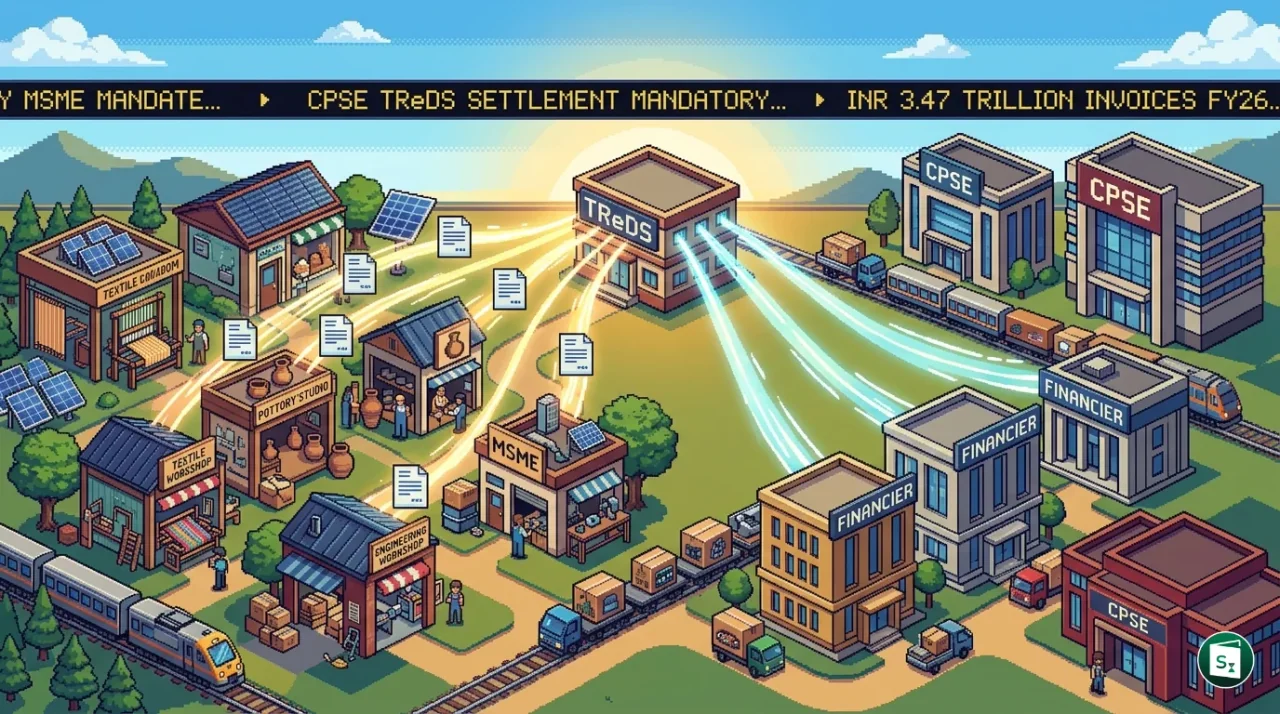
The platform operates as a three-party marketplace. An MSME supplier that has delivered goods or completed services uploads its invoice on a TReDS platform. The buyer, typically a large corporation or a government department, digitally accepts the invoice, confirming the payment obligation. Once accepted, the invoice becomes a factoring unit available for bidding by multiple financiers, including banks and non-banking financial companies (NBFCs). These financiers compete to discount the invoice, and the MSME can accept the best bid, receiving funds within 24 to 48 hours.
Financing through TReDS comes with two critical features. It is collateral-free, meaning the MSME does not need to pledge any assets. And it is without recourse, meaning the MSME has no liability if the buyer defaults on the payment. The financier bears the credit risk of the buyer.
Currently, five platforms are authorised to operate TReDS in India: RXIL (Receivables Exchange of India Ltd), a joint venture between SIDBI and NSE; M1xchange; Invoicemart; C2treds; and DTX.
The New Mandate: What Changed on June 30, 2026
The Ministry of MSME notified the revised guidelines on June 30, 2026, making it mandatory for all operating CPSEs to route settlements of every invoice raised by MSME suppliers through RBI-authorised TReDS platforms. This is not merely an onboarding requirement. It mandates that the actual payment settlement must happen through the TReDS ecosystem.
Under the new framework, CPSEs must disclose details of all MSME invoices routed and settled through TReDS in the form and manner specified by the RBI. They are also required to obtain a certificate from their statutory auditors confirming registration on at least one TReDS platform and compliance with the notification. This audit requirement adds a layer of accountability and ensures that the mandate is not circumvented.
The MSME Ministry has positioned CPSEs as role models for payment discipline. By making TReDS the default settlement channel for public sector procurement, the government expects to set a benchmark that large corporate buyers across India will follow.
A Progressive Expansion: From ₹500 Crore to Every CPSE
The latest mandate is the culmination of a decade-long effort to widen the reach of TReDS. The government first mandated onboarding of CPSEs and companies with a turnover above ₹500 crore on TReDS platforms in 2018. In 2024, the Finance Minister in the Union Budget halved the threshold to ₹250 crore, bringing an additional 7,000 companies and 22 more CPSEs under the mandate. The latest notification, issued on June 30, 2026, completes this progression by making not just onboarding but actual settlement of MSME invoices through TReDS mandatory for all CPSEs.
| Milestone | Change | Year |
|---|---|---|
| Initial mandate | Mandatory onboarding for CPSEs and companies with turnover above ₹500 crore | 2018 |
| Threshold halved | Threshold lowered to ₹250 crore; onboarding deadline March 31, 2025 | 2024 |
| Mandatory settlement | All CPSEs must settle MSME invoices through TReDS | 2026 |
Beyond CPSEs, the government is also exploring integration between Government e-Marketplace (GeM) and TReDS so that MSMEs can move seamlessly from procurement to invoice to financing without switching platforms.
Why This Matters for India’s MSME Ecosystem
Delayed payments have been one of the most persistent challenges for MSMEs in India. Under Section 15 of the Micro, Small and Medium Enterprises Development (MSMED) Act, 2006, buyers are required to make payment within 45 days from the date of acceptance of goods or services. In practice, however, payment cycles often stretch to 60 to 90 days or more, locking up the working capital of small suppliers.
The TReDS mandate directly addresses this by creating an alternative channel. Instead of waiting for the buyer to pay on the due date, the MSME can get financed against the approved invoice within hours.
MSMEs can receive funds within 24 to 48 hours instead of waiting months for payment, giving them immediate working capital relief. The financing is secured solely against the buyer-accepted invoice, requiring no asset pledge. Multiple financiers bid for each invoice, which drives down discount rates through competition. And since the financing is without recourse, the MSME bears no liability if the buyer fails to pay on the due date.
MSMEs form the backbone of the Indian economy, contributing 31.1% to the GDP, 35.4% of manufacturing output, and 48.58% of exports. With over 8.70 crore enterprises registered on the Udyam Registration Portal and Udyam Assist Platform, the sector is the second-largest employer in the country after agriculture. Any improvement in their cash flow has a direct multiplier effect on economic activity and employment.
The Growth Story: From ₹40,000 Crore to ₹3.47 Lakh Crore
The TReDS platform has seen remarkable growth in adoption over the last five years. According to the Ministry of MSME, invoice financing through TReDS jumped from ₹40,000 crore in FY2021-22 to ₹3.47 lakh crore in FY2025-26. This is nearly a nine-fold increase in four years.
| Financial Year | Invoice Discounting Volume |
|---|---|
| FY22 | ₹40,000 crore |
| FY26 | ₹3.47 lakh crore |
The surge reflects growing confidence among buyers, financiers, and MSMEs in the digital invoice discounting mechanism. The mandatory onboarding of large companies and CPSEs has expanded the pool of buyers on the platform, while the lowering of the turnover threshold to ₹250 crore in 2024 brought thousands more companies into the net. The latest settlement mandate is expected to accelerate this growth further by ensuring that every CPSE procurement from MSMEs is captured on TReDS.
Key Takeaways
- The Ministry of MSME notified on June 30, 2026 that all CPSEs must settle MSME invoices through RBI-authorised TReDS platforms.
- TReDS is an electronic platform regulated by the RBI under the Payment and Settlement Systems Act, 2007, operational since 2017.
- Financing through TReDS is collateral-free and without recourse, with funds disbursed within 24 to 48 hours.
- The turnover threshold for mandatory onboarding was progressively lowered from ₹500 crore (2018) to ₹250 crore (2024).
- Invoice discounting on TReDS grew from ₹40,000 crore (FY22) to ₹3.47 lakh crore (FY26).
- Five TReDS platforms are currently authorised: RXIL, M1xchange, Invoicemart, C2treds, and DTX.
- CPSEs must obtain a statutory auditor’s certificate confirming TReDS registration and compliance as part of their annual audit.