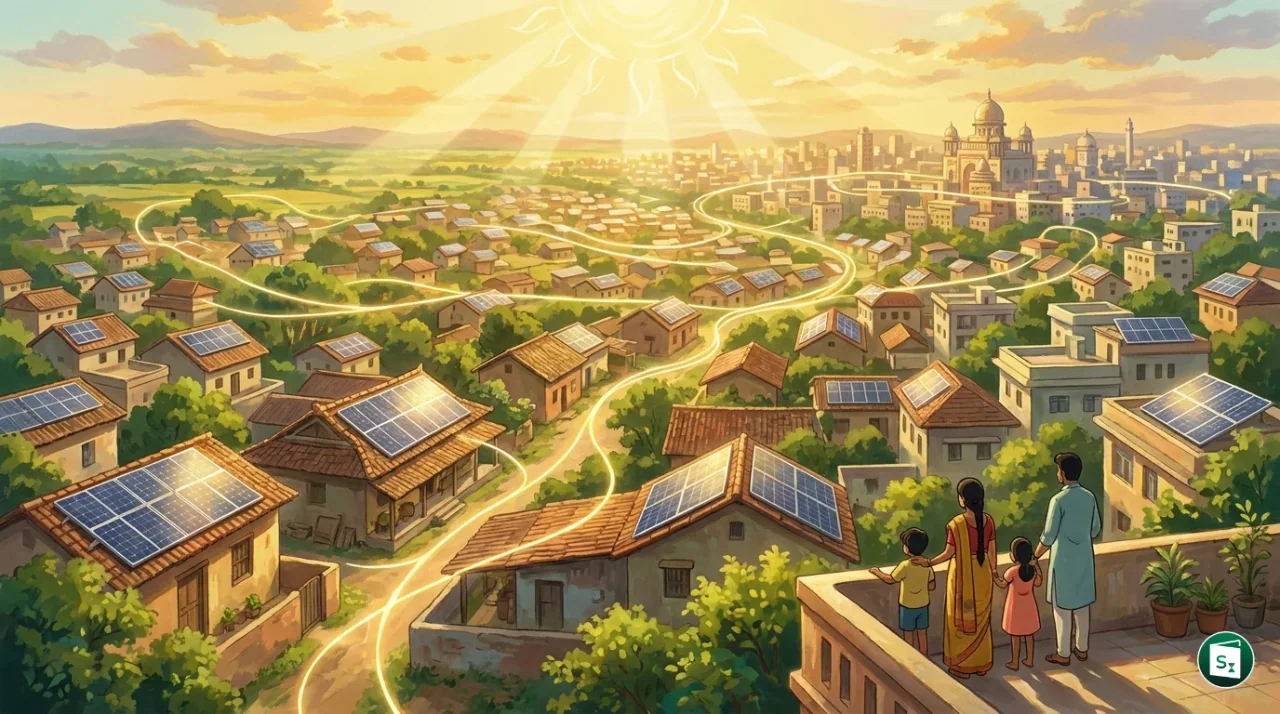
The World Bank’s Board of Executive Directors has approved an $890 million financing package to accelerate India’s national rooftop solar programme. The funding will support the government’s flagship PM Surya Ghar: Muft Bijli Yojana, which aims to install rooftop solar systems in 10 million households across the country. Alongside this, the World Bank will help mobilize an additional $4.2 billion in private financing, making this one of the largest multilateral pushes for residential solar adoption in a single country.
The World Bank Financing Package
The approved package combines multiple instruments from the World Bank Group. It includes an $820 million loan from the International Bank for Reconstruction and Development (IBRD) , a $60 million concessional loan from the Clean Technology Fund, and a $10 million grant from the IBRD’s Livable Planet Fund.
| Component | Amount | Source |
|---|---|---|
| IBRD Loan | $820 million | International Bank for Reconstruction and Development |
| Concessional Loan | $60 million | Clean Technology Fund |
| Grant | $10 million | IBRD Livable Planet Fund |
| Total Public Financing | $890 million | World Bank Group |
| Private Financing Mobilization | $4.2 billion | Commercial loans through financial institutions |
The Clean Technology Fund is a multilateral climate fund that provides concessional financing to scale up low-carbon technologies in developing countries. The Livable Planet Fund is a special World Bank partnership that incentivizes middle-income countries to address global challenges such as climate change while pursuing national development priorities.
This is not the World Bank’s first engagement with India’s rooftop solar sector. Over the past decade, the Bank has mobilized more than $2 billion to help grow India’s installed rooftop solar capacity from roughly 500 MW to over 27 GW. The latest package builds directly on that track record.
The programme is expected to create around 1.7 million jobs across the renewable energy manufacturing, installation, and services value chain. By improving access to affordable finance including collateral-free loans, the initiative aims to unlock the residential segment, which has so far lagged behind utility-scale solar adoption.
PM Surya Ghar: Muft Bijli Yojana Explained
PM Surya Ghar: Muft Bijli Yojana was launched by Prime Minister Narendra Modi on February 15, 2024, with a total government outlay of \u20b975,021 crore. It is implemented by the Ministry of New and Renewable Energy (MNRE) through the Rural Electrification Corporation (REC) , which serves as the National Programme Implementation Agency.
The scheme targets the installation of rooftop solar systems in 1 crore (10 million) households by March 2027, making it the world’s largest residential rooftop solar programme. The goal is to provide up to 300 units of free electricity per month to each beneficiary household.
How the Scheme Works
Eligible households receive a Central Financial Assistance (CFA) in the form of a direct subsidy deposited into their bank accounts through the Direct Benefit Transfer (DBT) system after installation and inspection by the local power distribution company (DISCOM).
| System Capacity | Monthly Consumption | Subsidy Amount |
|---|---|---|
| 1 kW | 0-150 units | \u20b930,000 |
| 2 kW | 150-300 units | \u20b960,000 |
| 3 kW or higher | More than 300 units | \u20b978,000 |
Households can also avail collateral-free loans from nationalized banks at a concessional interest rate of repo rate plus 50 basis points (currently about 5.75% per annum) with a tenure of 10 years. Any excess electricity generated can be sold back to the grid through net metering, allowing households to earn additional income of about \u20b917,000 to \u20b918,000 per year.
Progress So Far
Since its launch, the scheme has made impressive headway. By March 2026, over 26.19 lakh (2.62 million) rooftop solar systems had been installed, adding 9.56 GW of capacity. The government has disbursed more than \u20b917,967 crore in subsidy support to beneficiaries. In the first quarter of 2026 alone, India added 2.7 GW of rooftop solar capacity, with the residential segment accounting for 82% of installations.
Maharashtra, Gujarat, and Uttar Pradesh have emerged as the leading states in rooftop solar adoption under the scheme.
Why Residential Rooftop Solar Lagged Behind
India has rapidly scaled up utility-scale solar capacity over the past decade, crossing 100 GW of total installed solar capacity in January 2025 and reaching over 150 GW by March 2026. However, the residential rooftop segment grew at a much slower pace despite the country’s enormous potential.
Several factors held back adoption. The high upfront cost of installing a rooftop solar system, which can range from \u20b91 lakh to \u20b93 lakh for an average household, remained the primary barrier. Limited access to affordable financing, lack of awareness among consumers, and complex approval processes involving DISCOMs further slowed uptake. Many households were also hesitant due to concerns about maintenance and the reliability of net metering arrangements.
The World Bank financing directly addresses these gaps. The $4.2 billion in mobilized private financing will enable financial institutions to offer affordable commercial loans to households, reducing the upfront burden. The $10 million grant from the Livable Planet Fund supports technical assistance, capacity building for DISCOMs, and consumer awareness campaigns. The concessional loan from the Clean Technology Fund helps lower the cost of capital, making loans cheaper for end consumers.
Over the 25-year lifecycle of the installed systems, the programme is estimated to generate about 1,000 billion units of renewable electricity and cut 720 million tonnes of CO2 equivalent emissions.
India’s Broader Renewable Energy Roadmap
This financing fits into India’s larger climate and energy commitments. At COP26 in Glasgow, India pledged to achieve 500 GW of non-fossil fuel energy capacity by 2030 and meet 50% of its energy requirements from renewable sources. The country has also committed to becoming a net zero carbon economy by 2070.
India’s non-fossil fuel electricity capacity has already crossed 220 GW, accounting for more than 50% of the nation’s total installed power capacity. Of this, solar power constitutes the largest share. The government has set a specific target of 280 GW of installed solar capacity by 2030.
| Target | Deadline | Current Status |
|---|---|---|
| 500 GW non-fossil fuel capacity | 2030 | Over 220 GW achieved |
| 280 GW solar capacity | 2030 | Over 150 GW achieved |
| Net zero emissions | 2070 | In progress |
| 60% non-fossil electricity mix | 2035 | Over 50% achieved |
The rooftop solar segment is critical to meeting these targets. Unlike large solar parks that require vast tracts of land and long transmission lines, rooftop solar generates power at the point of consumption, reducing transmission and distribution losses. It also reduces strain on the grid during peak hours, lowers subsidy burdens on state governments, and puts money back into the pockets of consumers.
Key Takeaways
- The World Bank approved an $890 million financing package for India’s rooftop solar programme, comprising an $820 million IBRD loan, a $60 million Clean Technology Fund concessional loan, and a $10 million Livable Planet Fund grant.
- An additional $4.2 billion in private financing will be mobilized through commercial loans to support household installations.
- The scheme is expected to create 1.7 million jobs across manufacturing, installation, and services.
- PM Surya Ghar: Muft Bijli Yojana, launched in February 2024 with an outlay of \u20b975,021 crore, targets rooftop solar installations in 1 crore households by March 2027.
- Over 26 lakh rooftop solar systems have been installed under the scheme as of March 2026, with \u20b917,967 crore disbursed as subsidy.
- The International Bank for Reconstruction and Development (IBRD) , established in 1944 at the Bretton Woods Conference, is headquartered in Washington, D.C. and is the lending arm of the World Bank Group.